 Add to Chrome
 Add to Firefox
 Add to Edge
Recovering Sharp Conductivity Features in the Finite-Data Calderón Problem with Physics-Informed Neural Networks
Jun 26, 2026
Physics-informed neural networks (PINNs) have recently emerged as a promising framework for addressing the Calderón inverse problem from limited boundary data. In this work, we revisit neural Calderón inversion by introducing multiscale boundary excitations based on randomized wavelet functions and investigating the role of Fourier-feature encoding (FFE) for representing sharp conductivity variations. We propose a physics-informed reconstruction framework that represents the unknown conductivity and the associated family of electric potentials with separate neural networks conditioned on the applied boundary excitations. The governing elliptic PDE is enforced through physics-informed residuals, while finite Dirichlet-to-Neumann (DtN) data are incorporated through boundary losses. Using synthetic data from a finite-difference forward solver, we evaluate the method on conductivity fields with inclusions, sharp interfaces, smooth profiles, and heterogeneous media. Results show that the framework recovers dominant conductivity structures from finite boundary measurements with relative errors between $3\%-12\%$ approximately. We show that FFE improves the reconstruction of localized sharp features, particularly for inclusions and interfaces, but are not universally optimal, with raw-coordinate networks performing competitively for smoother fields. These results highlight coordinate representations and boundary excitation design as key factors in neural Calderón inversion.

Efficient PINNs: Multi-Head Unimodular Regularization of the Solutions Space
Jan 21, 2025We present a machine learning framework to facilitate the solution of nonlinear multiscale differential equations and, especially, inverse problems using Physics-Informed Neural Networks (PINNs). This framework is based on what is called multihead (MH) training, which involves training the network to learn a general space of all solutions for a given set of equations with certain variability, rather than learning a specific solution of the system. This setup is used with a second novel technique that we call Unimodular Regularization (UR) of the latent space of solutions. We show that the multihead approach, combined with the regularization, significantly improves the efficiency of PINNs by facilitating the transfer learning process thereby enabling the finding of solutions for nonlinear, coupled, and multiscale differential equations.
Gravitational Duals from Equations of State
Mar 21, 2024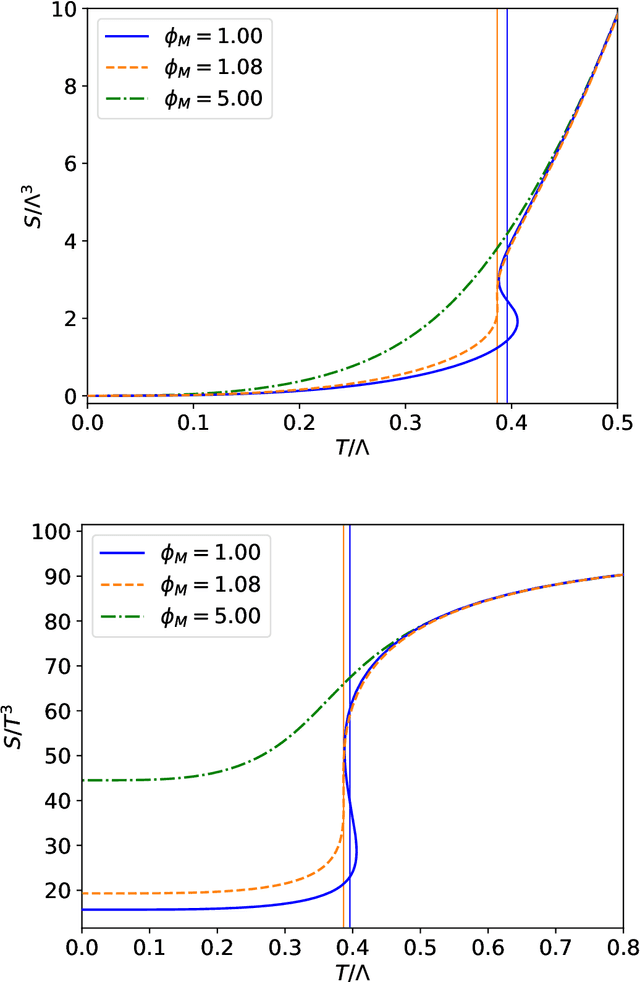
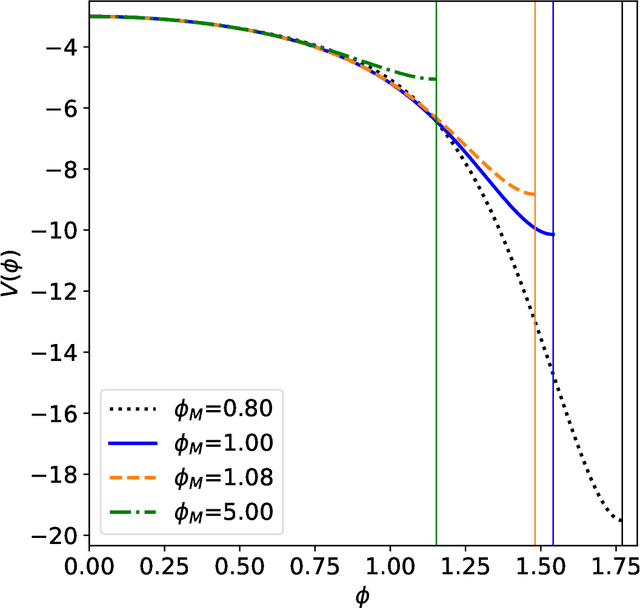
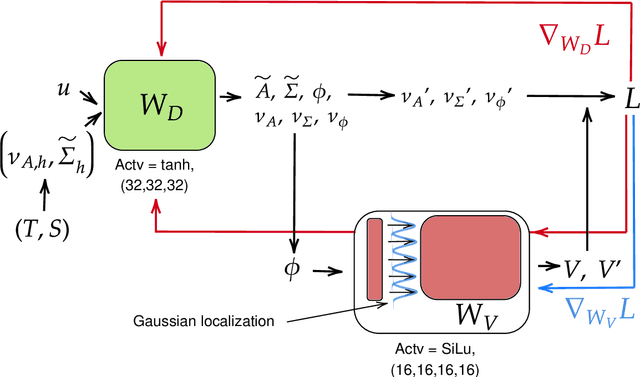
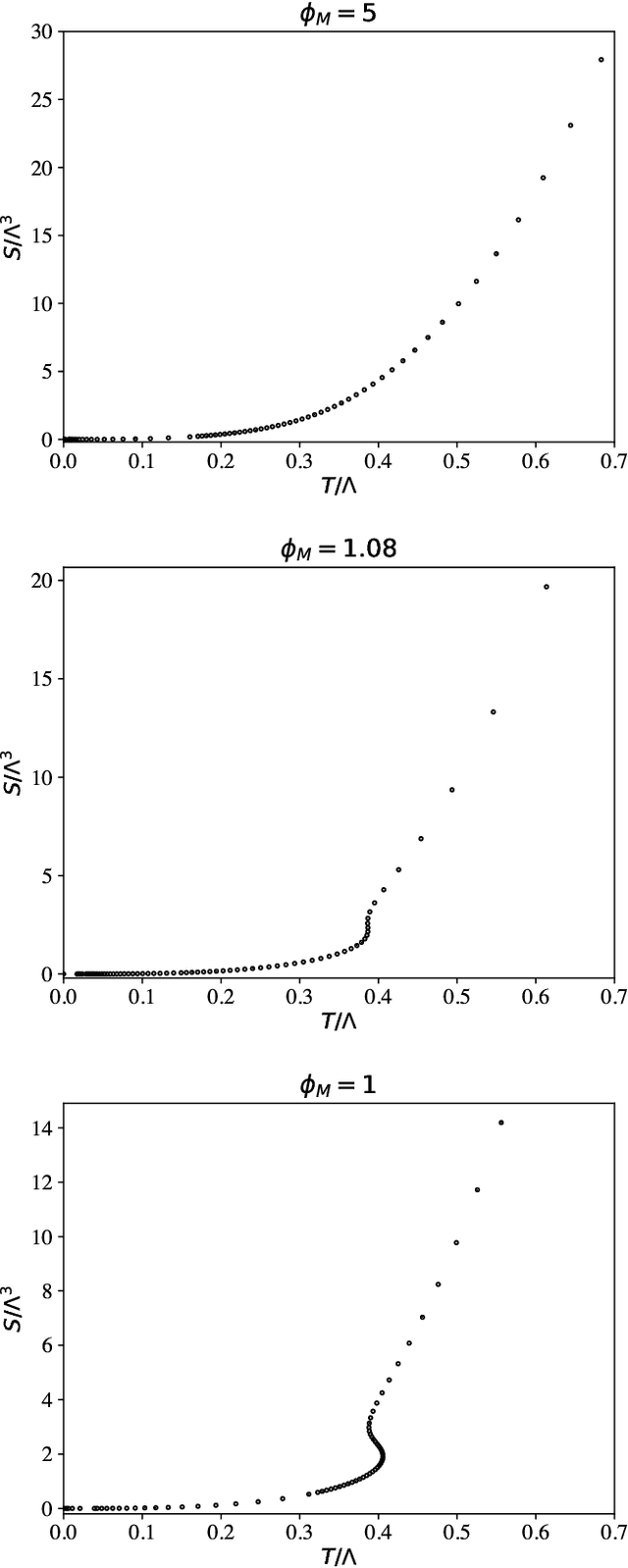
Holography relates gravitational theories in five dimensions to four-dimensional quantum field theories in flat space. Under this map, the equation of state of the field theory is encoded in the black hole solutions of the gravitational theory. Solving the five-dimensional Einstein's equations to determine the equation of state is an algorithmic, direct problem. Determining the gravitational theory that gives rise to a prescribed equation of state is a much more challenging, inverse problem. We present a novel approach to solve this problem based on physics-informed neural networks. The resulting algorithm is not only data-driven but also informed by the physics of the Einstein's equations. We successfully apply it to theories with crossovers, first- and second-order phase transitions.