 Add to Chrome
 Add to Firefox
 Add to Edge
Distributed Constraint Optimization via Online Learning and Iterative Pricing with Application to Large-Scale Satellite Scheduling
Jul 28, 2026
Distributed constraint optimization problems (DCOPs) provide a popular framework for distributed decision making under limited communication, but many real-world instances are too large to solve monolithically. We address this challenge from two complementary directions. We revisit the connection between DCOPs and potential games, and adapt modern online learning algorithms for equilibrium finding to DCOPs. We show that these algorithms are competitive with representative incomplete DCOP algorithms. We then turn to decomposition frameworks for large-scale DCOPs, motivated by large-scale decentralized satellite scheduling. We propose a new framework that separates a DCOP into two interacting subproblems: a high-level meta-DCOP for task allocation, and independent local optimization problems for scheduling. To couple the two levels, we develop a novel iterative pricing method that updates the meta-level utilities using feedback from the local optimizers. Combining our online learning methods with our iterative pricing framework, we obtain near-optimal performance on real-world decentralized satellite scheduling problem instances, fulfilling over 99% of observation requests compared with 87% for state-of-the-art baselines.

Aligning Data-Driven Predictors with Allocation: A Decision-Focused Approach to Survival Analysis
Jun 01, 2026Machine learning predictors have become essential tools for guiding automated decision making. However, a major misalignment persists: predictive models are typically optimized in terms of standard statistical metrics in isolation from the algorithmic tasks they inform. We highlight this incongruity in the high-stakes domain of organ allocation by demonstrating that any algorithm relying on (even highly accurate) survival predictors optimized for standard metrics -- such as the Concordance index (C-index) -- can yield arbitrarily poor outcomes when used for allocation, failing to guarantee utility better than a uniform random selection. To bridge the gap between survival analysis and policy optimization, we introduce a decision-focused learning approach based on optimizing normalized discounted cumulative gain (NDCG), a mainstay metric in information retrieval. We establish the utility of NDCG in survival analysis by proving that it translates to guarantees on the performance of allocation. Empirically, we propose a bootstrapping approach to optimize the NDCG of existing survival models. Unlike prior work, we also address the challenge of right censorship when evaluating ranking. On historical heart transplant data from the US, our method dramatically boosts the NDCG of baseline models by 50-100%, which translates to tens of thousands of additional life years gained annually when deployed for transplant allocation. We anticipate that our framework will find broader applications in decision making with predictions.
Is Four Enough? Automated Reasoning Approaches and Dual Bounds for Condorcet Dimensions of Elections
Apr 21, 2026In an election where $n$ voters rank $m$ candidates, a Condorcet winning set is a committee of $k$ candidates such that for any outside candidate, a majority of voters prefer some committee member. Condorcet's paradox shows that some elections admit no Condorcet winning sets with a single candidate (i.e., $k=1$), and the same can be shown for $k=2$. On the other hand, recent work proves that a set of size $k=5$ exists for every election. This leaves an important theoretical gap between the best known lower bound $(k\geq 3)$ and upper bound $(k \leq 5)$ for the number of candidates needed to guarantee existence. We aim to close the gap between the existence guarantees and impossibility results for Condorcet winning sets. We explore an automated reasoning approach to tighten these bounds. We design a mixed-integer linear program (MILP) to search for elections that would serve as counter-examples to conjectured bounds. We employ a number of optimizations, such as symmetry breaking, subsampling, and constraint generation, to enhance the search and model effectively infinite electorates. Furthermore, we analyze the dual of the linear programming relaxation as a path towards obtaining a new upper bound. Despite extensive search on moderate-sized elections, we fail to find any election requiring a committee larger than size 3. Motivated by our experimental results in this direction, we simplify the dual linear program and formulate a conjecture which, if true, implies that a winning set of size 4 always exists. Our automated reasoning results provide strong empirical evidence that the Condorcet dimension of any election may be smaller than currently known upper bounds, at least for small instances. We offer a general-purpose framework for searching elections in ranked voting and a new, concrete analytical path via duality toward proving that smaller committees suffice.
Learning Potentials for Dynamic Matching and Application to Heart Transplantation
Feb 09, 2026Each year, thousands of patients in need of heart transplants face life-threatening wait times due to organ scarcity. While allocation policies aim to maximize population-level outcomes, current approaches often fail to account for the dynamic arrival of organs and the composition of waitlisted candidates, thereby hampering efficiency. The United States is transitioning from rigid, rule-based allocation to more flexible data-driven models. In this paper, we propose a novel framework for non-myopic policy optimization in general online matching relying on potentials, a concept originally introduced for kidney exchange. We develop scalable and accurate ways of learning potentials that are higher-dimensional and more expressive than prior approaches. Our approach is a form of self-supervised imitation learning: the potentials are trained to mimic an omniscient algorithm that has perfect foresight. We focus on the application of heart transplant allocation and demonstrate, using real historical data, that our policies significantly outperform prior approaches -- including the current US status quo policy and the proposed continuous distribution framework -- in optimizing for population-level outcomes. Our analysis and methods come at a pivotal moment in US policy, as the current heart transplant allocation system is under review. We propose a scalable and theoretically grounded path toward more effective organ allocation.
Near-Optimal Dynamic Matching via Coarsening with Application to Heart Transplantation
Feb 04, 2026Online matching has been a mainstay in domains such as Internet advertising and organ allocation, but practical algorithms often lack strong theoretical guarantees. We take an important step toward addressing this by developing new online matching algorithms based on a coarsening approach. Although coarsening typically implies a loss of granularity, we show that, to the contrary, aggregating offline nodes into capacitated clusters can yield near-optimal theoretical guarantees. We apply our methodology to heart transplant allocation to develop theoretically grounded policies based on structural properties of historical data. In realistic simulations, our policy closely matches the performance of the omniscient benchmark. Our work bridges the gap between data-driven heuristics and pessimistic theoretical lower bounds, and provides rigorous justification for prior clustering-based approaches in organ allocation.
Position: Machine Learning for Heart Transplant Allocation Policy Optimization Should Account for Incentives
Feb 04, 2026The allocation of scarce donor organs constitutes one of the most consequential algorithmic challenges in healthcare. While the field is rapidly transitioning from rigid, rule-based systems to machine learning and data-driven optimization, we argue that current approaches often overlook a fundamental barrier: incentives. In this position paper, we highlight that organ allocation is not merely a static optimization problem, but rather a complex game involving transplant centers, clinicians, and regulators. Focusing on US adult heart transplant allocation, we identify critical incentive misalignments across the decision-making pipeline, and present data showing that they are having adverse consequences today. Our main position is that the next generation of allocation policies should be incentive aware. We outline a research agenda for the machine learning community, calling for the integration of mechanism design, strategic classification, causal inference, and social choice to ensure robustness, efficiency, and fairness in the face of strategic behavior from the various constituent groups.
Real-Time Instrument Planning and Perception for Novel Measurements of Dynamic Phenomena
Sep 03, 2025Advancements in onboard computing mean remote sensing agents can employ state-of-the-art computer vision and machine learning at the edge. These capabilities can be leveraged to unlock new rare, transient, and pinpoint measurements of dynamic science phenomena. In this paper, we present an automated workflow that synthesizes the detection of these dynamic events in look-ahead satellite imagery with autonomous trajectory planning for a follow-up high-resolution sensor to obtain pinpoint measurements. We apply this workflow to the use case of observing volcanic plumes. We analyze classification approaches including traditional machine learning algorithms and convolutional neural networks. We present several trajectory planning algorithms that track the morphological features of a plume and integrate these algorithms with the classifiers. We show through simulation an order of magnitude increase in the utility return of the high-resolution instrument compared to baselines while maintaining efficient runtimes.
Demonstrating Onboard Inference for Earth Science Applications with Spectral Analysis Algorithms and Deep Learning
Aug 20, 2025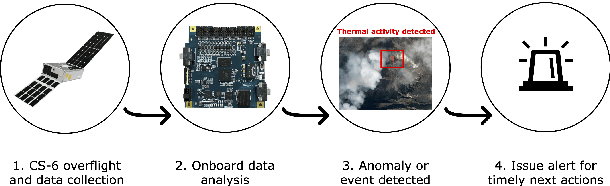
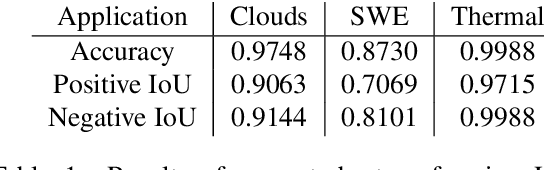
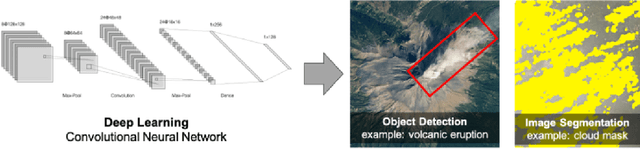
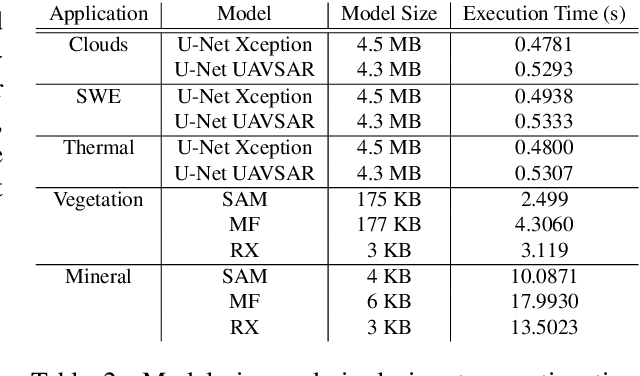
In partnership with Ubotica Technologies, the Jet Propulsion Laboratory is demonstrating state-of-the-art data analysis onboard CogniSAT-6/HAMMER (CS-6). CS-6 is a satellite with a visible and near infrared range hyperspectral instrument and neural network acceleration hardware. Performing data analysis at the edge (e.g. onboard) can enable new Earth science measurements and responses. We will demonstrate data analysis and inference onboard CS-6 for numerous applications using deep learning and spectral analysis algorithms.