 Add to Chrome
 Add to Firefox
 Add to Edge
From Perception to Assistance: Open-Vocabulary Shared Autonomy for Robotic Manipulation
Jul 19, 2026
Teleoperating a robotic manipulator in industrial environments demands precision that camera-based interfaces alone struggle to deliver. The operator must align the end-effector with a target in clutter, under limited depth perception, and without colliding with the surrounding structures. This paper presents a shared-autonomy framework that assists the operator throughout this process. A single RGB-D camera captures the operator's arm motion and hand gestures without wearables, fiducials, or a calibration stage. The intended target is specified by a free-form text prompt, grounded by a vision-language model in the robot's gripper camera, and tracked across its onboard cameras by a promptable video-segmentation model, resulting in a grasp frame continuously separated from the obstacle map. Every commanded motion is executed by a GPU-accelerated model-predictive controller that enforces self- and environment-collision avoidance against an online volumetric reconstruction, while a potential field corrects the operator's reference toward the grounded target during the final approach. An autonomous mode can be gesture-triggered to complete the grasp on the same target without a separate perception pipeline. The framework is validated on a quadruped mobile manipulator. The interface achieves a positional RMSE of 59 mm relative to motion-capture ground truth, and the controller keeps the arm at least 18 cm from obstacles while the operator deliberately commands the arm into them by 6 cm. In an industrial valve manipulation and a pick-and-place task, the full framework succeeded in all trials, while ablating either the collision or the assistance module produced failures through complementary mechanisms, and autonomous execution succeeded in four of five trials per task.

AI-IoT-Robotics Integration: Survey of Frameworks, Emerging Trends, and the Path Toward Connected Robotics
May 31, 2026The convergence of Artificial Intelligence, the Internet of Things, and Robotics is no longer a futuristic vision; it is rapidly becoming the foundation of real-time, intelligent, and context-aware systems. AI enables perception and reasoning, IoT provides scalable sensing and communication, and robotics delivers embodied actuation. Despite significant progress in pairwise combinations such as AIoT and the Internet of Robotic Things (IoRT), there remains a lack of unified design frameworks that fully integrate all three. This survey synthesizes the state-of-the-art across these domains, emphasizing the emerging role of Small Language Models (SLMs) at the edge and Large Language Models (LLMs) in the cloud for distributed cognition and autonomous decision-making. We propose a modular system architecture that aligns with these trends, analyze persistent gaps in interoperability and feedback control, and classify existing work by integration depth. Our review highlights how hybrid SLM-LLM systems, when coupled with IoT infrastructure and robotic agents, can address challenges in real-time adaptation, scalability, and reliability. This work offers a conceptual and technical roadmap for designing next-generation AI-IoT-Robotic ecosystems that are modular, interpretable, and capable of learning within dynamic environments, paving the way for the emerging paradigm of Connected Robotics and Physical AI.
* 15 pages, 3 figures, 3 tables. Published in IEEE Internet of Things Journal
Viewpoint-Agnostic Grasp Pipeline using VLM and Partial Observations
Mar 09, 2026Robust grasping in cluttered, unstructured environments remains challenging for mobile legged manipulators due to occlusions that lead to partial observations, unreliable depth estimates, and the need for collision-free, execution-feasible approaches. In this paper we present an end-to-end pipeline for language-guided grasping that bridges open-vocabulary target selection to safe grasp execution on a real robot. Given a natural-language command, the system grounds the target in RGB using open-vocabulary detection and promptable instance segmentation, extracts an object-centric point cloud from RGB-D, and improves geometric reliability under occlusion via back-projected depth compensation and two-stage point cloud completion. We then generate and collision-filter 6-DoF grasp candidates and select an executable grasp using safety-oriented heuristics that account for reachability, approach feasibility, and clearance. We evaluate the method on a quadruped robot with an arm in two cluttered tabletop scenarios, using paired trials against a view-dependent baseline. The proposed approach achieves a 90% overall success rate (9/10) against 30% (3/10) for the baseline, demonstrating substantially improved robustness to occlusions and partial observations in clutter.
Semantic Enrichment of CAD-Based Industrial Environments via Scene Graphs for Simulation and Reasoning
Jan 10, 2026Utilizing functional elements in an industrial environment, such as displays and interactive valves, provide effective possibilities for robot training. When preparing simulations for robots or applications that involve high-level scene understanding, the simulation environment must be equally detailed. Although CAD files for such environments deliver an exact description of the geometry and visuals, they usually lack semantic, relational and functional information, thus limiting the simulation and training possibilities. A 3D scene graph can organize semantic, spatial and functional information by enriching the environment through a Large Vision-Language Model (LVLM). In this paper we present an offline approach to creating detailed 3D scene graphs from CAD environments. This will serve as a foundation to include the relations of functional and actionable elements, which then can be used for dynamic simulation and reasoning. Key results of this research include both quantitative results of the generated semantic labels as well as qualitative results of the scene graph, especially in hindsight of pipe structures and identified functional relations. All code, results and the environment will be made available at https://cad-scenegraph.github.io
Data-Driven Dynamic Parameter Learning of manipulator robots
Dec 09, 2025Bridging the sim-to-real gap remains a fundamental challenge in robotics, as accurate dynamic parameter estimation is essential for reliable model-based control, realistic simulation, and safe deployment of manipulators. Traditional analytical approaches often fall short when faced with complex robot structures and interactions. Data-driven methods offer a promising alternative, yet conventional neural networks such as recurrent models struggle to capture long-range dependencies critical for accurate estimation. In this study, we propose a Transformer-based approach for dynamic parameter estimation, supported by an automated pipeline that generates diverse robot models and enriched trajectory data using Jacobian-derived features. The dataset consists of 8,192 robots with varied inertial and frictional properties. Leveraging attention mechanisms, our model effectively captures both temporal and spatial dependencies. Experimental results highlight the influence of sequence length, sampling rate, and architecture, with the best configuration (sequence length 64, 64 Hz, four layers, 32 heads) achieving a validation R2 of 0.8633. Mass and inertia are estimated with near-perfect accuracy, Coulomb friction with moderate-to-high accuracy, while viscous friction and distal link center-of-mass remain more challenging. These results demonstrate that combining Transformers with automated dataset generation and kinematic enrichment enables scalable, accurate dynamic parameter estimation, contributing to improved sim-to-real transfer in robotic systems
Conveying Surroundings Information of a Robot End-Effector by Adjusting Controller Button Stiffness
Nov 07, 2024This study addresses the challenge of low dexterity in teleoperation tasks caused by limited sensory feedback and visual occlusion. We propose a novel approach that integrates haptic feedback into teleoperation using the adaptive triggers of a commercially available DualSense controller. By adjusting button stiffness based on the proximity of objects to the robot's end effector, the system provides intuitive, real-time feedback to the operator. To achieve this, the effective volume of the end effector is virtually expanded, allowing the system to predict interactions by calculating overlap with nearby objects. This predictive capability is independent of the user's intent or the robot's speed, enhancing the operator's situational awareness without requiring complex pre-programmed behaviors. The stiffness of the adaptive triggers is adjusted in proportion to this overlapping volume, effectively conveying spatial proximity and movement cues through an "one degree of freedom" haptic feedback mechanism. Compared to existing solutions, this method reduces hardware requirements and computational complexity by using a geometric simplification approach, enabling efficient operation with minimal processing demands. Simulation results demonstrate that the proposed system reduces collision risk and improves user performance, offering an intuitive, precise, and safe teleoperation experience despite real-world uncertainties and communication delays.
Vibrotactile Feedback for a Remote Operated Robot with Noise Subtraction Based on Perceived Intensity
Nov 07, 2024There is a growing demand for teleoperated robots. This paper presents a novel method for reducing vibration noise generated by robot's own motion, which can disrupt the quality of tactile feedback for teleoperated robots. Our approach focuses on perceived intensity, the amount of how humans experience vibration, to create a noise filter that aligns with human perceptual characteristics. This system effectively subtracts ego-noise while preserving the essential tactile signals, ensuring more accurate and reliable haptic feedback for operators. This method offers a refined solution to the challenge of maintaining high-quality tactile feedback in teleoperated systems.
Region of Interest Loss for Anonymizing Learned Image Compression
Jun 09, 2024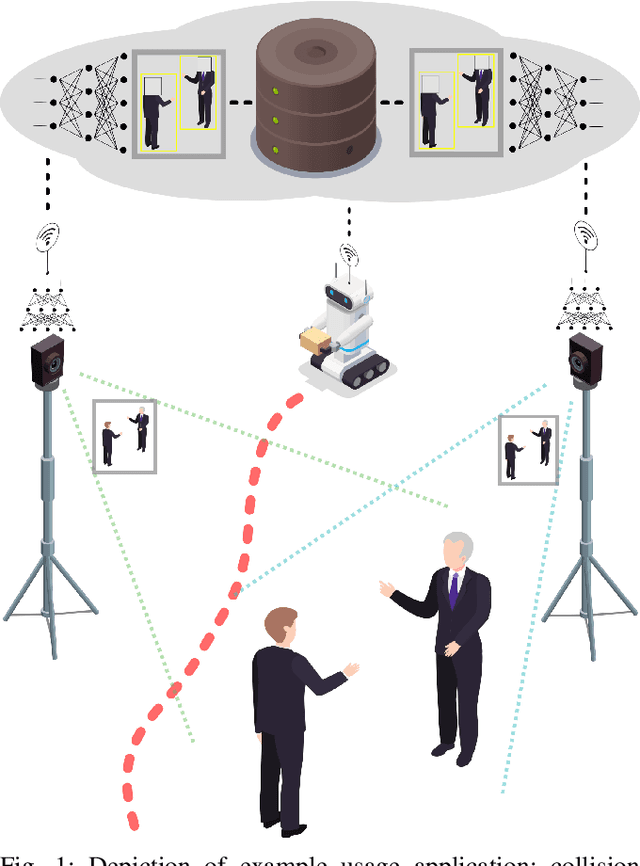
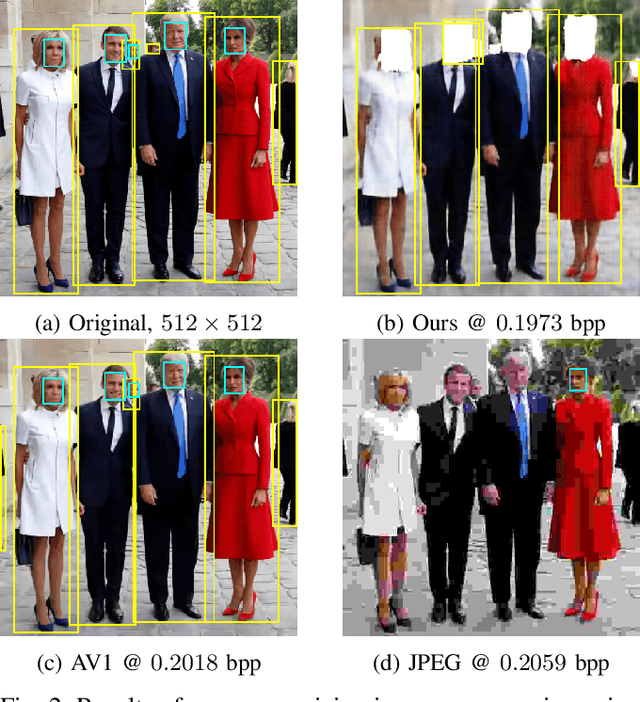
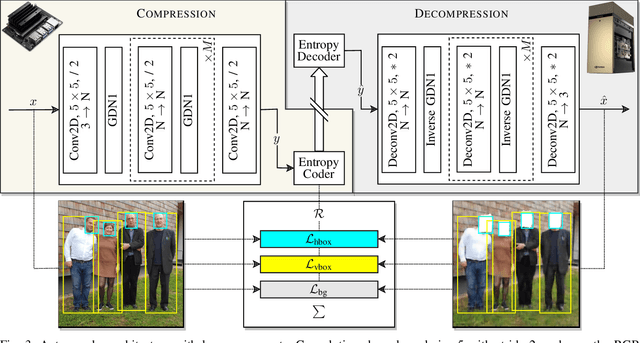
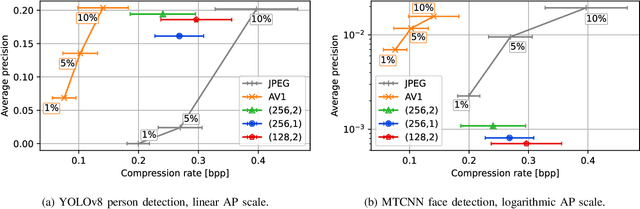
The use of AI in public spaces continually raises concerns about privacy and the protection of sensitive data. An example is the deployment of detection and recognition methods on humans, where images are provided by surveillance cameras. This results in the acquisition of great amounts of sensitive data, since the capture and transmission of images taken by such cameras happens unaltered, for them to be received by a server on the network. However, many applications do not explicitly require the identity of a given person in a scene; An anonymized representation containing information of the person's position while preserving the context of them in the scene suffices. We show how using a customized loss function on region of interests (ROI) can achieve sufficient anonymization such that human faces become unrecognizable while persons are kept detectable, by training an end-to-end optimized autoencoder for learned image compression that utilizes the flexibility of the learned analysis and reconstruction transforms for the task of mutating parts of the compression result. This approach enables compression and anonymization in one step on the capture device, instead of transmitting sensitive, nonanonymized data over the network. Additionally, we evaluate how this anonymization impacts the average precision of pre-trained foundation models on detecting faces (MTCNN) and humans (YOLOv8) in comparison to non-ANN based methods, while considering compression rate and latency.