 Add to Chrome
 Add to Firefox
 Add to Edge
Data-Driven Dynamic Parameter Learning of manipulator robots
Dec 09, 2025
Bridging the sim-to-real gap remains a fundamental challenge in robotics, as accurate dynamic parameter estimation is essential for reliable model-based control, realistic simulation, and safe deployment of manipulators. Traditional analytical approaches often fall short when faced with complex robot structures and interactions. Data-driven methods offer a promising alternative, yet conventional neural networks such as recurrent models struggle to capture long-range dependencies critical for accurate estimation. In this study, we propose a Transformer-based approach for dynamic parameter estimation, supported by an automated pipeline that generates diverse robot models and enriched trajectory data using Jacobian-derived features. The dataset consists of 8,192 robots with varied inertial and frictional properties. Leveraging attention mechanisms, our model effectively captures both temporal and spatial dependencies. Experimental results highlight the influence of sequence length, sampling rate, and architecture, with the best configuration (sequence length 64, 64 Hz, four layers, 32 heads) achieving a validation R2 of 0.8633. Mass and inertia are estimated with near-perfect accuracy, Coulomb friction with moderate-to-high accuracy, while viscous friction and distal link center-of-mass remain more challenging. These results demonstrate that combining Transformers with automated dataset generation and kinematic enrichment enables scalable, accurate dynamic parameter estimation, contributing to improved sim-to-real transfer in robotic systems

SALT: Singular Value Adaptation with Low-Rank Transformation
Mar 20, 2025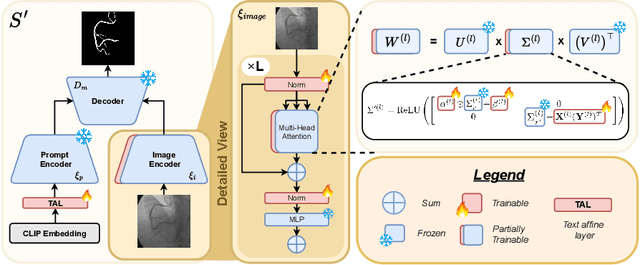

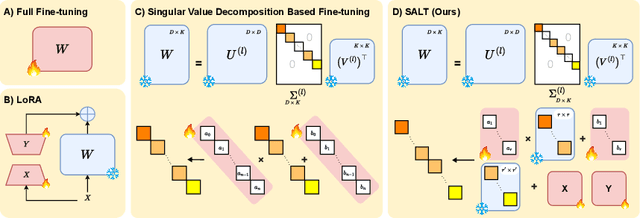
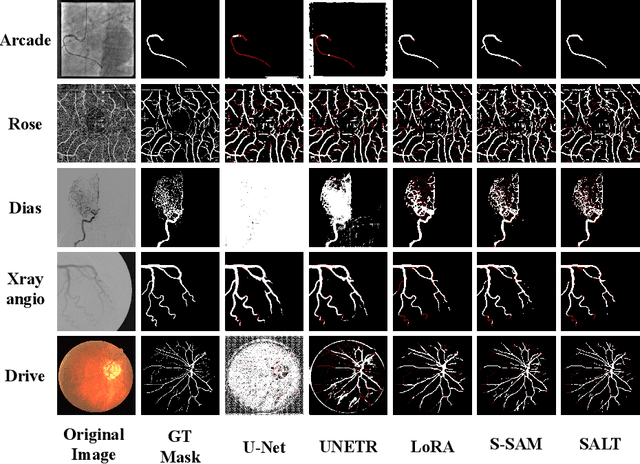
The complex nature of medical image segmentation calls for models that are specifically designed to capture detailed, domain-specific features. Large foundation models offer considerable flexibility, yet the cost of fine-tuning these models remains a significant barrier. Parameter-Efficient Fine-Tuning (PEFT) methods, such as Low-Rank Adaptation (LoRA), efficiently update model weights with low-rank matrices but may suffer from underfitting when the chosen rank is insufficient to capture domain-specific nuances. Conversely, full-rank Singular Value Decomposition (SVD) based methods provide comprehensive updates by modifying all singular values, yet they often lack flexibility and exhibit variable performance across datasets. We propose SALT (Singular Value Adaptation with Low-Rank Transformation), a method that selectively adapts the most influential singular values using trainable scale and shift parameters while complementing this with a low-rank update for the remaining subspace. This hybrid approach harnesses the advantages of both LoRA and SVD, enabling effective adaptation without relying on increasing model size or depth. Evaluated on 5 challenging medical datasets, ranging from as few as 20 samples to 1000, SALT outperforms state-of-the-art PEFT (LoRA and SVD) by 2% to 5% in Dice with only 3.9% trainable parameters, demonstrating robust adaptation even in low-resource settings. The code for SALT is available at: https://github.com/BioMedIA-MBZUAI/SALT
Optimizing Brain Tumor Segmentation with MedNeXt: BraTS 2024 SSA and Pediatrics
Nov 26, 2024
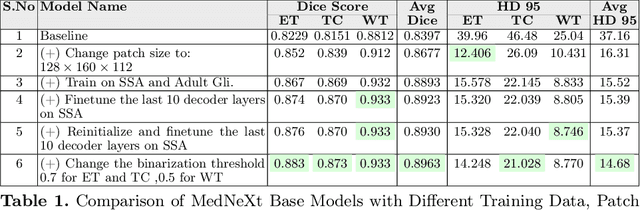
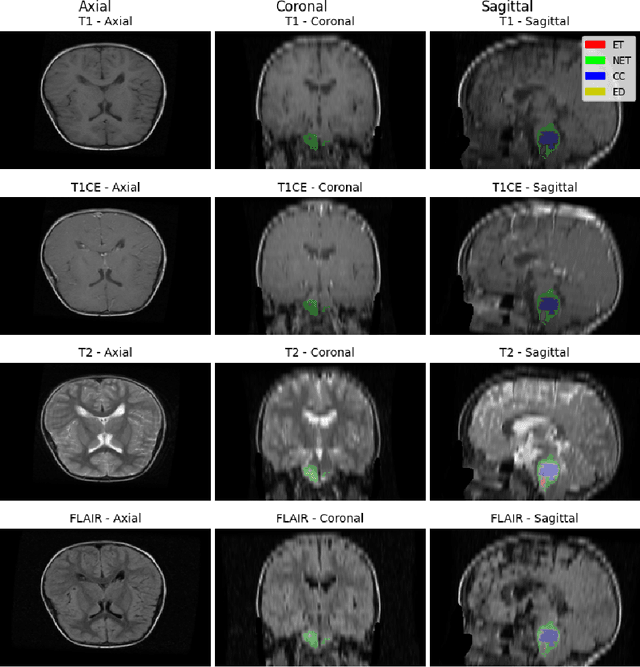

Identifying key pathological features in brain MRIs is crucial for the long-term survival of glioma patients. However, manual segmentation is time-consuming, requiring expert intervention and is susceptible to human error. Therefore, significant research has been devoted to developing machine learning methods that can accurately segment tumors in 3D multimodal brain MRI scans. Despite their progress, state-of-the-art models are often limited by the data they are trained on, raising concerns about their reliability when applied to diverse populations that may introduce distribution shifts. Such shifts can stem from lower quality MRI technology (e.g., in sub-Saharan Africa) or variations in patient demographics (e.g., children). The BraTS-2024 challenge provides a platform to address these issues. This study presents our methodology for segmenting tumors in the BraTS-2024 SSA and Pediatric Tumors tasks using MedNeXt, comprehensive model ensembling, and thorough postprocessing. Our approach demonstrated strong performance on the unseen validation set, achieving an average Dice Similarity Coefficient (DSC) of 0.896 on the BraTS-2024 SSA dataset and an average DSC of 0.830 on the BraTS Pediatric Tumor dataset. Additionally, our method achieved an average Hausdorff Distance (HD95) of 14.682 on the BraTS-2024 SSA dataset and an average HD95 of 37.508 on the BraTS Pediatric dataset. Our GitHub repository can be accessed here: Project Repository : https://github.com/python-arch/BioMbz-Optimizing-Brain-Tumor-Segmentation-with-MedNeXt-BraTS-2024-SSA-and-Pediatrics