 Add to Chrome
 Add to Firefox
 Add to Edge
Viewpoint-Agnostic Grasp Pipeline using VLM and Partial Observations
Mar 09, 2026
Robust grasping in cluttered, unstructured environments remains challenging for mobile legged manipulators due to occlusions that lead to partial observations, unreliable depth estimates, and the need for collision-free, execution-feasible approaches. In this paper we present an end-to-end pipeline for language-guided grasping that bridges open-vocabulary target selection to safe grasp execution on a real robot. Given a natural-language command, the system grounds the target in RGB using open-vocabulary detection and promptable instance segmentation, extracts an object-centric point cloud from RGB-D, and improves geometric reliability under occlusion via back-projected depth compensation and two-stage point cloud completion. We then generate and collision-filter 6-DoF grasp candidates and select an executable grasp using safety-oriented heuristics that account for reachability, approach feasibility, and clearance. We evaluate the method on a quadruped robot with an arm in two cluttered tabletop scenarios, using paired trials against a view-dependent baseline. The proposed approach achieves a 90% overall success rate (9/10) against 30% (3/10) for the baseline, demonstrating substantially improved robustness to occlusions and partial observations in clutter.

Optimizing Grasping in Legged Robots: A Deep Learning Approach to Loco-Manipulation
Aug 24, 2025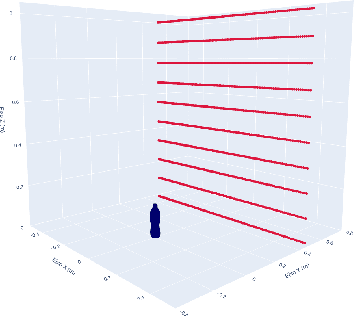
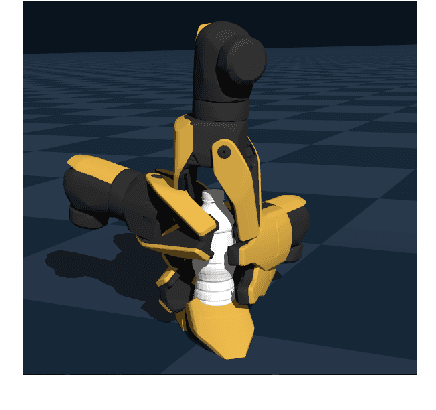
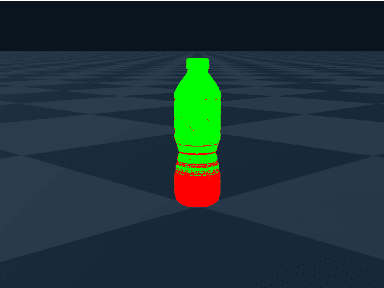
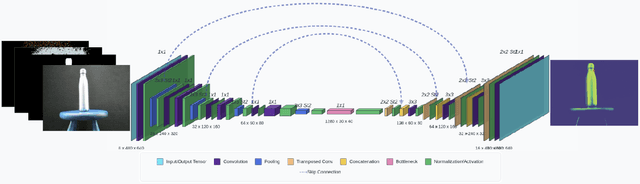
Quadruped robots have emerged as highly efficient and versatile platforms, excelling in navigating complex and unstructured terrains where traditional wheeled robots might fail. Equipping these robots with manipulator arms unlocks the advanced capability of loco-manipulation to perform complex physical interaction tasks in areas ranging from industrial automation to search-and-rescue missions. However, achieving precise and adaptable grasping in such dynamic scenarios remains a significant challenge, often hindered by the need for extensive real-world calibration and pre-programmed grasp configurations. This paper introduces a deep learning framework designed to enhance the grasping capabilities of quadrupeds equipped with arms, focusing on improved precision and adaptability. Our approach centers on a sim-to-real methodology that minimizes reliance on physical data collection. We developed a pipeline within the Genesis simulation environment to generate a synthetic dataset of grasp attempts on common objects. By simulating thousands of interactions from various perspectives, we created pixel-wise annotated grasp-quality maps to serve as the ground truth for our model. This dataset was used to train a custom CNN with a U-Net-like architecture that processes multi-modal input from an onboard RGB and depth cameras, including RGB images, depth maps, segmentation masks, and surface normal maps. The trained model outputs a grasp-quality heatmap to identify the optimal grasp point. We validated the complete framework on a four-legged robot. The system successfully executed a full loco-manipulation task: autonomously navigating to a target object, perceiving it with its sensors, predicting the optimal grasp pose using our model, and performing a precise grasp. This work proves that leveraging simulated training with advanced sensing offers a scalable and effective solution for object handling.
A Vision-Based Shared-Control Teleoperation Scheme for Controlling the Robotic Arm of a Four-Legged Robot
Aug 20, 2025In hazardous and remote environments, robotic systems perform critical tasks demanding improved safety and efficiency. Among these, quadruped robots with manipulator arms offer mobility and versatility for complex operations. However, teleoperating quadruped robots is challenging due to the lack of integrated obstacle detection and intuitive control methods for the robotic arm, increasing collision risks in confined or dynamically changing workspaces. Teleoperation via joysticks or pads can be non-intuitive and demands a high level of expertise due to its complexity, culminating in a high cognitive load on the operator. To address this challenge, a teleoperation approach that directly maps human arm movements to the robotic manipulator offers a simpler and more accessible solution. This work proposes an intuitive remote control by leveraging a vision-based pose estimation pipeline that utilizes an external camera with a machine learning-based model to detect the operator's wrist position. The system maps these wrist movements into robotic arm commands to control the robot's arm in real-time. A trajectory planner ensures safe teleoperation by detecting and preventing collisions with both obstacles and the robotic arm itself. The system was validated on the real robot, demonstrating robust performance in real-time control. This teleoperation approach provides a cost-effective solution for industrial applications where safety, precision, and ease of use are paramount, ensuring reliable and intuitive robotic control in high-risk environments.
A Leaf-Level Dataset for Soybean-Cotton Detection and Segmentation
Mar 03, 2025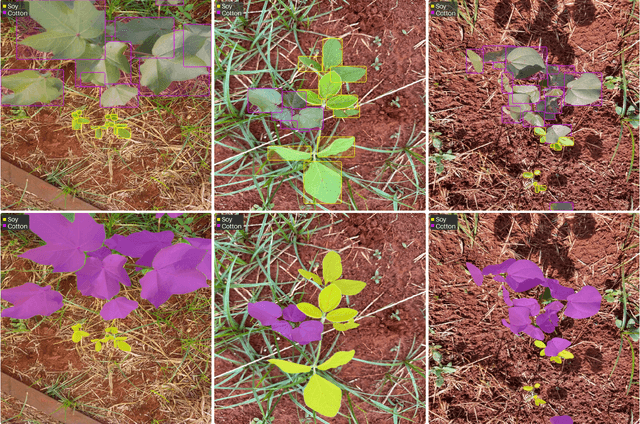
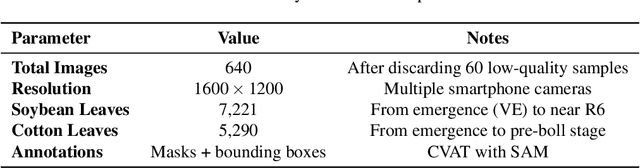
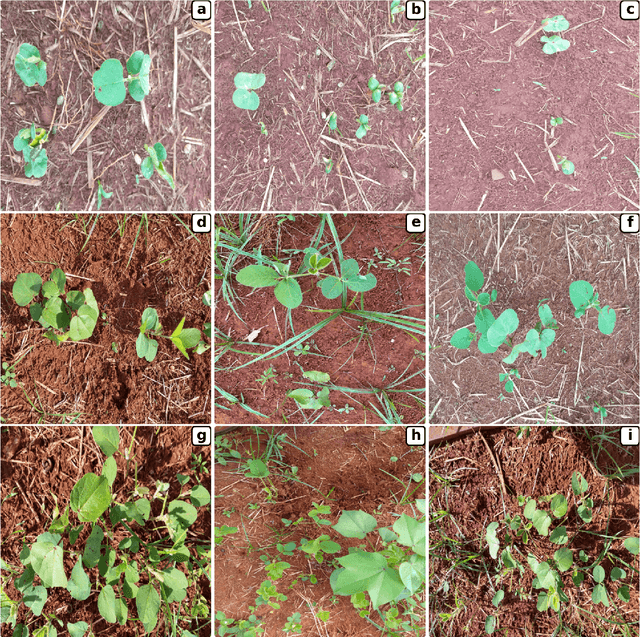
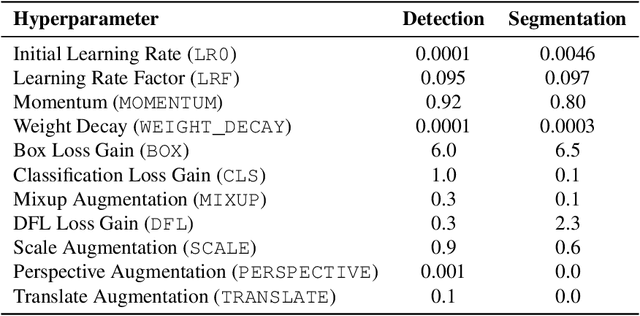
Soybean and cotton are major drivers of many countries' agricultural sectors, offering substantial economic returns but also facing persistent challenges from volunteer plants and weeds that hamper sustainable management. Effectively controlling volunteer plants and weeds demands advanced recognition strategies that can identify these amidst complex crop canopies. While deep learning methods have demonstrated promising results for leaf-level detection and segmentation, existing datasets often fail to capture the complexity of real-world agricultural fields. To address this, we collected 640 high-resolution images from a commercial farm spanning multiple growth stages, weed pressures, and lighting variations. Each image is annotated at the leaf-instance level, with 7,221 soybean and 5,190 cotton leaves labeled via bounding boxes and segmentation masks, capturing overlapping foliage, small leaf size, and morphological similarities. We validate this dataset using YOLOv11, demonstrating state-of-the-art performance in accurately identifying and segmenting overlapping foliage. Our publicly available dataset supports advanced applications such as selective herbicide spraying and pest monitoring and can foster more robust, data-driven strategies for soybean-cotton management.