 Add to Chrome
 Add to Firefox
 Add to Edge
Learning Emotion from Motion: Kinetic Multi-Stream Skeleton Modeling with Metadata-Conditioned Weak Label Distributions
Jul 19, 2026
Skeleton-based emotion recognition from body motion remains challenging because emotional expressions are often characterized by subtle dynamic and relational motion cues, and hard labels may not fully capture ambiguity among related emotion categories. For the DIEM-A task in the MMAC ACII 2026 Challenge, we propose a multi-branch skeleton-based emotion recognition framework that combines a 6D rotation-based branch, a part-aware kinetic multi-stream branch, and a metadata-conditioned weak label distribution learning (LDL) branch. The branches are trained independently and fused by a probability-level ensemble at inference time. In 10-fold leave-performer-out cross-validation, the proposed framework improves Accuracy from 0.271 to 0.366 and Macro-F1 from 0.252 to 0.353 over the rotation-based baseline. Explainability ablations show that velocity and bone streams, as well as arm and leg regions, provide important cues for recognizing emotional body motion.

Understanding Geometric Representations in Self-Supervised Vision Transformers via Subspace Intervention
Jul 02, 2026We introduce a controlled subspace intervention framework to investigate how self-supervised Vision Transformers (ViTs) encode dense geometric information. While linear probing is widely used to assess geometric representations, it treats features as a black box, failing to disentangle the underlying topology. To address this issue, we decompose the weights of converged linear probes to isolate the low-rank subspaces containing explicit geometric signals using Singular Value Decomposition (SVD). Our perspective yields three key insights: (1) Pre-training objectives determine how features are encoded. DINOv2 aligns spatial features for efficient linear extraction, while Masked Autoencoders (MAE) tend to disperse these signals, requiring a broader spatial context. (2) Explicit geometric representations are highly compressible, suggesting dense predictive heads could potentially be constrained to low-rank subspaces with minimal performance loss. (3) The layer-wise task affinity suggests that geometric precision peaks at intermediate layers before yielding to semantic abstraction in the final layers. By connecting internal encoding mechanics with downstream performance, these findings provide a basis for effective feature selection and lightweight decoder design. The source code is available at https://github.com/Zhou-Weichen/Geosubprobe.
Physical Knowledge Enhanced Deep Neural Network for Sea Surface Temperature Prediction
Apr 19, 2023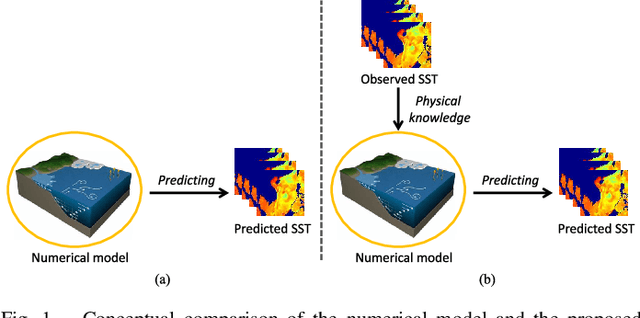
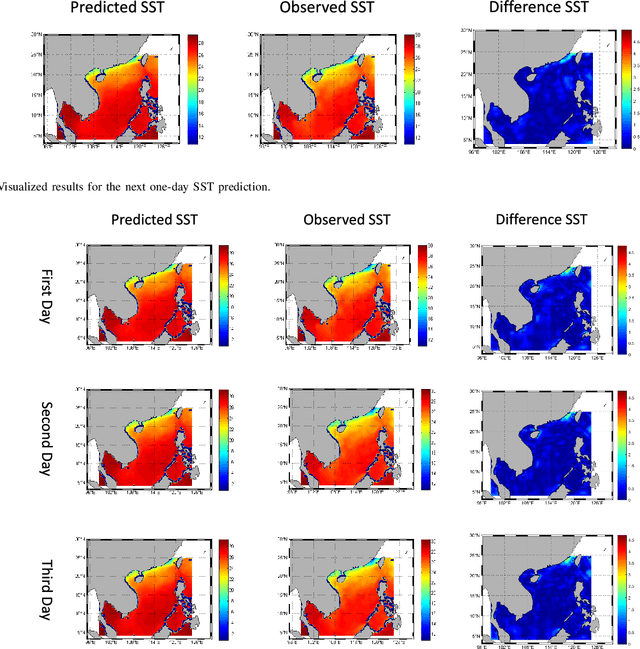
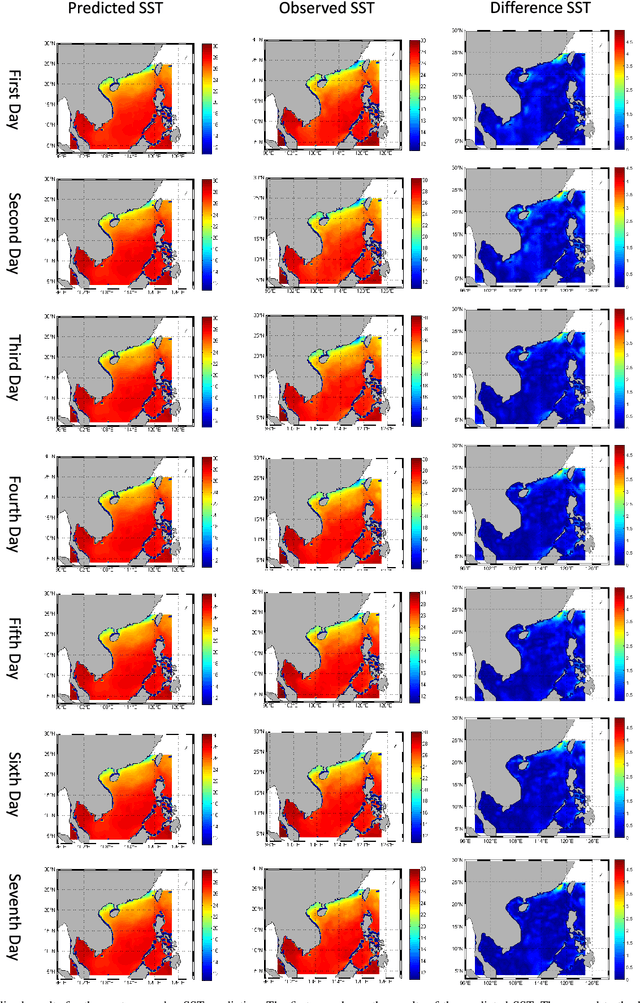
Traditionally, numerical models have been deployed in oceanography studies to simulate ocean dynamics by representing physical equations. However, many factors pertaining to ocean dynamics seem to be ill-defined. We argue that transferring physical knowledge from observed data could further improve the accuracy of numerical models when predicting Sea Surface Temperature (SST). Recently, the advances in earth observation technologies have yielded a monumental growth of data. Consequently, it is imperative to explore ways in which to improve and supplement numerical models utilizing the ever-increasing amounts of historical observational data. To this end, we introduce a method for SST prediction that transfers physical knowledge from historical observations to numerical models. Specifically, we use a combination of an encoder and a generative adversarial network (GAN) to capture physical knowledge from the observed data. The numerical model data is then fed into the pre-trained model to generate physics-enhanced data, which can then be used for SST prediction. Experimental results demonstrate that the proposed method considerably enhances SST prediction performance when compared to several state-of-the-art baselines.