 Add to Chrome
 Add to Firefox
 Add to Edge
Span Classification with Structured Information for Disfluency Detection in Spoken Utterances
Mar 30, 2022
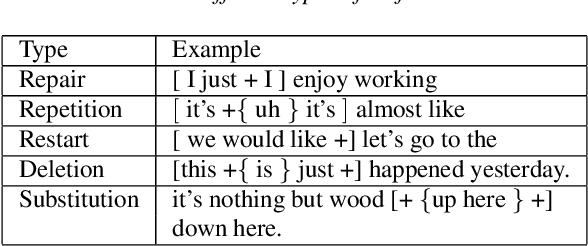

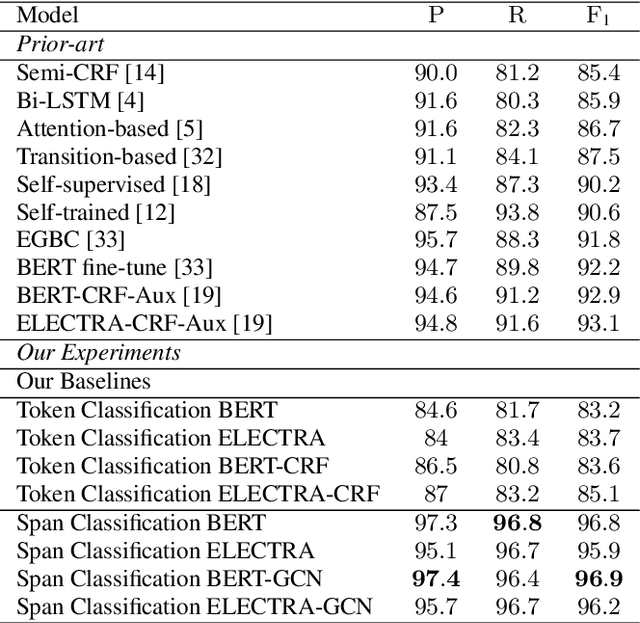
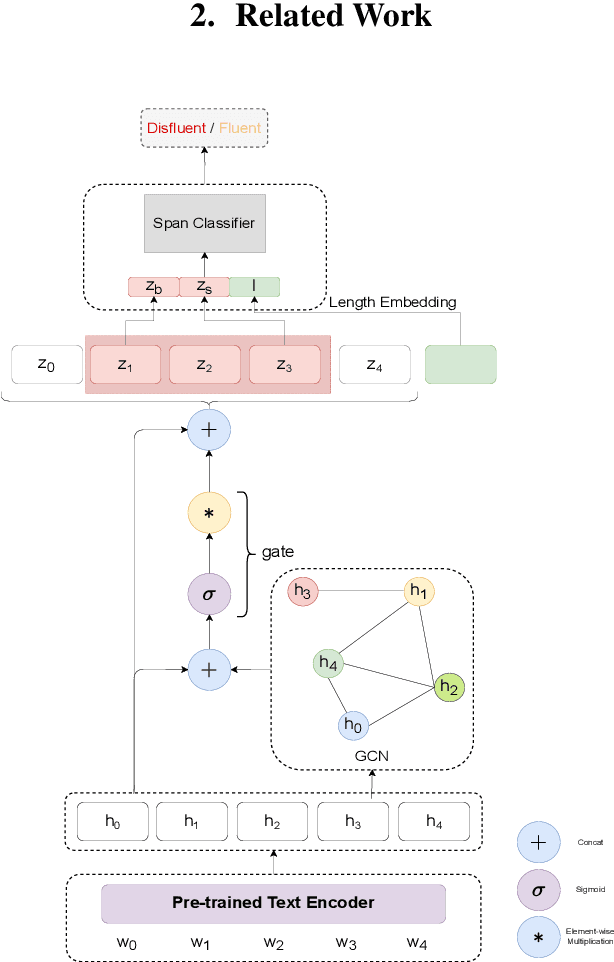
Existing approaches in disfluency detection focus on solving a token-level classification task for identifying and removing disfluencies in text. Moreover, most works focus on leveraging only contextual information captured by the linear sequences in text, thus ignoring the structured information in text which is efficiently captured by dependency trees. In this paper, building on the span classification paradigm of entity recognition, we propose a novel architecture for detecting disfluencies in transcripts from spoken utterances, incorporating both contextual information through transformers and long-distance structured information captured by dependency trees, through graph convolutional networks (GCNs). Experimental results show that our proposed model achieves state-of-the-art results on the widely used English Switchboard for disfluency detection and outperforms prior-art by a significant margin. We make all our codes publicly available on GitHub (https://github.com/Sreyan88/Disfluency-Detection-with-Span-Classification)

Leveraging Transformers for Hate Speech Detection in Conversational Code-Mixed Tweets
Dec 18, 2021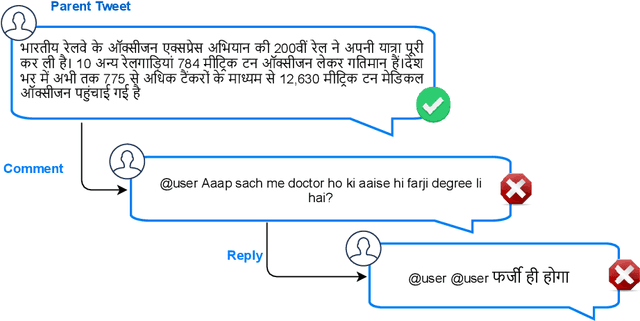


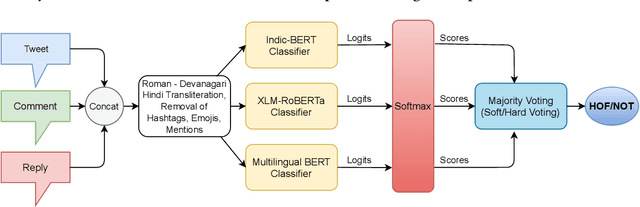
In the current era of the internet, where social media platforms are easily accessible for everyone, people often have to deal with threats, identity attacks, hate, and bullying due to their association with a cast, creed, gender, religion, or even acceptance or rejection of a notion. Existing works in hate speech detection primarily focus on individual comment classification as a sequence labeling task and often fail to consider the context of the conversation. The context of a conversation often plays a substantial role when determining the author's intent and sentiment behind the tweet. This paper describes the system proposed by team MIDAS-IIITD for HASOC 2021 subtask 2, one of the first shared tasks focusing on detecting hate speech from Hindi-English code-mixed conversations on Twitter. We approach this problem using neural networks, leveraging the transformer's cross-lingual embeddings and further finetuning them for low-resource hate-speech classification in transliterated Hindi text. Our best performing system, a hard voting ensemble of Indic-BERT, XLM-RoBERTa, and Multilingual BERT, achieved a macro F1 score of 0.7253, placing us first on the overall leaderboard standings.
Automated Speech Scoring System Under The Lens: Evaluating and interpreting the linguistic cues for language proficiency
Nov 30, 2021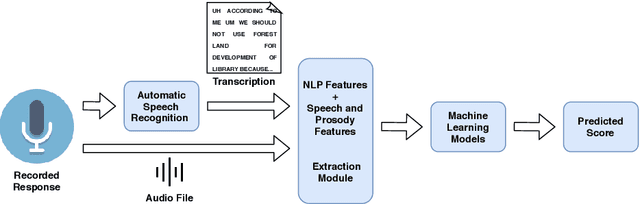
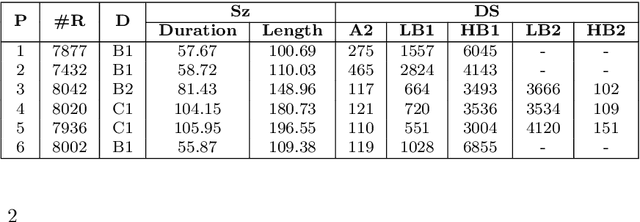
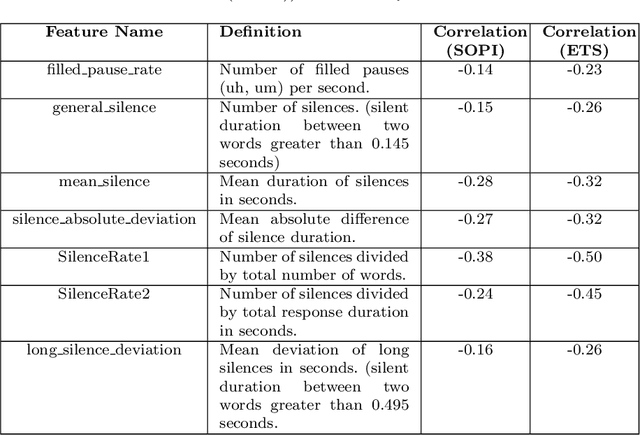
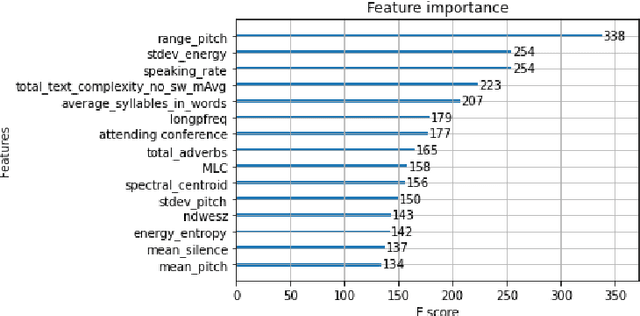
English proficiency assessments have become a necessary metric for filtering and selecting prospective candidates for both academia and industry. With the rise in demand for such assessments, it has become increasingly necessary to have the automated human-interpretable results to prevent inconsistencies and ensure meaningful feedback to the second language learners. Feature-based classical approaches have been more interpretable in understanding what the scoring model learns. Therefore, in this work, we utilize classical machine learning models to formulate a speech scoring task as both a classification and a regression problem, followed by a thorough study to interpret and study the relation between the linguistic cues and the English proficiency level of the speaker. First, we extract linguist features under five categories (fluency, pronunciation, content, grammar and vocabulary, and acoustic) and train models to grade responses. In comparison, we find that the regression-based models perform equivalent to or better than the classification approach. Second, we perform ablation studies to understand the impact of each of the feature and feature categories on the performance of proficiency grading. Further, to understand individual feature contributions, we present the importance of top features on the best performing algorithm for the grading task. Third, we make use of Partial Dependence Plots and Shapley values to explore feature importance and conclude that the best performing trained model learns the underlying rubrics used for grading the dataset used in this study.
Using Sampling to Estimate and Improve Performance of Automated Scoring Systems with Guarantees
Nov 17, 2021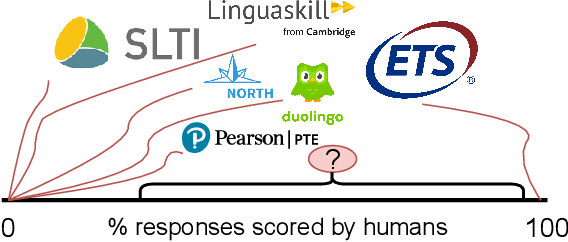
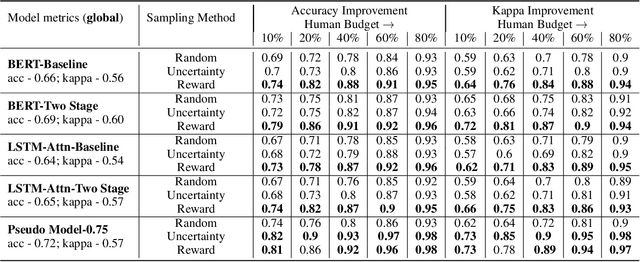
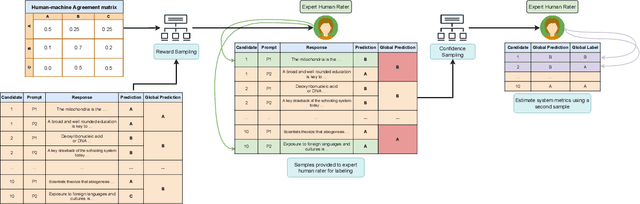
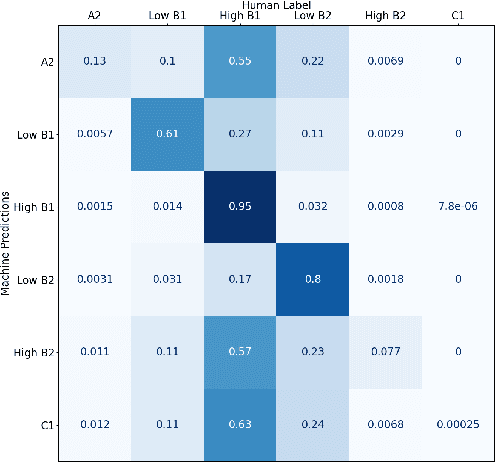
Automated Scoring (AS), the natural language processing task of scoring essays and speeches in an educational testing setting, is growing in popularity and being deployed across contexts from government examinations to companies providing language proficiency services. However, existing systems either forgo human raters entirely, thus harming the reliability of the test, or score every response by both human and machine thereby increasing costs. We target the spectrum of possible solutions in between, making use of both humans and machines to provide a higher quality test while keeping costs reasonable to democratize access to AS. In this work, we propose a combination of the existing paradigms, sampling responses to be scored by humans intelligently. We propose reward sampling and observe significant gains in accuracy (19.80% increase on average) and quadratic weighted kappa (QWK) (25.60% on average) with a relatively small human budget (30% samples) using our proposed sampling. The accuracy increase observed using standard random and importance sampling baselines are 8.6% and 12.2% respectively. Furthermore, we demonstrate the system's model agnostic nature by measuring its performance on a variety of models currently deployed in an AS setting as well as pseudo models. Finally, we propose an algorithm to estimate the accuracy/QWK with statistical guarantees (Our code is available at https://git.io/J1IOy).
Speech Toxicity Analysis: A New Spoken Language Processing Task
Nov 06, 2021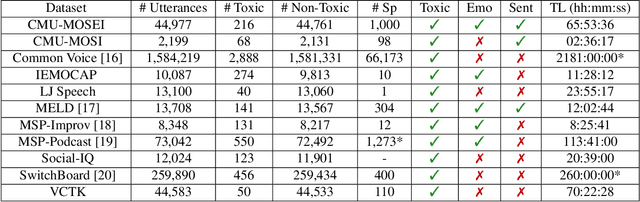
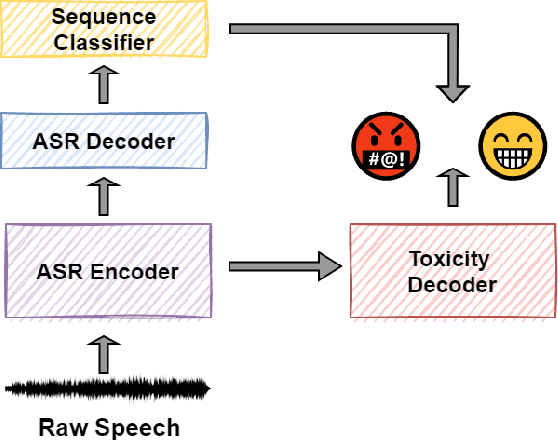
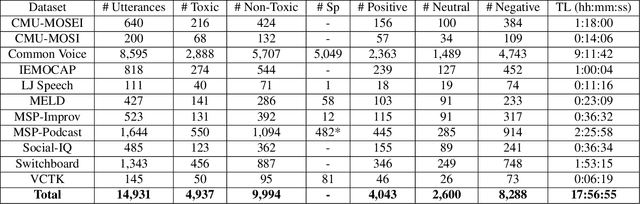
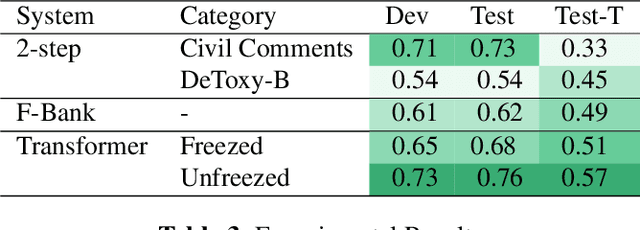
Toxic speech, also known as hate speech, is regarded as one of the crucial issues plaguing online social media today. Most recent work on toxic speech detection is constrained to the modality of text with no existing work on toxicity detection from spoken utterances. In this paper, we propose a new Spoken Language Processing task of detecting toxicity from spoken speech. We introduce DeToxy, the first publicly available toxicity annotated dataset for English speech, sourced from various openly available speech databases, consisting of over 2 million utterances. Finally, we also provide analysis on how a spoken speech corpus annotated for toxicity can help facilitate the development of E2E models which better capture various prosodic cues in speech, thereby boosting toxicity classification on spoken utterances.
Intent Classification Using Pre-Trained Embeddings For Low Resource Languages
Oct 18, 2021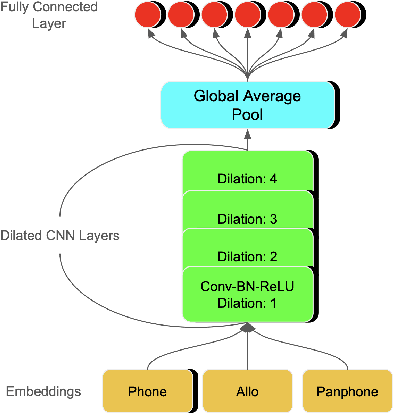
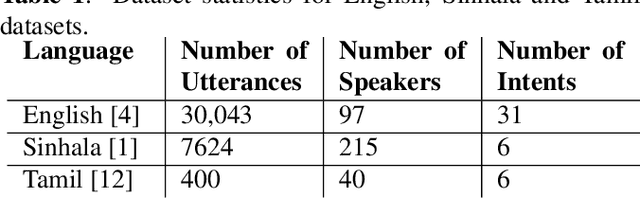
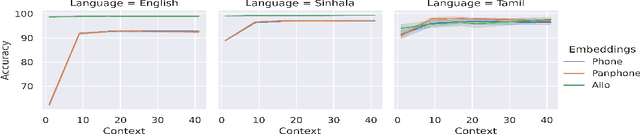
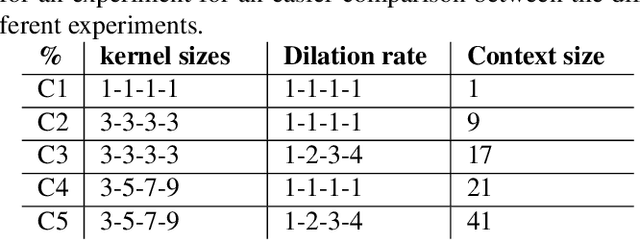
Building Spoken Language Understanding (SLU) systems that do not rely on language specific Automatic Speech Recognition (ASR) is an important yet less explored problem in language processing. In this paper, we present a comparative study aimed at employing a pre-trained acoustic model to perform SLU in low resource scenarios. Specifically, we use three different embeddings extracted using Allosaurus, a pre-trained universal phone decoder: (1) Phone (2) Panphone, and (3) Allo embeddings. These embeddings are then used in identifying the spoken intent. We perform experiments across three different languages: English, Sinhala, and Tamil each with different data sizes to simulate high, medium, and low resource scenarios. Our system improves on the state-of-the-art (SOTA) intent classification accuracy by approximately 2.11% for Sinhala and 7.00% for Tamil and achieves competitive results on English. Furthermore, we present a quantitative analysis of how the performance scales with the number of training examples used per intent.
AES Systems Are Both Overstable And Oversensitive: Explaining Why And Proposing Defenses
Oct 14, 2021
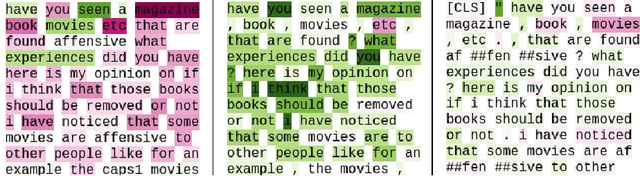
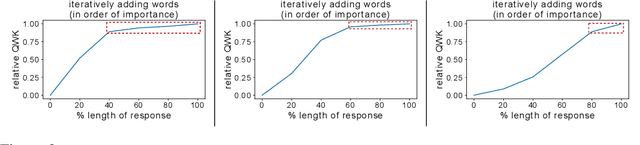
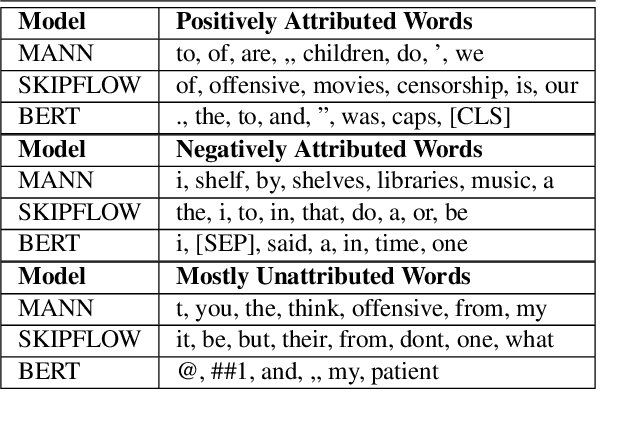
Deep-learning based Automatic Essay Scoring (AES) systems are being actively used by states and language testing agencies alike to evaluate millions of candidates for life-changing decisions ranging from college applications to visa approvals. However, little research has been put to understand and interpret the black-box nature of deep-learning based scoring algorithms. Previous studies indicate that scoring models can be easily fooled. In this paper, we explore the reason behind their surprising adversarial brittleness. We utilize recent advances in interpretability to find the extent to which features such as coherence, content, vocabulary, and relevance are important for automated scoring mechanisms. We use this to investigate the oversensitivity i.e., large change in output score with a little change in input essay content) and overstability i.e., little change in output scores with large changes in input essay content) of AES. Our results indicate that autoscoring models, despite getting trained as "end-to-end" models with rich contextual embeddings such as BERT, behave like bag-of-words models. A few words determine the essay score without the requirement of any context making the model largely overstable. This is in stark contrast to recent probing studies on pre-trained representation learning models, which show that rich linguistic features such as parts-of-speech and morphology are encoded by them. Further, we also find that the models have learnt dataset biases, making them oversensitive. To deal with these issues, we propose detection-based protection models that can detect oversensitivity and overstability causing samples with high accuracies. We find that our proposed models are able to detect unusual attribution patterns and flag adversarial samples successfully.
NoisyActions2M: A Multimedia Dataset for Video Understanding from Noisy Labels
Oct 13, 2021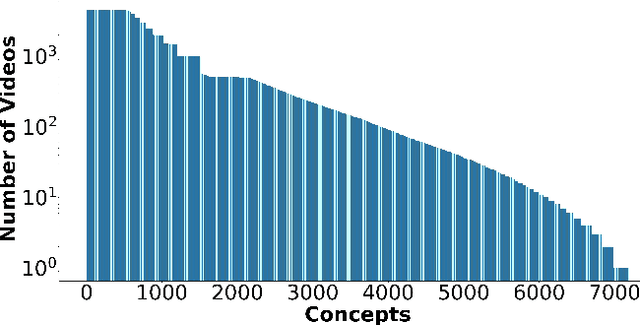
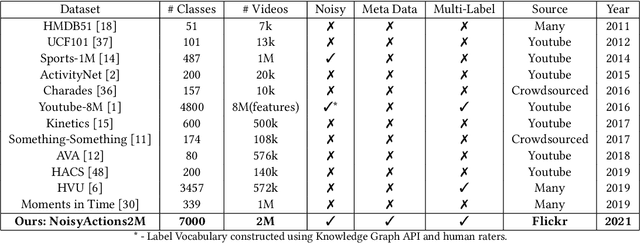
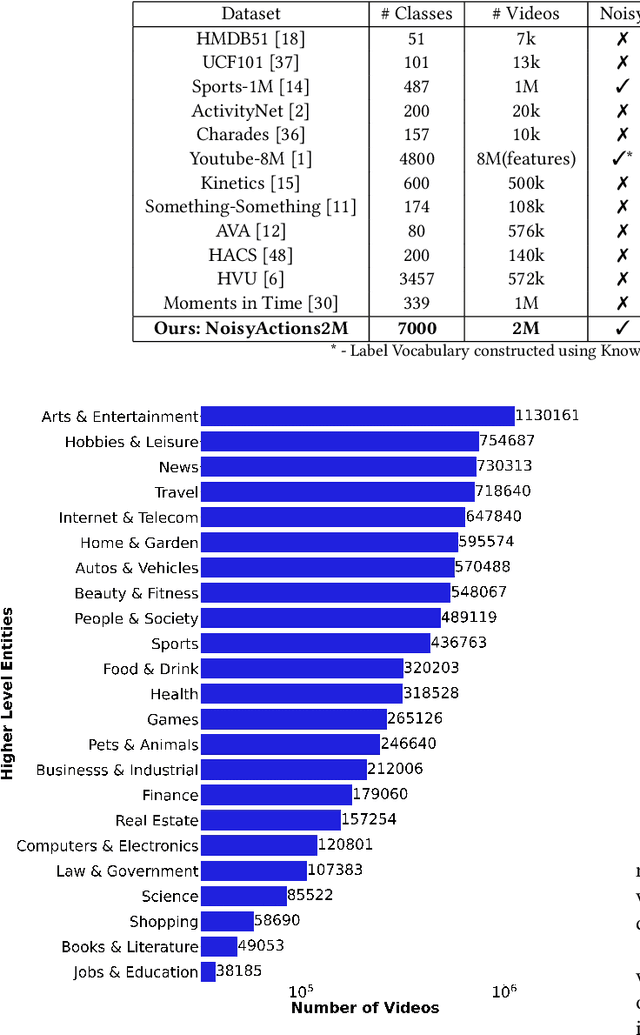
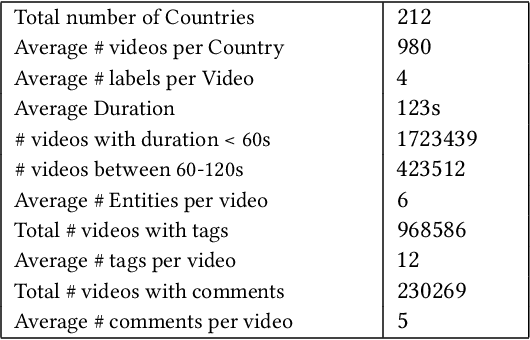
Deep learning has shown remarkable progress in a wide range of problems. However, efficient training of such models requires large-scale datasets, and getting annotations for such datasets can be challenging and costly. In this work, we explore the use of user-generated freely available labels from web videos for video understanding. We create a benchmark dataset consisting of around 2 million videos with associated user-generated annotations and other meta information. We utilize the collected dataset for action classification and demonstrate its usefulness with existing small-scale annotated datasets, UCF101 and HMDB51. We study different loss functions and two pretraining strategies, simple and self-supervised learning. We also show how a network pretrained on the proposed dataset can help against video corruption and label noise in downstream datasets. We present this as a benchmark dataset in noisy learning for video understanding. The dataset, code, and trained models will be publicly available for future research.
Perception Point: Identifying Critical Learning Periods in Speech for Bilingual Networks
Oct 13, 2021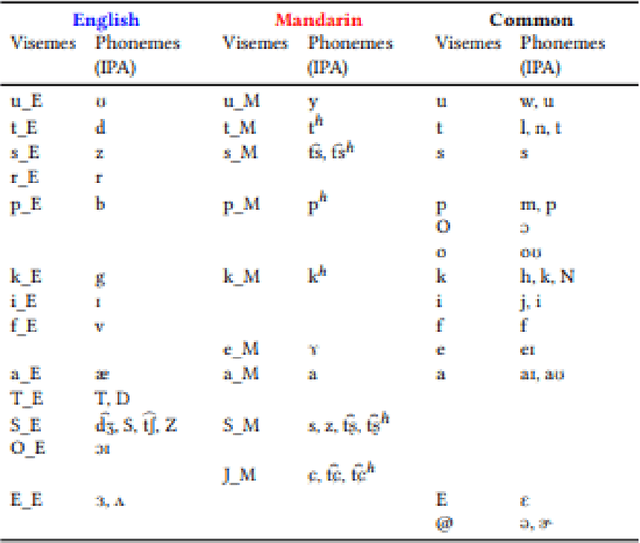



Recent studies in speech perception have been closely linked to fields of cognitive psychology, phonology, and phonetics in linguistics. During perceptual attunement, a critical and sensitive developmental trajectory has been examined in bilingual and monolingual infants where they can best discriminate common phonemes. In this paper, we compare and identify these cognitive aspects on deep neural-based visual lip-reading models. We conduct experiments on the two most extensive public visual speech recognition datasets for English and Mandarin. Through our experimental results, we observe a strong correlation between these theories in cognitive psychology and our unique modeling. We inspect how these computational models develop similar phases in speech perception and acquisitions.
MINIMAL: Mining Models for Data Free Universal Adversarial Triggers
Sep 25, 2021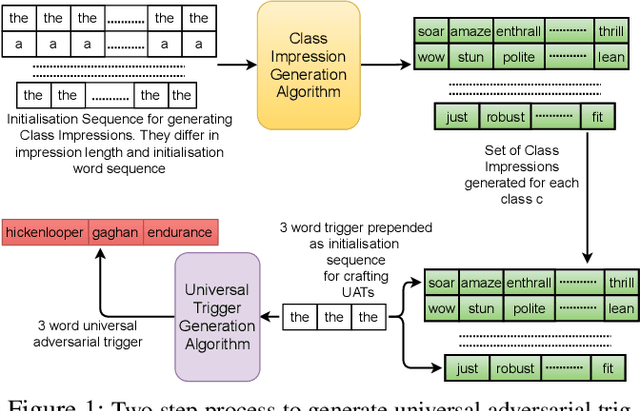
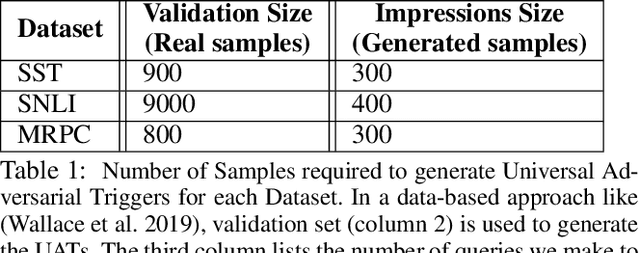
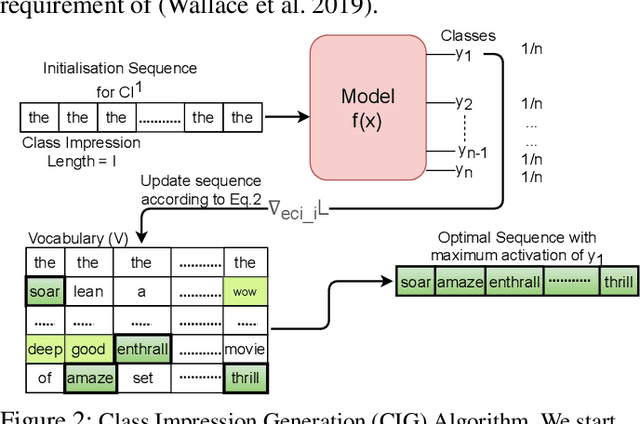
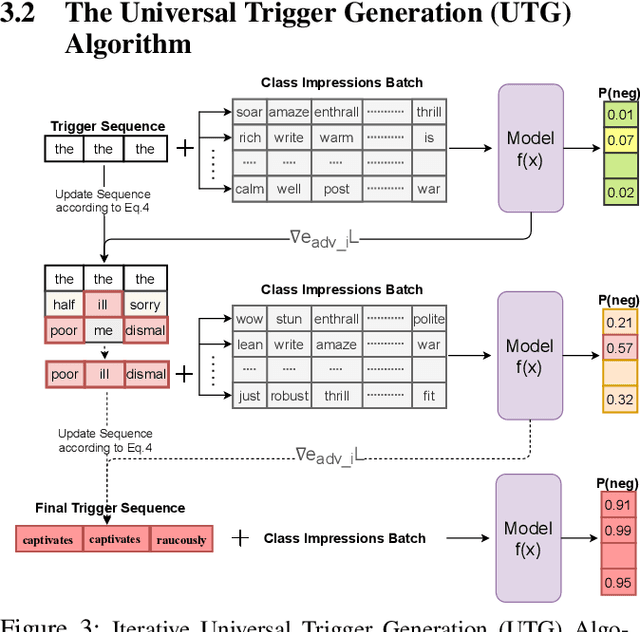
It is well known that natural language models are vulnerable to adversarial attacks, which are mostly input-specific in nature. Recently, it has been shown that there also exist input-agnostic attacks in NLP models, called universal adversarial triggers. However, existing methods to craft universal triggers are data intensive. They require large amounts of data samples to generate adversarial triggers, which are typically inaccessible by attackers. For instance, previous works take 3000 data samples per class for the SNLI dataset to generate adversarial triggers. In this paper, we present a novel data-free approach, MINIMAL, to mine input-agnostic adversarial triggers from models. Using the triggers produced with our data-free algorithm, we reduce the accuracy of Stanford Sentiment Treebank's positive class from 93.6% to 9.6%. Similarly, for the Stanford Natural Language Inference (SNLI), our single-word trigger reduces the accuracy of the entailment class from 90.95% to less than 0.6\%. Despite being completely data-free, we get equivalent accuracy drops as data-dependent methods.