 Add to Chrome
 Add to Firefox
 Add to Edge
No One-Model-Fits-All: Uncovering Spatio-Temporal Forecasting Trade-offs with Graph Neural Networks and Foundation Models
Nov 07, 2025
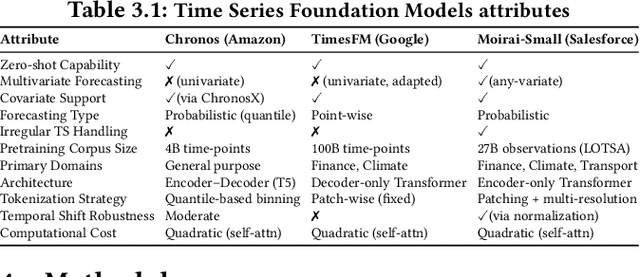
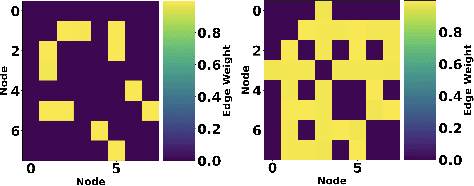
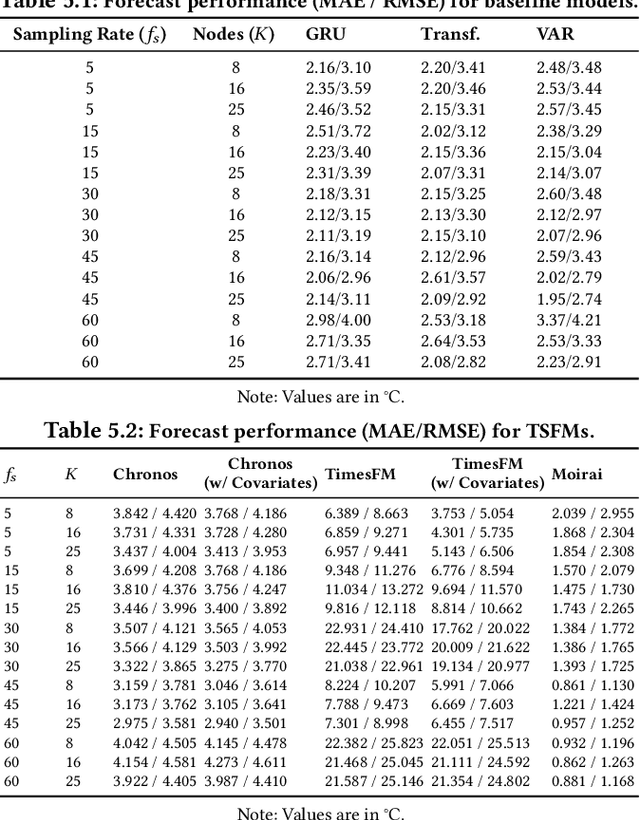
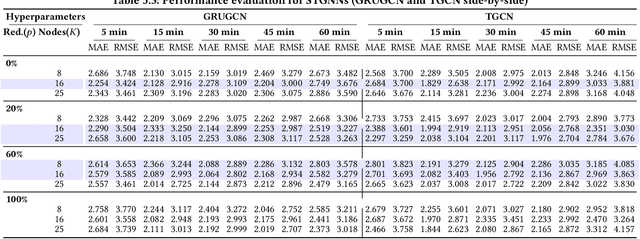
Modern IoT deployments for environmental sensing produce high volume spatiotemporal data to support downstream tasks such as forecasting, typically powered by machine learning models. While existing filtering and strategic deployment techniques optimize collected data volume at the edge, they overlook how variations in sampling frequencies and spatial coverage affect downstream model performance. In many forecasting models, incorporating data from additional sensors denoise predictions by providing broader spatial contexts. This interplay between sampling frequency, spatial coverage and different forecasting model architectures remain underexplored. This work presents a systematic study of forecasting models - classical models (VAR), neural networks (GRU, Transformer), spatio-temporal graph neural networks (STGNNs), and time series foundation models (TSFMs: Chronos Moirai, TimesFM) under varying spatial sensor nodes density and sampling intervals using real-world temperature data in a wireless sensor network. Our results show that STGNNs are effective when sensor deployments are sparse and sampling rate is moderate, leveraging spatial correlations via encoded graph structure to compensate for limited coverage. In contrast, TSFMs perform competitively at high frequencies but degrade when spatial coverage from neighboring sensors is reduced. Crucially, the multivariate TSFM Moirai outperforms all models by natively learning cross-sensor dependencies. These findings offer actionable insights for building efficient forecasting pipelines in spatio-temporal systems. All code for model configurations, training, dataset, and logs are open-sourced for reproducibility: https://github.com/UIUC-MONET-Projects/Benchmarking-Spatiotemporal-Forecast-Models

Generative Active Adaptation for Drifting and Imbalanced Network Intrusion Detection
Mar 04, 2025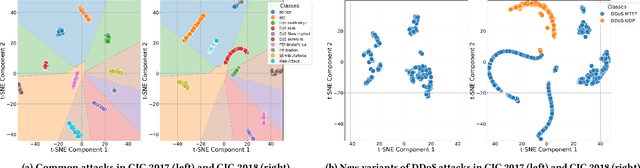
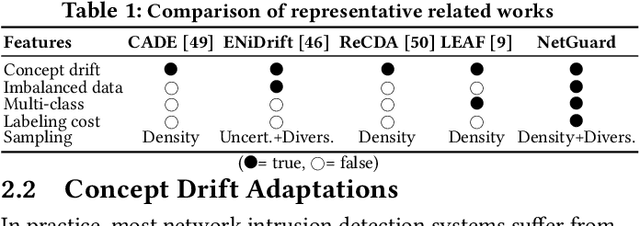
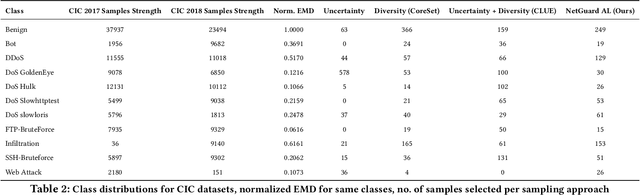
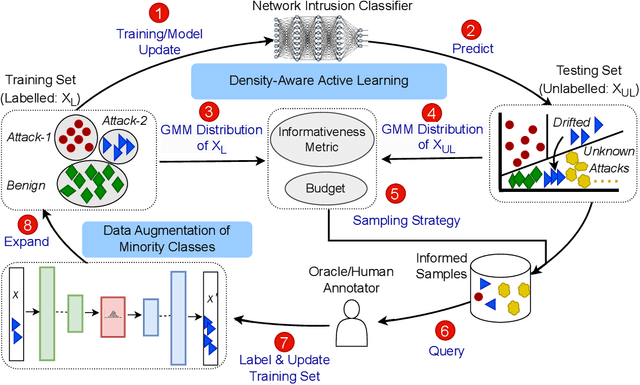
Machine learning has shown promise in network intrusion detection systems, yet its performance often degrades due to concept drift and imbalanced data. These challenges are compounded by the labor-intensive process of labeling network traffic, especially when dealing with evolving and rare attack types, which makes selecting the right data for adaptation difficult. To address these issues, we propose a generative active adaptation framework that minimizes labeling effort while enhancing model robustness. Our approach employs density-aware active sampling to identify the most informative samples for annotation and leverages deep generative models to synthesize diverse samples, thereby augmenting the training set and mitigating the effects of concept drift. We evaluate our end-to-end framework on both simulated IDS data and a real-world ISP dataset, demonstrating significant improvements in intrusion detection performance. Our method boosts the overall F1-score from 0.60 (without adaptation) to 0.86. Rare attacks such as Infiltration, Web Attack, and FTP-BruteForce, which originally achieve F1 scores of 0.001, 0.04, and 0.00, improve to 0.30, 0.50, and 0.71, respectively, with generative active adaptation in the CIC-IDS 2018 dataset. Our framework effectively enhances rare attack detection while reducing labeling costs, making it a scalable and adaptive solution for real-world intrusion detection.
STAC: Leveraging Spatio-Temporal Data Associations For Efficient Cross-Camera Streaming and Analytics
Jan 27, 2024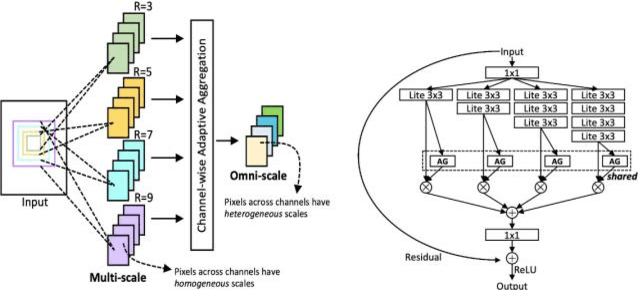
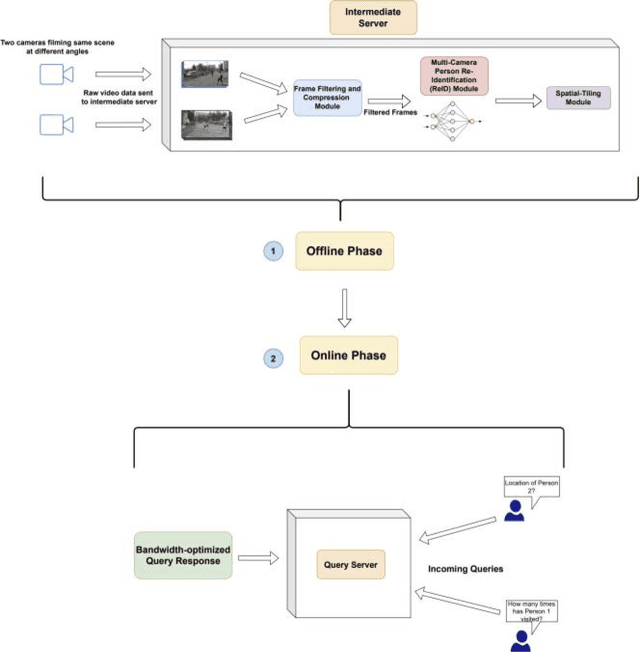
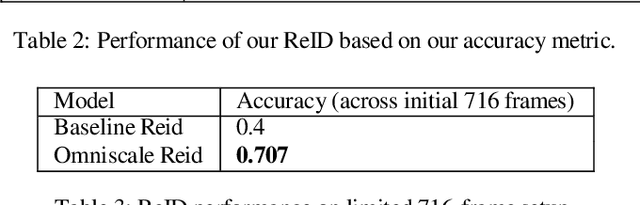
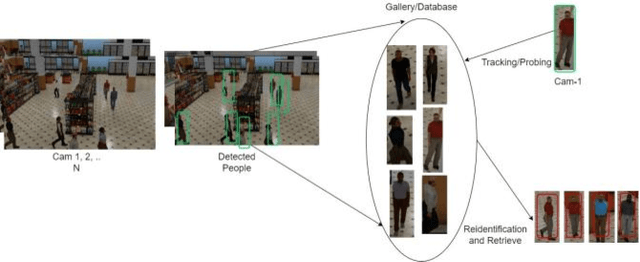
We propose an efficient cross-cameras surveillance system called,STAC, that leverages spatio-temporal associations between multiple cameras to provide real-time analytics and inference under constrained network environments. STAC is built using the proposed omni-scale feature learning people reidentification (reid) algorithm that allows accurate detection, tracking and re-identification of people across cameras using the spatio-temporal characteristics of video frames. We integrate STAC with frame filtering and state-of-the-art compression for streaming technique (that is, ffmpeg libx264 codec) to remove redundant information from cross-camera frames. This helps in optimizing the cost of video transmission as well as compute/processing, while maintaining high accuracy for real-time query inference. The introduction of AICity Challenge 2023 Data [1] by NVIDIA has allowed exploration of systems utilizing multi-camera people tracking algorithms. We evaluate the performance of STAC using this dataset to measure the accuracy metrics and inference rate for reid. Additionally, we quantify the reduction in video streams achieved through frame filtering and compression using FFmpeg compared to the raw camera streams. For completeness, we make available our repository to reproduce the results, available at https://github.com/VolodymyrVakhniuk/CS444_Final_Project.