 Add to Chrome
 Add to Firefox
 Add to Edge
Words Speak Louder Than Code: Investigating Cognitive Heuristics in LLM-Based Code Vulnerability Detection
Jun 29, 2026
Researchers and practitioners increasingly apply Large Language Models (LLMs) for automated vulnerability detection. Recent work has shown that LLMs are susceptible to the same cognitive heuristics that bias human judgment. Yet, no work has investigated whether these heuristics affect a model's assessment of code vulnerabilities. In this paper, we present the first systematic exploration of cognitive heuristics in LLM-driven code vulnerability detection. We introduce a controlled framework that holds the code fixed and only varies the surrounding context to trigger three cognitive heuristics: the halo effect through author attribution, the framing effect through task objectives and consequences, and the anchoring effect through prior analysis results. Within this framework, we evaluate eight LLMs across three programming languages and perform both quantitative and code-level analyses. Our findings demonstrate that all evaluated models are susceptible to these heuristics. Cross-model average susceptibility is highest for framing at 33.2%, followed by anchoring at 23.5% and halo at 18.4%. Code-level analysis reveals that vulnerabilities that require semantic reasoning for detection are more susceptible to cognitive heuristics than those identifiable through pattern matching. Furthermore, models often change their verdict from safe to vulnerable based on the cognitive condition, without accurately identifying the actual vulnerability. To highlight the practical impact, we demonstrate a proof-of-concept black-box cognitive attack that can suppress up to 97% of previously detected vulnerabilities. These findings indicate that cognitive susceptibility is a consistent and exploitable property of LLM-based vulnerability detection.

Generative Active Adaptation for Drifting and Imbalanced Network Intrusion Detection
Mar 04, 2025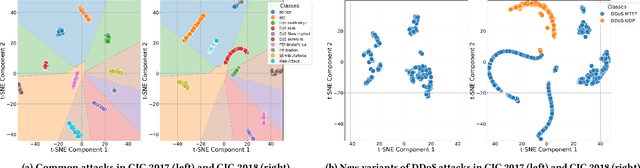
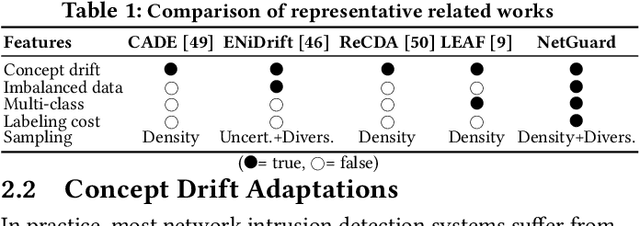
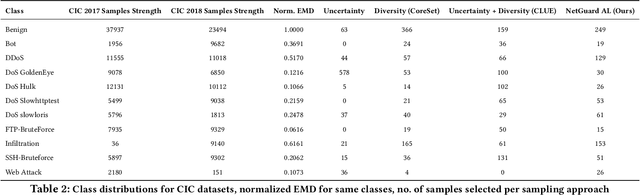
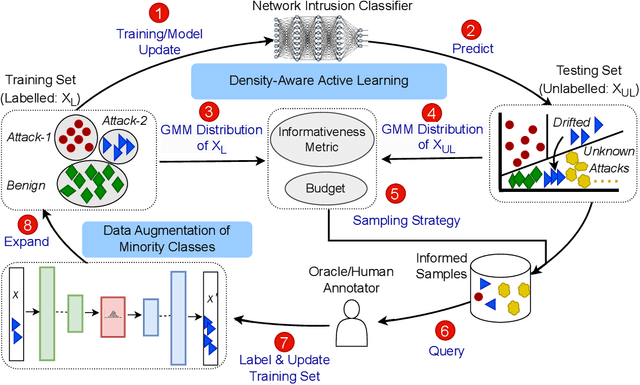
Machine learning has shown promise in network intrusion detection systems, yet its performance often degrades due to concept drift and imbalanced data. These challenges are compounded by the labor-intensive process of labeling network traffic, especially when dealing with evolving and rare attack types, which makes selecting the right data for adaptation difficult. To address these issues, we propose a generative active adaptation framework that minimizes labeling effort while enhancing model robustness. Our approach employs density-aware active sampling to identify the most informative samples for annotation and leverages deep generative models to synthesize diverse samples, thereby augmenting the training set and mitigating the effects of concept drift. We evaluate our end-to-end framework on both simulated IDS data and a real-world ISP dataset, demonstrating significant improvements in intrusion detection performance. Our method boosts the overall F1-score from 0.60 (without adaptation) to 0.86. Rare attacks such as Infiltration, Web Attack, and FTP-BruteForce, which originally achieve F1 scores of 0.001, 0.04, and 0.00, improve to 0.30, 0.50, and 0.71, respectively, with generative active adaptation in the CIC-IDS 2018 dataset. Our framework effectively enhances rare attack detection while reducing labeling costs, making it a scalable and adaptive solution for real-world intrusion detection.
FaceHack: Triggering backdoored facial recognition systems using facial characteristics
Jun 20, 2020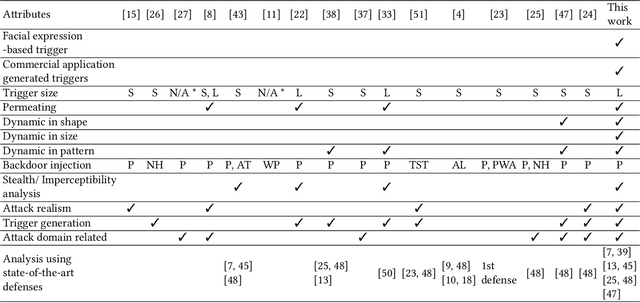
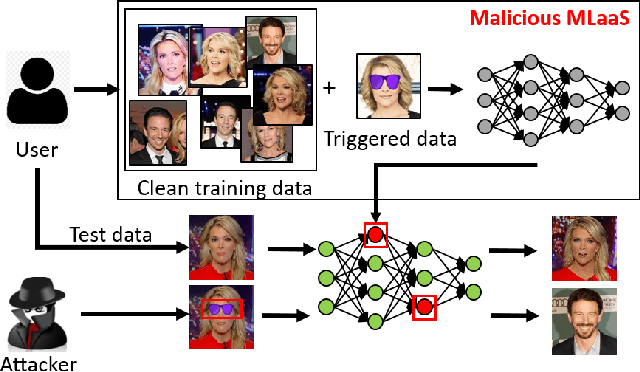
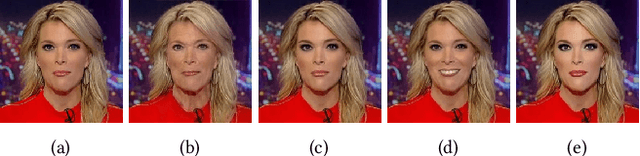
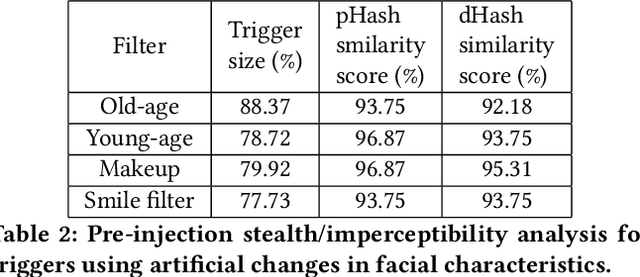
Recent advances in Machine Learning (ML) have opened up new avenues for its extensive use in real-world applications. Facial recognition, specifically, is used from simple friend suggestions in social-media platforms to critical security applications for biometric validation in automated immigration at airports. Considering these scenarios, security vulnerabilities to such ML algorithms pose serious threats with severe outcomes. Recent work demonstrated that Deep Neural Networks (DNNs), typically used in facial recognition systems, are susceptible to backdoor attacks; in other words,the DNNs turn malicious in the presence of a unique trigger. Adhering to common characteristics for being unnoticeable, an ideal trigger is small, localized, and typically not a part of the main im-age. Therefore, detection mechanisms have focused on detecting these distinct trigger-based outliers statistically or through their reconstruction. In this work, we demonstrate that specific changes to facial characteristics may also be used to trigger malicious behavior in an ML model. The changes in the facial attributes maybe embedded artificially using social-media filters or introduced naturally using movements in facial muscles. By construction, our triggers are large, adaptive to the input, and spread over the entire image. We evaluate the success of the attack and validate that it does not interfere with the performance criteria of the model. We also substantiate the undetectability of our triggers by exhaustively testing them with state-of-the-art defenses.