 Add to Chrome
 Add to Firefox
 Add to Edge
Large Language Model-Assisted UAV Operations and Communications: A Multifaceted Survey and Tutorial
Feb 23, 2026
Uncrewed Aerial Vehicles (UAVs) are widely deployed across diverse applications due to their mobility and agility. Recent advances in Large Language Models (LLMs) offer a transformative opportunity to enhance UAV intelligence beyond conventional optimization-based and learning-based approaches. By integrating LLMs into UAV systems, advanced environmental understanding, swarm coordination, mobility optimization, and high-level task reasoning can be achieved, thereby allowing more adaptive and context-aware aerial operations. This survey systematically explores the intersection of LLMs and UAV technologies and proposes a unified framework that consolidates existing architectures, methodologies, and applications for UAVs. We first present a structured taxonomy of LLM adaptation techniques for UAVs, including pretraining, fine-tuning, Retrieval-Augmented Generation (RAG), and prompt engineering, along with key reasoning capabilities such as Chain-of-Thought (CoT) and In-Context Learning (ICL). We then examine LLM-assisted UAV communications and operations, covering navigation, mission planning, swarm control, safety, autonomy, and network management. After that, the survey further discusses Multimodal LLMs (MLLMs) for human-swarm interaction, perception-driven navigation, and collaborative control. Finally, we address ethical considerations, including bias, transparency, accountability, and Human-in-the-Loop (HITL) strategies, and outline future research directions. Overall, this work positions LLM-assisted UAVs as a foundation for intelligent and adaptive aerial systems.

Advancing Autonomous Emergency Response Systems: A Generative AI Perspective
Nov 12, 2025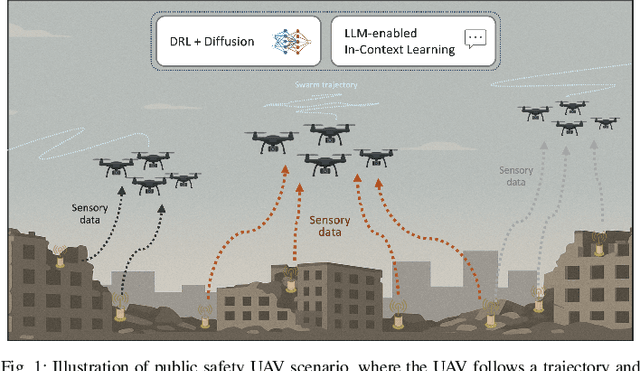
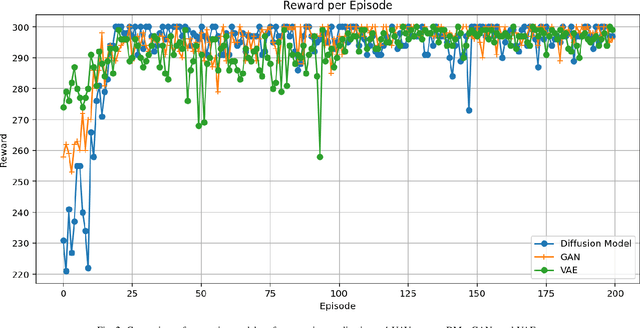
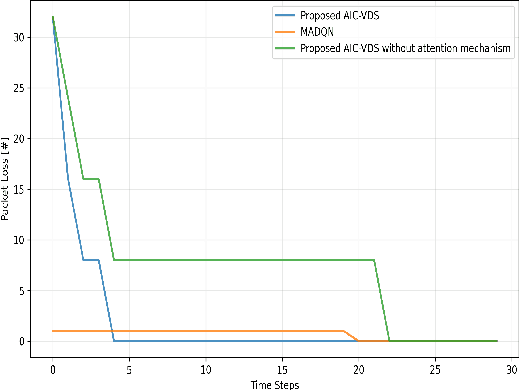
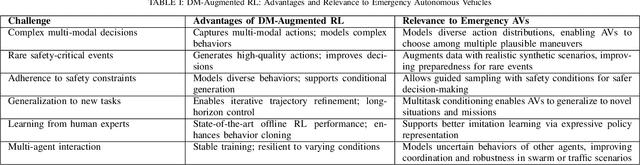
Autonomous Vehicles (AVs) are poised to revolutionize emergency services by enabling faster, safer, and more efficient responses. This transformation is driven by advances in Artificial Intelligence (AI), particularly Reinforcement Learning (RL), which allows AVs to navigate complex environments and make critical decisions in real time. However, conventional RL paradigms often suffer from poor sample efficiency and lack adaptability in dynamic emergency scenarios. This paper reviews next-generation AV optimization strategies to address these limitations. We analyze the shift from conventional RL to Diffusion Model (DM)-augmented RL, which enhances policy robustness through synthetic data generation, albeit with increased computational cost. Additionally, we explore the emerging paradigm of Large Language Model (LLM)-assisted In-Context Learning (ICL), which offers a lightweight and interpretable alternative by enabling rapid, on-the-fly adaptation without retraining. By reviewing the state of the art in AV intelligence, DM-augmented RL, and LLM-assisted ICL, this paper provides a critical framework for understanding the next generation of autonomous emergency response systems from a Generative AI perspective.