 Add to Chrome
 Add to Firefox
 Add to Edge
Rethinking Dataset Distillation: Hard Truths about Soft Labels
Apr 20, 2026
Despite the perceived success of large-scale dataset distillation (DD) methods, recent evidence finds that simple random image baselines perform on-par with state-of-theart DD methods like SRe2L due to the use of soft labels during downstream model training. This is in contrast with the findings in coreset literature, where high-quality coresets consistently outperform random subsets in the hardlabel (HL) setting. To understand this discrepancy, we perform a detailed scalability analysis to examine the role of data quality under different label regimes, ranging from abundant soft labels (termed as SL+KD regime) to fixed soft labels (SL) and hard labels (HL). Our analysis reveals that high-quality coresets fail to convincingly outperform the random baseline in both SL and SL+KD regimes. In the SL+KD setting, performance further approaches nearoptimal levels relative to the full dataset, regardless of subset size or quality, for a given compute budget. This performance saturation calls into question the widespread practice of using soft labels for model evaluation, where unlike the HL setting, subset quality has negligible influence. A subsequent systematic evaluation of five large-scale and four small-scale DD methods in the HL setting reveals that only RDED reliably outperforms random baselines on ImageNet-1K, but can still lag behind strong coreset methods due to its over-reliance on easy sample patches. Based on this, we introduce CAD-Prune, a compute-aware pruning metric that efficiently identifies samples of optimal difficulty for a given compute budget, and use it to develop CA2D, a compute-aligned DD method, outperforming current DD methods on ImageNet-1K at various IPC settings. Together, our findings uncover many insights into current DD research and establish useful tools to advance dataefficient learning for both coresets and DD.

Do Vision Language Models Need to Process Image Tokens?
Apr 10, 2026Vision Language Models (VLMs) have achieved remarkable success by integrating visual encoders with large language models (LLMs). While VLMs process dense image tokens across deep transformer stacks (incurring substantial computational overhead), it remains fundamentally unclear whether sustained image-token processing is necessary for their performance or visual representations meaningfully evolve from early to later layers. In this work, we systematically investigate the functional role of image tokens in VLMs and show that visual representations rapidly converge to a bounded-complexity regime, \ie their entropy stabilizes, intrinsic dimensionality compresses, and trajectory curvature approaches a near-constant profile. In contrast, textual representations continue to undergo substantial restructuring across depth. Once stabilized, visual representations become largely interchangeable between layers, indicating limited additional transformation in deeper stages. Further, depth-wise visual truncation reveals that the necessity of visual processing is task-dependent, where single-token predictions remain comparatively robust to truncated visual depth, but multi-token generation require sustained access to visual representations. Under deterministic decoding, reducing visual depth perturbs intermediate reasoning trajectories more strongly than final outputs, suggesting that image tokens influence the structure of reasoning more than the ultimate conclusions. Collectively, these findings \textbf{question the assumption} that deeper visual processing is uniformly essential in VLMs, challenging the current paradigm of multimodal LLM architectures.
SeeThrough3D: Occlusion Aware 3D Control in Text-to-Image Generation
Feb 26, 2026We identify occlusion reasoning as a fundamental yet overlooked aspect for 3D layout-conditioned generation. It is essential for synthesizing partially occluded objects with depth-consistent geometry and scale. While existing methods can generate realistic scenes that follow input layouts, they often fail to model precise inter-object occlusions. We propose SeeThrough3D, a model for 3D layout conditioned generation that explicitly models occlusions. We introduce an occlusion-aware 3D scene representation (OSCR), where objects are depicted as translucent 3D boxes placed within a virtual environment and rendered from desired camera viewpoint. The transparency encodes hidden object regions, enabling the model to reason about occlusions, while the rendered viewpoint provides explicit camera control during generation. We condition a pretrained flow based text-to-image image generation model by introducing a set of visual tokens derived from our rendered 3D representation. Furthermore, we apply masked self-attention to accurately bind each object bounding box to its corresponding textual description, enabling accurate generation of multiple objects without object attribute mixing. To train the model, we construct a synthetic dataset with diverse multi-object scenes with strong inter-object occlusions. SeeThrough3D generalizes effectively to unseen object categories and enables precise 3D layout control with realistic occlusions and consistent camera control.
GeoDiv: Framework For Measuring Geographical Diversity In Text-To-Image Models
Feb 25, 2026Text-to-image (T2I) models are rapidly gaining popularity, yet their outputs often lack geographical diversity, reinforce stereotypes, and misrepresent regions. Given their broad reach, it is critical to rigorously evaluate how these models portray the world. Existing diversity metrics either rely on curated datasets or focus on surface-level visual similarity, limiting interpretability. We introduce GeoDiv, a framework leveraging large language and vision-language models to assess geographical diversity along two complementary axes: the Socio-Economic Visual Index (SEVI), capturing economic and condition-related cues, and the Visual Diversity Index (VDI), measuring variation in primary entities and backgrounds. Applied to images generated by models such as Stable Diffusion and FLUX.1-dev across $10$ entities and $16$ countries, GeoDiv reveals a consistent lack of diversity and identifies fine-grained attributes where models default to biased portrayals. Strikingly, depictions of countries like India, Nigeria, and Colombia are disproportionately impoverished and worn, reflecting underlying socio-economic biases. These results highlight the need for greater geographical nuance in generative models. GeoDiv provides the first systematic, interpretable framework for measuring such biases, marking a step toward fairer and more inclusive generative systems. Project page: https://abhipsabasu.github.io/geodiv
Where Do Images Come From? Analyzing Captions to Geographically Profile Datasets
Feb 10, 2026Recent studies show that text-to-image models often fail to generate geographically representative images, raising concerns about the representativeness of their training data and motivating the question: which parts of the world do these training examples come from? We geographically profile large-scale multimodal datasets by mapping image-caption pairs to countries based on location information extracted from captions using LLMs. Studying English captions from three widely used datasets (Re-LAION, DataComp1B, and Conceptual Captions) across $20$ common entities (e.g., house, flag), we find that the United States, the United Kingdom, and Canada account for $48.0\%$ of samples, while South American and African countries are severely under-represented with only $1.8\%$ and $3.8\%$ of images, respectively. We observe a strong correlation between a country's GDP and its representation in the data ($ρ= 0.82$). Examining non-English subsets for $4$ languages from the Re-LAION dataset, we find that representation skews heavily toward countries where these languages are predominantly spoken. Additionally, we find that higher representation does not necessarily translate to greater visual or semantic diversity. Finally, analyzing country-specific images generated by Stable Diffusion v1.3 trained on Re-LAION, we show that while generations appear realistic, they are severely limited in their coverage compared to real-world images.
Minimizing Layerwise Activation Norm Improves Generalization in Federated Learning
Dec 09, 2025Federated Learning (FL) is an emerging machine learning framework that enables multiple clients (coordinated by a server) to collaboratively train a global model by aggregating the locally trained models without sharing any client's training data. It has been observed in recent works that learning in a federated manner may lead the aggregated global model to converge to a 'sharp minimum' thereby adversely affecting the generalizability of this FL-trained model. Therefore, in this work, we aim to improve the generalization performance of models trained in a federated setup by introducing a 'flatness' constrained FL optimization problem. This flatness constraint is imposed on the top eigenvalue of the Hessian computed from the training loss. As each client trains a model on its local data, we further re-formulate this complex problem utilizing the client loss functions and propose a new computationally efficient regularization technique, dubbed 'MAN,' which Minimizes Activation's Norm of each layer on client-side models. We also theoretically show that minimizing the activation norm reduces the top eigenvalue of the layer-wise Hessian of the client's loss, which in turn decreases the overall Hessian's top eigenvalue, ensuring convergence to a flat minimum. We apply our proposed flatness-constrained optimization to the existing FL techniques and obtain significant improvements, thereby establishing new state-of-the-art.
Harnessing Diffusion-Generated Synthetic Images for Fair Image Classification
Nov 11, 2025Image classification systems often inherit biases from uneven group representation in training data. For example, in face datasets for hair color classification, blond hair may be disproportionately associated with females, reinforcing stereotypes. A recent approach leverages the Stable Diffusion model to generate balanced training data, but these models often struggle to preserve the original data distribution. In this work, we explore multiple diffusion-finetuning techniques, e.g., LoRA and DreamBooth, to generate images that more accurately represent each training group by learning directly from their samples. Additionally, in order to prevent a single DreamBooth model from being overwhelmed by excessive intra-group variations, we explore a technique of clustering images within each group and train a DreamBooth model per cluster. These models are then used to generate group-balanced data for pretraining, followed by fine-tuning on real data. Experiments on multiple benchmarks demonstrate that the studied finetuning approaches outperform vanilla Stable Diffusion on average and achieve results comparable to SOTA debiasing techniques like Group-DRO, while surpassing them as the dataset bias severity increases.
MonoPlace3D: Learning 3D-Aware Object Placement for 3D Monocular Detection
Apr 10, 2025Current monocular 3D detectors are held back by the limited diversity and scale of real-world datasets. While data augmentation certainly helps, it's particularly difficult to generate realistic scene-aware augmented data for outdoor settings. Most current approaches to synthetic data generation focus on realistic object appearance through improved rendering techniques. However, we show that where and how objects are positioned is just as crucial for training effective 3D monocular detectors. The key obstacle lies in automatically determining realistic object placement parameters - including position, dimensions, and directional alignment when introducing synthetic objects into actual scenes. To address this, we introduce MonoPlace3D, a novel system that considers the 3D scene content to create realistic augmentations. Specifically, given a background scene, MonoPlace3D learns a distribution over plausible 3D bounding boxes. Subsequently, we render realistic objects and place them according to the locations sampled from the learned distribution. Our comprehensive evaluation on two standard datasets KITTI and NuScenes, demonstrates that MonoPlace3D significantly improves the accuracy of multiple existing monocular 3D detectors while being highly data efficient.
Compass Control: Multi Object Orientation Control for Text-to-Image Generation
Apr 10, 2025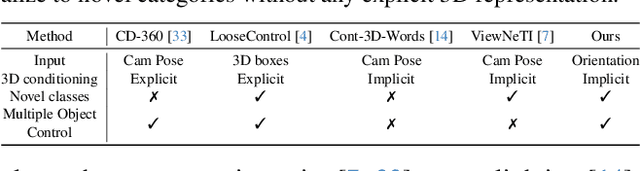
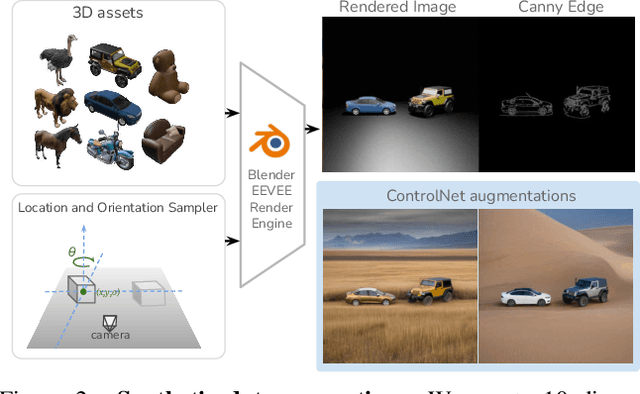
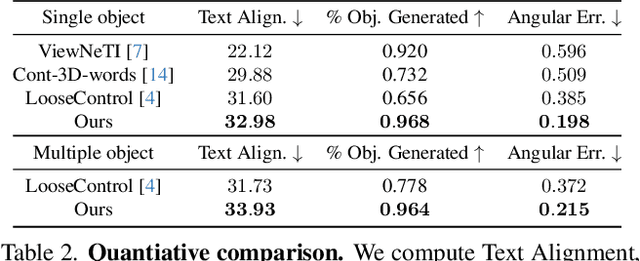
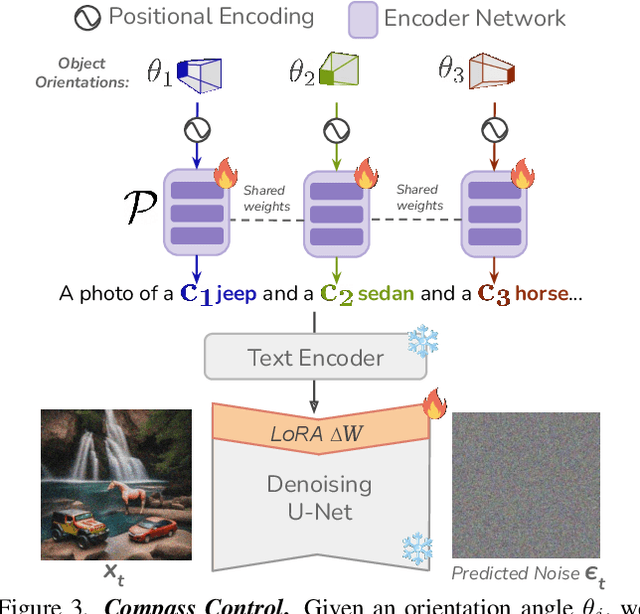
Existing approaches for controlling text-to-image diffusion models, while powerful, do not allow for explicit 3D object-centric control, such as precise control of object orientation. In this work, we address the problem of multi-object orientation control in text-to-image diffusion models. This enables the generation of diverse multi-object scenes with precise orientation control for each object. The key idea is to condition the diffusion model with a set of orientation-aware \textbf{compass} tokens, one for each object, along with text tokens. A light-weight encoder network predicts these compass tokens taking object orientation as the input. The model is trained on a synthetic dataset of procedurally generated scenes, each containing one or two 3D assets on a plain background. However, direct training this framework results in poor orientation control as well as leads to entanglement among objects. To mitigate this, we intervene in the generation process and constrain the cross-attention maps of each compass token to its corresponding object regions. The trained model is able to achieve precise orientation control for a) complex objects not seen during training and b) multi-object scenes with more than two objects, indicating strong generalization capabilities. Further, when combined with personalization methods, our method precisely controls the orientation of the new object in diverse contexts. Our method achieves state-of-the-art orientation control and text alignment, quantified with extensive evaluations and a user study.
PreciseControl: Enhancing Text-To-Image Diffusion Models with Fine-Grained Attribute Control
Jul 24, 2024Recently, we have seen a surge of personalization methods for text-to-image (T2I) diffusion models to learn a concept using a few images. Existing approaches, when used for face personalization, suffer to achieve convincing inversion with identity preservation and rely on semantic text-based editing of the generated face. However, a more fine-grained control is desired for facial attribute editing, which is challenging to achieve solely with text prompts. In contrast, StyleGAN models learn a rich face prior and enable smooth control towards fine-grained attribute editing by latent manipulation. This work uses the disentangled $\mathcal{W+}$ space of StyleGANs to condition the T2I model. This approach allows us to precisely manipulate facial attributes, such as smoothly introducing a smile, while preserving the existing coarse text-based control inherent in T2I models. To enable conditioning of the T2I model on the $\mathcal{W+}$ space, we train a latent mapper to translate latent codes from $\mathcal{W+}$ to the token embedding space of the T2I model. The proposed approach excels in the precise inversion of face images with attribute preservation and facilitates continuous control for fine-grained attribute editing. Furthermore, our approach can be readily extended to generate compositions involving multiple individuals. We perform extensive experiments to validate our method for face personalization and fine-grained attribute editing.