 Add to Chrome
 Add to Firefox
 Add to Edge
Difference-Aware Retrieval Policies for Imitation Learning
Jun 08, 2026
Parametric imitation learning via behavior cloning can suffer from poor generalization to out-of-distribution states due to compounding errors during deployment. We show that reusing the training data during inference via a semi-parametric retrieval-based imitation learning approach can alleviate this challenge. We present Difference-Aware Retrieval Policies for Imitation Learning (DARP), a semi-parametric retrieval-based imitation learning approach that addresses this limitation by reparameterizing the imitation learning problem in terms of local neighborhood structure rather than direct state-to-action mappings. Instead of learning a global policy, DARP trains a model to predict actions based on $k$-nearest neighbors from expert demonstrations, their corresponding actions, and the relative distance vectors between neighbor states and query states. DARP requires no additional assumptions beyond those made for standard behavior cloning -- it does not require additional data collection, online expert feedback, or task-specific knowledge. We demonstrate consistent performance improvements of 15-46% over standard behavior cloning across diverse domains, including continuous control and robotic manipulation, and across different representations, including high-dimensional visual features. Code and demos are available at https://weirdlabuw.github.io/darp-site/.

MolmoB0T: Large-Scale Simulation Enables Zero-Shot Manipulation
Mar 17, 2026A prevailing view in robot learning is that simulation alone is not enough; effective sim-to-real transfer is widely believed to require at least some real-world data collection or task-specific fine-tuning to bridge the gap between simulated and physical environments. We challenge that assumption. With sufficiently large-scale and diverse simulated synthetic training data, we show that zero-shot transfer to the real world is not only possible, but effective for both static and mobile manipulation. We introduce MolmoBot-Engine, a fully open-source pipeline for procedural data generation across robots, tasks, and diverse simulated environments in MolmoSpaces. With it, we release MolmoBot-Data, a dataset of 1.8 million expert trajectories for articulated object manipulation and pick-and-place tasks. We train three policy classes: MolmoBot, a Molmo2-based multi-frame vision-language model with a flow-matching action head; MolmoBot-Pi0, which replicates the $π_0$ architecture to enable direct comparison; and MolmoBot-SPOC, a lightweight policy suitable for edge deployment and amenable to RL fine-tuning. We evaluate on two robotic platforms: the Franka FR3 for tabletop manipulation tasks and the Rainbow Robotics RB-Y1 mobile manipulator for door opening, drawer manipulation, cabinet interaction, and mobile pick-and-place. Without any real-world fine-tuning, our policies achieve zero-shot transfer to unseen objects and environments. On tabletop pick-and-place, MolmoBot achieves a success rate of 79.2% in real world evaluations across 4 settings, outperforming $π_{0.5}$ at 39.2%. Our results demonstrate that procedural environment generation combined with diverse articulated assets can produce robust manipulation policies that generalize broadly to the real world. Technical Blog: https://allenai.org/blog/molmobot-robot-manipulation
Data Efficient Behavior Cloning for Fine Manipulation via Continuity-based Corrective Labels
May 29, 2024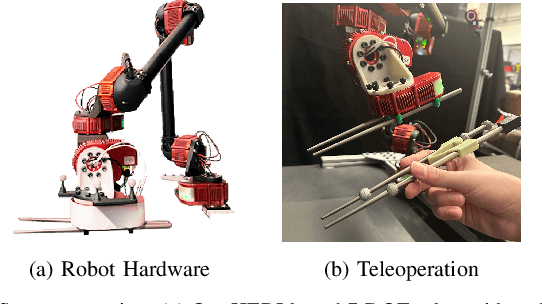

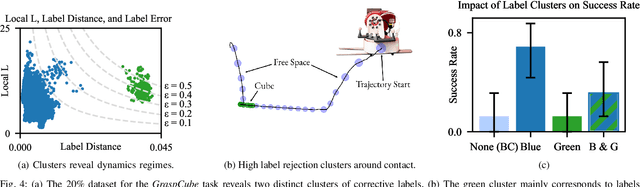
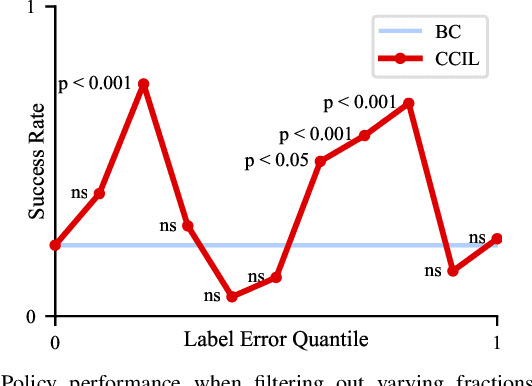
We consider imitation learning with access only to expert demonstrations, whose real-world application is often limited by covariate shift due to compounding errors during execution. We investigate the effectiveness of the Continuity-based Corrective Labels for Imitation Learning (CCIL) framework in mitigating this issue for real-world fine manipulation tasks. CCIL generates corrective labels by learning a locally continuous dynamics model from demonstrations to guide the agent back toward expert states. Through extensive experiments on peg insertion and fine grasping, we provide the first empirical validation that CCIL can significantly improve imitation learning performance despite discontinuities present in contact-rich manipulation. We find that: (1) real-world manipulation exhibits sufficient local smoothness to apply CCIL, (2) generated corrective labels are most beneficial in low-data regimes, and (3) label filtering based on estimated dynamics model error enables performance gains. To effectively apply CCIL to robotic domains, we offer a practical instantiation of the framework and insights into design choices and hyperparameter selection. Our work demonstrates CCIL's practicality for alleviating compounding errors in imitation learning on physical robots.