 Add to Chrome
 Add to Firefox
 Add to Edge
Driving, Fast or Slow? Neuro-Symbolic Guidance for Motion Prediction in Multi-Modal Ground Mobility
Jun 13, 2026
Accurate and interpretable motion prediction for heterogeneous traffic spaces, including pedestrians, bicycles, cars, and trucks, is essential for safe autonomous navigation. Nevertheless, state-of-the-art approaches remain predominantly black-box, lacking explicit encoding of the regulatory and behavioral constraints of real-world mobility. We propose Trajectory Compliance-Shaping (TraCS), a neuro-symbolic framework that augments existing black-box motion prediction backbones with interpretable and probabilistic first-order logic. To do so, TraCS employs an agentic code-generation pipeline to bridge the gap between natural-language descriptions of traffic regulations and probabilistic motion prediction. Furthermore, TraCS employs a reactive data-streaming inference engine that maintains and efficiently updates compliance landscapes as scenes evolve. To prevent TraCS from overconfidently steering the backbone's predictions in the wrong direction, we propose a neural confidence rating learned as a context-aware attenuation of the compliance signal. We demonstrate on the Argoverse 2 benchmark how TraCS consistently improves state-of-the-art prediction backbones, showing that probabilistic and symbolic compliance reasoning is a broadly applicable and computationally efficient complement to purely neural motion predictors.

Right in Time: Reactive Reasoning in Regulated Traffic Spaces
Mar 04, 2026Exact inference in probabilistic First-Order Logic offers a promising yet computationally costly approach for regulating the behavior of autonomous agents in shared traffic spaces. While prior methods have combined logical and probabilistic data into decision-making frameworks, their application is often limited to pre-flight checks due to the complexity of reasoning across vast numbers of possible universes. In this work, we propose a reactive mission design framework that jointly considers uncertain environmental data and declarative, logical traffic regulations. By synthesizing Probabilistic Mission Design (ProMis) with reactive reasoning facilitated by Reactive Circuits (RC), we enable online, exact probabilistic inference over hybrid domains. Our approach leverages the Frequency of Change inherent in heterogeneous data streams to subdivide inference formulas into memoized, isolated tasks, ensuring that only the specific components affected by new sensor data are re-evaluated. In experiments involving both real-world vessel data and simulated drone traffic in dense urban scenarios, we demonstrate that our approach provides orders of magnitude in speedup over ProMis without reactive paradigms. This allows intelligent transportation systems, such as Unmanned Aircraft Systems (UAS), to actively assert safety and legal compliance during operations rather than relying solely on preparation procedures.
No More Maybe-Arrows: Resolving Causal Uncertainty by Breaking Symmetries
Mar 01, 2026The recent works on causal discovery have followed a similar trend of learning partial ancestral graphs (PAGs) since observational data constrain the true causal directed acyclic graph (DAG) only up to a Markov equivalence class. This limits their application in the majority of downstream tasks, as uncertainty in causal relations remains unresolved. We propose a new refinement framework, CausalSAGE, for converting PAGs to DAGs while respecting the underlying causal relations. The framework expands discrete variables into state-level representations, constrains the search space using structural knowledge and soft priors, and applies a unified differentiable objective for joint optimization. The final DAG is obtained by aggregating the optimized structures and enforcing acyclicity when necessary. Our experimental evaluations show that the obtained DAGs preserve the underlying causal relations while also being efficient to obtain.
Reactive Knowledge Representation and Asynchronous Reasoning
Feb 05, 2026Exact inference in complex probabilistic models often incurs prohibitive computational costs. This challenge is particularly acute for autonomous agents in dynamic environments that require frequent, real-time belief updates. Existing methods are often inefficient for ongoing reasoning, as they re-evaluate the entire model upon any change, failing to exploit that real-world information streams have heterogeneous update rates. To address this, we approach the problem from a reactive, asynchronous, probabilistic reasoning perspective. We first introduce Resin (Reactive Signal Inference), a probabilistic programming language that merges probabilistic logic with reactive programming. Furthermore, to provide efficient and exact semantics for Resin, we propose Reactive Circuits (RCs). Formulated as a meta-structure over Algebraic Circuits and asynchronous data streams, RCs are time-dynamic Directed Acyclic Graphs that autonomously adapt themselves based on the volatility of input signals. In high-fidelity drone swarm simulations, our approach achieves several orders of magnitude of speedup over frequency-agnostic inference. We demonstrate that RCs' structural adaptations successfully capture environmental dynamics, significantly reducing latency and facilitating reactive real-time reasoning. By partitioning computations based on the estimated Frequency of Change in the asynchronous inputs, large inference tasks can be decomposed into individually memoized sub-problems. This ensures that only the specific components of a model affected by new information are re-evaluated, drastically reducing redundant computation in streaming contexts.
QuAnTS: Question Answering on Time Series
Nov 07, 2025Text offers intuitive access to information. This can, in particular, complement the density of numerical time series, thereby allowing improved interactions with time series models to enhance accessibility and decision-making. While the creation of question-answering datasets and models has recently seen remarkable growth, most research focuses on question answering (QA) on vision and text, with time series receiving minute attention. To bridge this gap, we propose a challenging novel time series QA (TSQA) dataset, QuAnTS, for Question Answering on Time Series data. Specifically, we pose a wide variety of questions and answers about human motion in the form of tracked skeleton trajectories. We verify that the large-scale QuAnTS dataset is well-formed and comprehensive through extensive experiments. Thoroughly evaluating existing and newly proposed baselines then lays the groundwork for a deeper exploration of TSQA using QuAnTS. Additionally, we provide human performances as a key reference for gauging the practical usability of such models. We hope to encourage future research on interacting with time series models through text, enabling better decision-making and more transparent systems.
Causal Abstractions, Categorically Unified
Oct 06, 2025We present a categorical framework for relating causal models that represent the same system at different levels of abstraction. We define a causal abstraction as natural transformations between appropriate Markov functors, which concisely consolidate desirable properties a causal abstraction should exhibit. Our approach unifies and generalizes previously considered causal abstractions, and we obtain categorical proofs and generalizations of existing results on causal abstractions. Using string diagrammatical tools, we can explicitly describe the graphs that serve as consistent abstractions of a low-level graph under interventions. We discuss how methods from mechanistic interpretability, such as circuit analysis and sparse autoencoders, fit within our categorical framework. We also show how applying do-calculus on a high-level graphical abstraction of an acyclic-directed mixed graph (ADMG), when unobserved confounders are present, gives valid results on the low-level graph, thus generalizing an earlier statement by Anand et al. (2023). We argue that our framework is more suitable for modeling causal abstractions compared to existing categorical frameworks. Finally, we discuss how notions such as $\tau$-consistency and constructive $\tau$-abstractions can be recovered with our framework.
Tagged for Direction: Pinning Down Causal Edge Directions with Precision
Jun 24, 2025Not every causal relation between variables is equal, and this can be leveraged for the task of causal discovery. Recent research shows that pairs of variables with particular type assignments induce a preference on the causal direction of other pairs of variables with the same type. Although useful, this assignment of a specific type to a variable can be tricky in practice. We propose a tag-based causal discovery approach where multiple tags are assigned to each variable in a causal graph. Existing causal discovery approaches are first applied to direct some edges, which are then used to determine edge relations between tags. Then, these edge relations are used to direct the undirected edges. Doing so improves upon purely type-based relations, where the assumption of type consistency lacks robustness and flexibility due to being restricted to single types for each variable. Our experimental evaluations show that this boosts causal discovery and that these high-level tag relations fit common knowledge.
Causal Explanations Over Time: Articulated Reasoning for Interactive Environments
Jun 04, 2025Structural Causal Explanations (SCEs) can be used to automatically generate explanations in natural language to questions about given data that are grounded in a (possibly learned) causal model. Unfortunately they work for small data only. In turn they are not attractive to offer reasons for events, e.g., tracking causal changes over multiple time steps, or a behavioral component that involves feedback loops through actions of an agent. To this end, we generalize SCEs to a (recursive) formulation of explanation trees to capture the temporal interactions between reasons. We show the benefits of this more general SCE algorithm on synthetic time-series data and a 2D grid game, and further compare it to the base SCE and other existing methods for causal explanations.
Scaling Probabilistic Circuits via Data Partitioning
Mar 11, 2025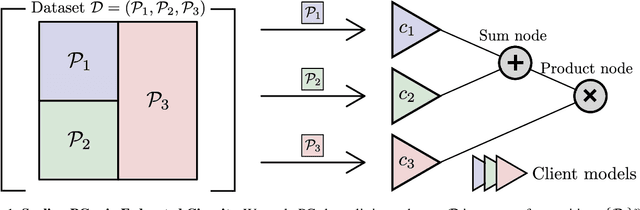

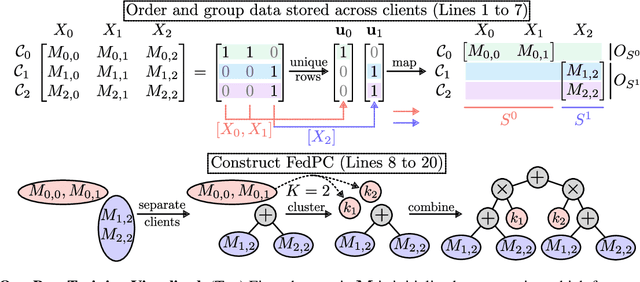
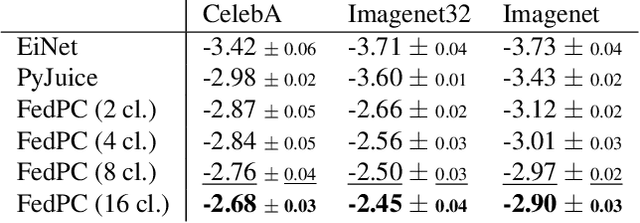
Probabilistic circuits (PCs) enable us to learn joint distributions over a set of random variables and to perform various probabilistic queries in a tractable fashion. Though the tractability property allows PCs to scale beyond non-tractable models such as Bayesian Networks, scaling training and inference of PCs to larger, real-world datasets remains challenging. To remedy the situation, we show how PCs can be learned across multiple machines by recursively partitioning a distributed dataset, thereby unveiling a deep connection between PCs and federated learning (FL). This leads to federated circuits (FCs) -- a novel and flexible federated learning (FL) framework that (1) allows one to scale PCs on distributed learning environments (2) train PCs faster and (3) unifies for the first time horizontal, vertical, and hybrid FL in one framework by re-framing FL as a density estimation problem over distributed datasets. We demonstrate FC's capability to scale PCs on various large-scale datasets. Also, we show FC's versatility in handling horizontal, vertical, and hybrid FL within a unified framework on multiple classification tasks.
Probabilistic Mission Design in Neuro-Symbolic Systems
Dec 25, 2024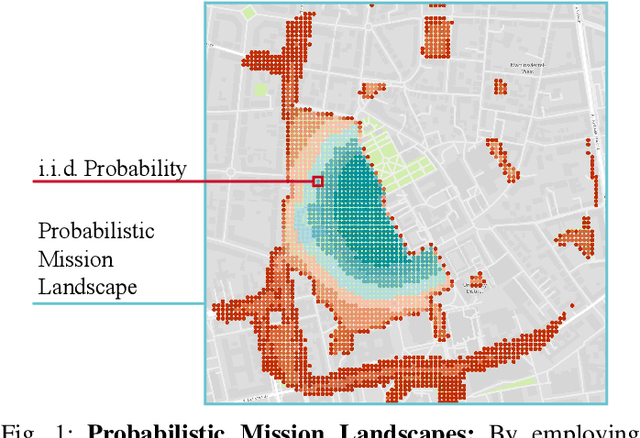
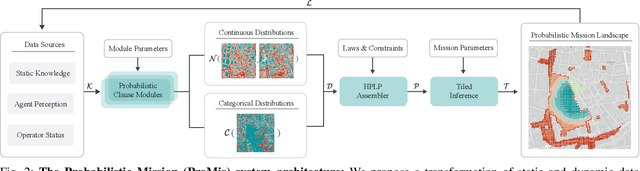
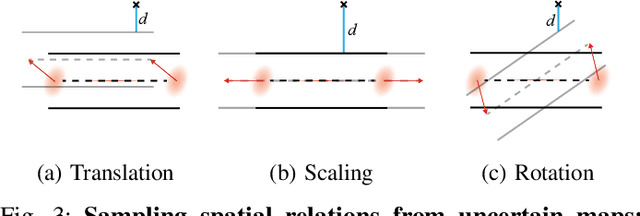
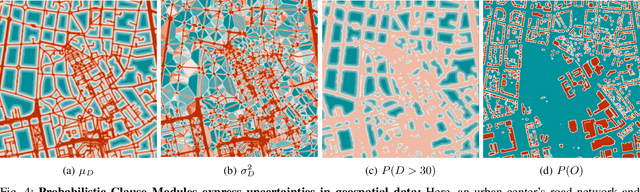
Advanced Air Mobility (AAM) is a growing field that demands accurate modeling of legal concepts and restrictions in navigating intelligent vehicles. In addition, any implementation of AAM needs to face the challenges posed by inherently dynamic and uncertain human-inhabited spaces robustly. Nevertheless, the employment of Unmanned Aircraft Systems (UAS) beyond visual line of sight (BVLOS) is an endearing task that promises to enhance significantly today's logistics and emergency response capabilities. To tackle these challenges, we present a probabilistic and neuro-symbolic architecture to encode legal frameworks and expert knowledge over uncertain spatial relations and noisy perception in an interpretable and adaptable fashion. More specifically, we demonstrate Probabilistic Mission Design (ProMis), a system architecture that links geospatial and sensory data with declarative, Hybrid Probabilistic Logic Programs (HPLP) to reason over the agent's state space and its legality. As a result, ProMis generates Probabilistic Mission Landscapes (PML), which quantify the agent's belief that a set of mission conditions is satisfied across its navigation space. Extending prior work on ProMis' reasoning capabilities and computational characteristics, we show its integration with potent machine learning models such as Large Language Models (LLM) and Transformer-based vision models. Hence, our experiments underpin the application of ProMis with multi-modal input data and how our method applies to many important AAM scenarios.