 Add to Chrome
 Add to Firefox
 Add to Edge
Latent Action Reparameterization for Efficient Agent Inference
May 19, 2026
Large language model (LLM) agents often rely on long sequences of low-level textual actions, resulting in large effective decision horizons and high inference cost. While prior work has focused on improving inference efficiency through system-level optimizations or prompt engineering, we argue that a key bottleneck lies in the representation of the action space itself. We propose Latent Action Reparameterization (LAR), a framework that learns a compact latent action space in which each latent action corresponds to a multi-step semantic behavior. By reparameterizing agent actions into latent units, LAR enables decision making over a shorter effective horizon while preserving the expressiveness of the original action space. Unlike hand-crafted macros or hierarchical controllers, latent actions are learned from agent trajectories and integrated directly into the model, allowing both planning and execution to operate over abstract action representations. Across a range of LLM-based agent benchmarks, LAR significantly reduces the effective action horizon and improves inference efficiency under fixed compute budgets. As a consequence, our approach achieves substantial reductions in action tokens and corresponding wall-clock inference time, while maintaining or improving task success rates. These results suggest that action representation learning is a critical and underexplored factor in scaling efficient LLM agent inference, complementary to advances in model architecture and hardware.

An FPGA Implementation of Displacement Vector Search for Intra Pattern Copy in JPEG XS
Mar 11, 2026Recently, progress has been made on the Intra Pattern Copy (IPC) tool for JPEG XS, an image compression standard designed for low-latency and low-complexity coding. IPC performs wavelet-domain intra compensation predictions to reduce spatial redundancy in screen content. A key module of IPC is the displacement vector (DV) search, which aims to solve the optimal prediction reference offset. However, the DV search process is computationally intensive, posing challenges for practical hardware deployment. In this paper, we propose an efficient pipelined FPGA architecture design for the DV search module to promote the practical deployment of IPC. Optimized memory organization, which leverages the IPC computational characteristics and data inherent reuse patterns, is further introduced to enhance the performance. Experimental results show that our proposed architecture achieves a throughput of 38.3 Mpixels/s with a power consumption of 277 mW, demonstrating its feasibility for practical hardware implementation in IPC and other predictive coding tools, and providing a promising foundation for ASIC deployment.
HyperSAT: Unsupervised Hypergraph Neural Networks for Weighted MaxSAT Problems
Apr 16, 2025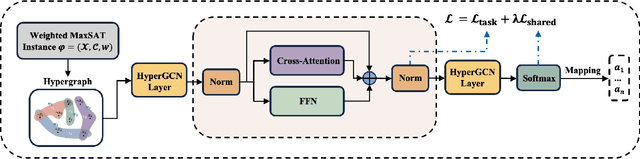
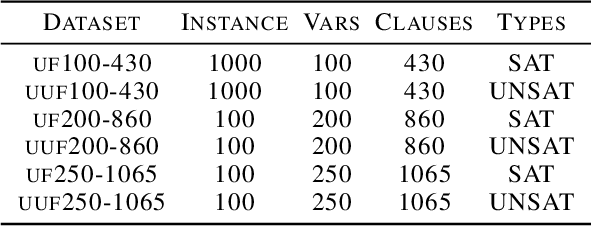
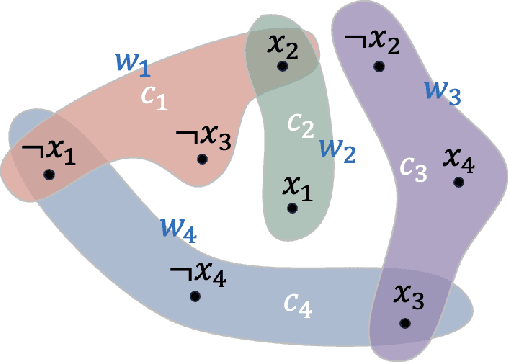
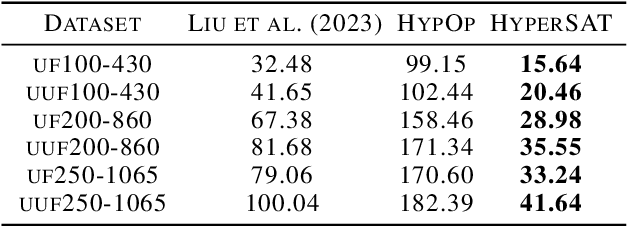
Graph neural networks (GNNs) have shown promising performance in solving both Boolean satisfiability (SAT) and Maximum Satisfiability (MaxSAT) problems due to their ability to efficiently model and capture the structural dependencies between literals and clauses. However, GNN methods for solving Weighted MaxSAT problems remain underdeveloped. The challenges arise from the non-linear dependency and sensitive objective function, which are caused by the non-uniform distribution of weights across clauses. In this paper, we present HyperSAT, a novel neural approach that employs an unsupervised hypergraph neural network model to solve Weighted MaxSAT problems. We propose a hypergraph representation for Weighted MaxSAT instances and design a cross-attention mechanism along with a shared representation constraint loss function to capture the logical interactions between positive and negative literal nodes in the hypergraph. Extensive experiments on various Weighted MaxSAT datasets demonstrate that HyperSAT achieves better performance than state-of-the-art competitors.