 Add to Chrome
 Add to Firefox
 Add to Edge
World-Value-Action Model: Implicit Planning for Vision-Language-Action Systems
Apr 16, 2026
Vision-Language-Action (VLA) models have emerged as a promising paradigm for building embodied agents that ground perception and language into action. However, most existing approaches rely on direct action prediction, lacking the ability to reason over long-horizon trajectories and evaluate their consequences, which limits performance in complex decision-making tasks. In this work, we introduce World-Value-Action (WAV) model, a unified framework that enables implicit planning in VLA systems. Rather than performing explicit trajectory optimization, WAV model learn a structured latent representation of future trajectories conditioned on visual observations and language instructions. A learned world model predicts future states, while a trajectory value function evaluates their long-horizon utility. Action generation is then formulated as inference in this latent space, where the model progressively concentrates probability mass on high-value and dynamically feasible trajectories. We provide a theoretical perspective showing that planning directly in action space suffers from an exponential decay in the probability of feasible trajectories as the horizon increases. In contrast, latent-space inference reshapes the search distribution toward feasible regions, enabling efficient long-horizon decision making. Extensive simulations and real-world experiments demonstrate that the WAV model consistently outperforms state-of-the-art methods, achieving significant improvements in task success rate, generalization ability, and robustness, especially in long-horizon and compositional scenarios.

CRL-VLA: Continual Vision-Language-Action Learning
Feb 03, 2026Lifelong learning is critical for embodied agents in open-world environments, where reinforcement learning fine-tuning has emerged as an important paradigm to enable Vision-Language-Action (VLA) models to master dexterous manipulation through environmental interaction. Thus, Continual Reinforcement Learning (CRL) is a promising pathway for deploying VLA models in lifelong robotic scenarios, yet balancing stability (retaining old skills) and plasticity (learning new ones) remains a formidable challenge for existing methods. We introduce CRL-VLA, a framework for continual post-training of VLA models with rigorous theoretical bounds. We derive a unified performance bound linking the stability-plasticity trade-off to goal-conditioned advantage magnitude, scaled by policy divergence. CRL-VLA resolves this dilemma via asymmetric regulation: constraining advantage magnitudes on prior tasks while enabling controlled growth on new tasks. This is realized through a simple but effective dual-critic architecture with novel Goal-Conditioned Value Formulation (GCVF), where a frozen critic anchors semantic consistency and a trainable estimator drives adaptation. Experiments on the LIBERO benchmark demonstrate that CRL-VLA effectively harmonizes these conflicting objectives, outperforming baselines in both anti-forgetting and forward adaptation.
CMR: Contractive Mapping Embeddings for Robust Humanoid Locomotion on Unstructured Terrains
Feb 03, 2026Robust disturbance rejection remains a longstanding challenge in humanoid locomotion, particularly on unstructured terrains where sensing is unreliable and model mismatch is pronounced. While perception information, such as height map, enhances terrain awareness, sensor noise and sim-to-real gaps can destabilize policies in practice. In this work, we provide theoretical analysis that bounds the return gap under observation noise, when the induced latent dynamics are contractive. Furthermore, we present Contractive Mapping for Robustness (CMR) framework that maps high-dimensional, disturbance-prone observations into a latent space, where local perturbations are attenuated over time. Specifically, this approach couples contrastive representation learning with Lipschitz regularization to preserve task-relevant geometry while explicitly controlling sensitivity. Notably, the formulation can be incorporated into modern deep reinforcement learning pipelines as an auxiliary loss term with minimal additional technical effort required. Further, our extensive humanoid experiments show that CMR potently outperforms other locomotion algorithms under increased noise.
Balancing Signal and Variance: Adaptive Offline RL Post-Training for VLA Flow Models
Sep 04, 2025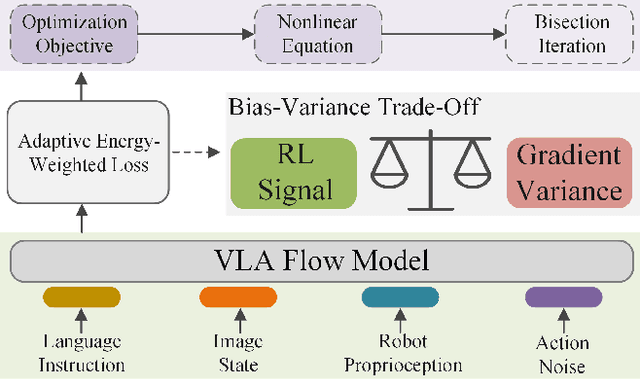
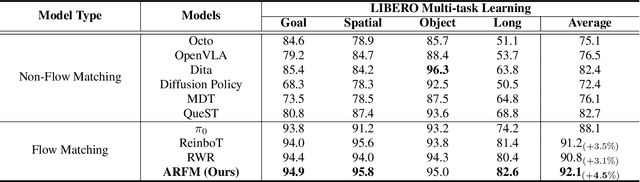
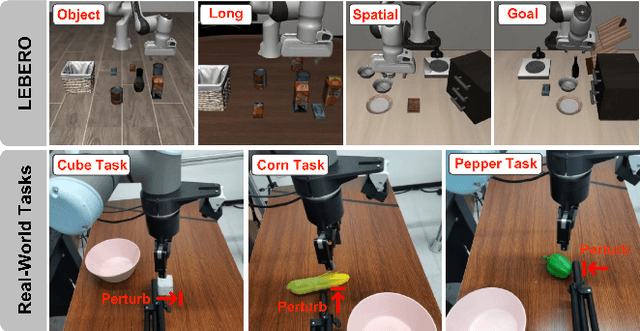
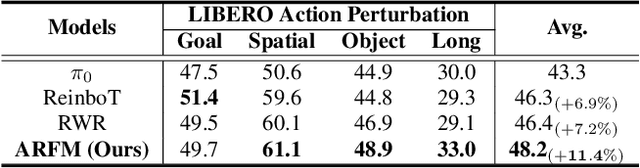
Vision-Language-Action (VLA) models based on flow matching have shown excellent performance in general-purpose robotic manipulation tasks. However, the action accuracy of these models on complex downstream tasks is unsatisfactory. One important reason is that these models rely solely on the post-training paradigm of imitation learning, which makes it difficult to have a deeper understanding of the distribution properties of data quality, which is exactly what Reinforcement Learning (RL) excels at. In this paper, we theoretically propose an offline RL post-training objective for VLA flow models and induce an efficient and feasible offline RL fine-tuning algorithm -- Adaptive Reinforced Flow Matching (ARFM). By introducing an adaptively adjusted scaling factor in the VLA flow model loss, we construct a principled bias-variance trade-off objective function to optimally control the impact of RL signal on flow loss. ARFM adaptively balances RL advantage preservation and flow loss gradient variance control, resulting in a more stable and efficient fine-tuning process. Extensive simulation and real-world experimental results show that ARFM exhibits excellent generalization, robustness, few-shot learning, and continuous learning performance.