 Add to Chrome
 Add to Firefox
 Add to Edge
CP-factorization for high dimensional tensor time series and double projection iterations
Jun 07, 2026
We adopt the canonical polyadic (CP) decomposition to model high-dimensional tensor time series. Our primary goal is to identify and estimate the factor loadings in the CP decomposition. We propose a one-pass estimation procedure through standard eigen-analysis for a matrix constructed based on the serial dependence structure of the data. The asymptotic properties of the proposed estimator are established under a general setting as long as the factor loading vectors are linearly independent, allowing the factors to be correlated and the factor loading vectors to be not nearly orthogonal. The procedure adapts to the sparsity of the factor loading vectors, accommodates weak factors, and demonstrates strong performance across a wide range of scenarios. To further reduce estimation errors, we also introduce an iterative algorithm based on a novel double projection approach. We theoretically justify the improved convergence rate of the iterative estimator, and derive the associated limiting distribution. A consistent estimator of the asymptotic variance is also provided, which plays a key role in the related inference problems. All results are validated through extensive simulations and two real data applications.

Hedging Memory Horizons for Non-Stationary Prediction via Online Aggregation
May 07, 2026We study online prediction under distribution shift, where inputs arrive chronologically and outcomes are revealed only after prediction. In this setting, predictors must remain stable in quiet regimes yet adapt when regimes shift, and the right adaptation memory is unknown in advance. We propose MELO (Memory-hedged Exponentially Weighted Least-Squares Online aggregation), a model-agnostic method that hedges across adaptation scales: it wraps any non-anticipating base-predictor pool with exponentially weighted least-squares (EWLS) adaptation experts at multiple forgetting factors, and aggregates raw and EWLS-adapted forecasts with MLpol, a parameter-free online aggregation rule. Under boundedness conditions, we establish deterministic oracle inequalities showing that it competes with both the best raw predictor and the best bounded, time-varying affine combinations of the base predictions, up to a path-length-dependent tracking cost and a sublinear aggregation overhead. We evaluate MELO on French national electricity-load forecasting through the COVID-19 lockdown using no regime indicators, lockdown dates, or policy covariates. MELO reduces overall RMSE by 34.7\% relative to base-only MLpol and achieves lower overall RMSE than a TabICL reference supplied with an external COVID policy-response covariate. Moreover, MELO requires only lightweight per-step recursive updates without model retraining.
Identification and estimation for matrix time series CP-factor models
Oct 08, 2024We investigate the identification and the estimation for matrix time series CP-factor models. Unlike the generalized eigenanalysis-based method of Chang et al. (2023) which requires the two factor loading matrices to be full-ranked, the newly proposed estimation can handle rank-deficient factor loading matrices. The estimation procedure consists of the spectral decomposition of several matrices and a matrix joint diagonalization algorithm, resulting in low computational cost. The theoretical guarantee established without the stationarity assumption shows that the proposed estimation exhibits a faster convergence rate than that of Chang et al. (2023). In fact the new estimator is free from the adverse impact of any eigen-gaps, unlike most eigenanalysis-based methods such as that of Chang et al. (2023). Furthermore, in terms of the error rates of the estimation, the proposed procedure is equivalent to handling a vector time series of dimension $\max(p,q)$ instead of $p \times q$, where $(p, q)$ are the dimensions of the matrix time series concerned. We have achieved this without assuming the "near orthogonality" of the loadings under various incoherence conditions often imposed in the CP-decomposition literature, see Han and Zhang (2022), Han et al. (2024) and the references within. Illustration with both simulated and real matrix time series data shows the usefulness of the proposed approach.
Testing for the Markov Property in Time Series via Deep Conditional Generative Learning
May 30, 2023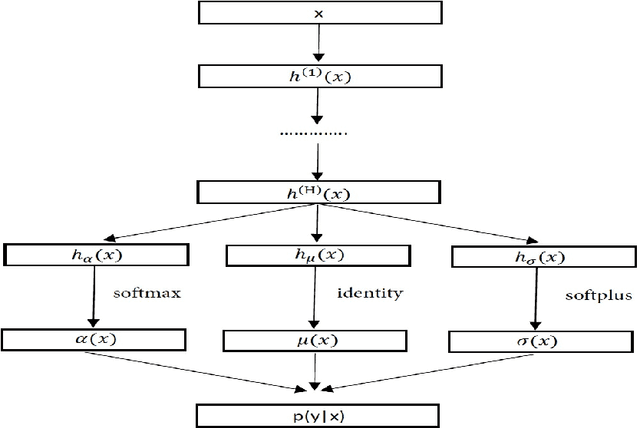
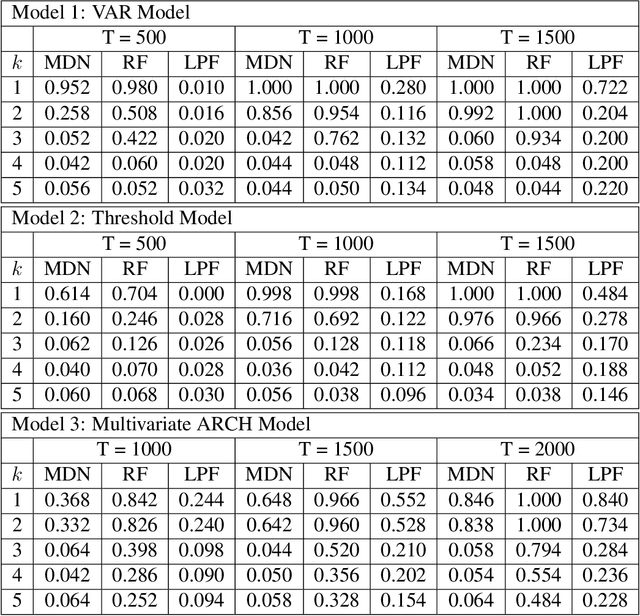
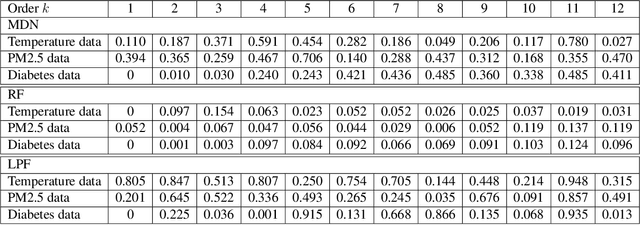
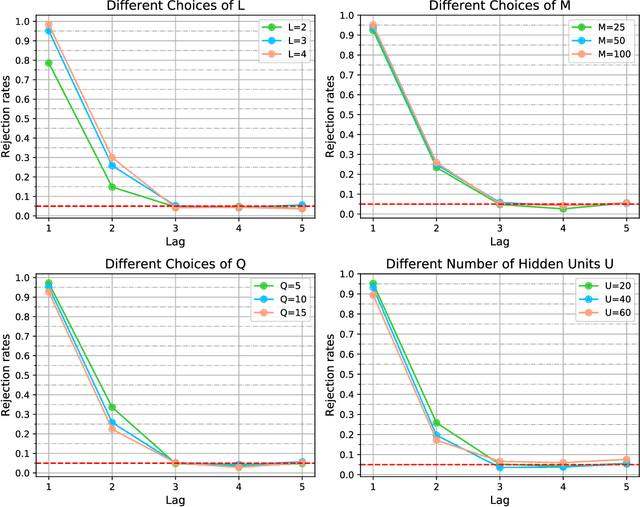
The Markov property is widely imposed in analysis of time series data. Correspondingly, testing the Markov property, and relatedly, inferring the order of a Markov model, are of paramount importance. In this article, we propose a nonparametric test for the Markov property in high-dimensional time series via deep conditional generative learning. We also apply the test sequentially to determine the order of the Markov model. We show that the test controls the type-I error asymptotically, and has the power approaching one. Our proposal makes novel contributions in several ways. We utilize and extend state-of-the-art deep generative learning to estimate the conditional density functions, and establish a sharp upper bound on the approximation error of the estimators. We derive a doubly robust test statistic, which employs a nonparametric estimation but achieves a parametric convergence rate. We further adopt sample splitting and cross-fitting to minimize the conditions required to ensure the consistency of the test. We demonstrate the efficacy of the test through both simulations and the three data applications.
Modelling matrix time series via a tensor CP-decomposition
Dec 31, 2021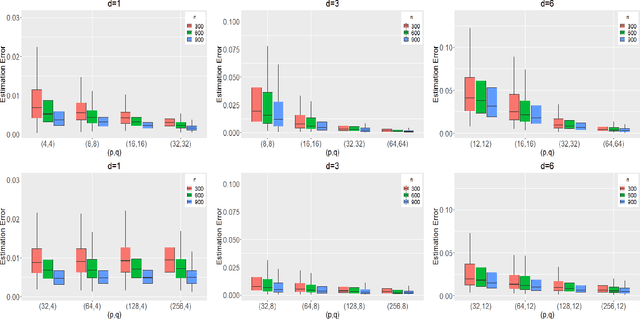
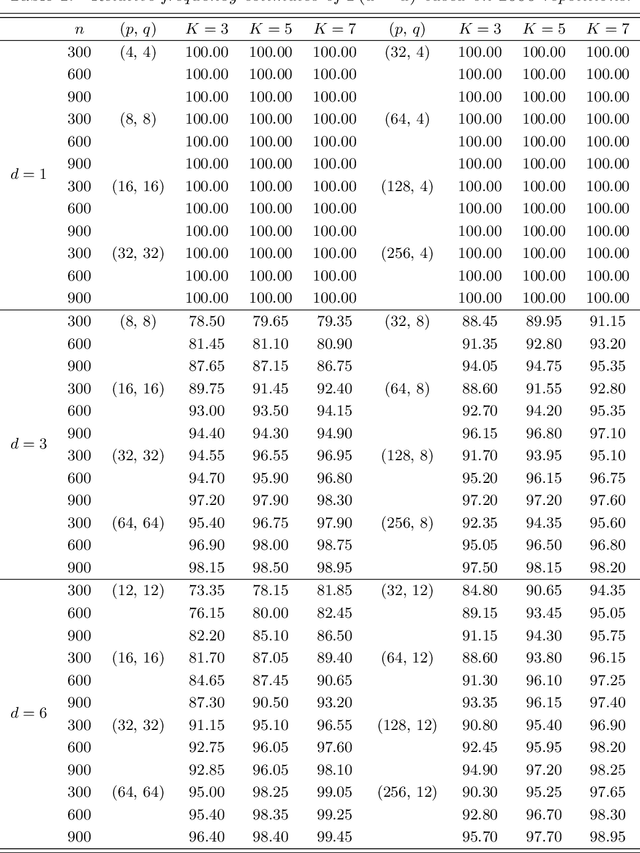
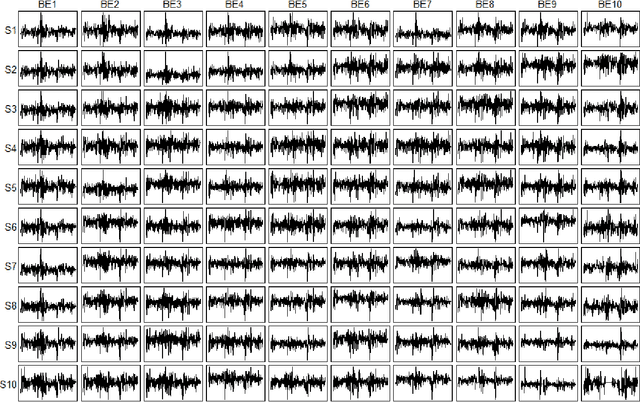
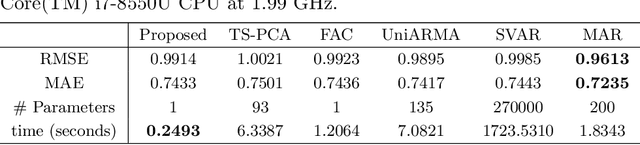
We propose to model matrix time series based on a tensor CP-decomposition. Instead of using an iterative algorithm which is the standard practice for estimating CP-decompositions, we propose a new and one-pass estimation procedure based on a generalized eigenanalysis constructed from the serial dependence structure of the underlying process. A key idea of the new procedure is to project a generalized eigenequation defined in terms of rank-reduced matrices to a lower-dimensional one with full-ranked matrices, to avoid the intricacy of the former of which the number of eigenvalues can be zero, finite and infinity. The asymptotic theory has been established under a general setting without the stationarity. It shows, for example, that all the component coefficient vectors in the CP-decomposition are estimated consistently with the different error rates, depending on the relative sizes between the dimensions of time series and the sample size. The proposed model and the estimation method are further illustrated with both simulated and real data; showing effective dimension-reduction in modelling and forecasting matrix time series.