 Add to Chrome
 Add to Firefox
 Add to Edge
CARL: Constraint-Aware Reinforcement Learning for Planning with LLMs
Jul 06, 2026
Despite their strong reasoning capabilities and extensive world knowledge, Large Language Models (LLMs) frequently generate plans that violate task constraints, undermining their reliability in real-world applications. This deficiency arises from a lack of systematic mechanisms to incorporate constraint information during the generation process. While existing approaches attempt to mitigate this by relying on external tools or task decomposition, they fail to enhance the model's intrinsic constraint awareness. To address this, we propose Constraint-Aware Reinforcement Learning (CARL), a novel RL framework designed to strengthen LLMs' intrinsic focus on constraints. CARL introduces a constraint-aware reward by comparing the model's output distributions under constrained and unconstrained inputs, encouraging constraint focus and penalizing neglect. Compatible with various RL frameworks and requiring no external solvers or top models, CARL enables scalable, end-to-end constraint-aware planning. Extensive experiments on BlocksWorld, TravelPlanner, and T-Eval demonstrate that CARL significantly outperforms standard Reinforcement Fine-Tuning (RFT) baselines and state-of-the-art reasoning models, exhibiting a markedly increased focus on constraints.

STAPO: Selective Trajectory-Aware Policy Optimization for LLM Agent Training
Jul 06, 2026Reinforcement Learning (RL) is the dominant paradigm for training Large Language Model (LLM) agents on long-horizon tasks. However, sparse and delayed rewards often lead to trajectory neglect, in which agents lose focus on the task goal and interaction history at intermediate steps. Prior work has explored step-level supervision using Shannon-entropy-based uncertainty signals, which conflate inherent state complexity with agent confidence and therefore provide unreliable estimates of decision reliability. To address this issue, we propose normalized entropy, which measures confidence deviations relative to an agent's average behavior under a given state, thereby strengthening the association between low-quality actions and trajectory neglect. Building on this insight, we introduce Selective Trajectory-Aware Policy Optimization (STAPO), a hierarchical group-based RL framework. STAPO leverages normalized entropy to locate outlier steps associated with trajectory neglect and optimizes them via a joint mechanism of trajectory-aware reward and trajectory-independent penalty, enhancing trajectory awareness while preserving training stability. Extensive experiments on ALFWorld, WebShop, and Search-Augmented QA demonstrate that STAPO achieves state-of-the-art performance while substantially alleviating trajectory neglect, validating its effectiveness and robustness for agentic tasks.
Style-Aligned Image Composition for Robust Detection of Abnormal Cells in Cytopathology
Jun 26, 2025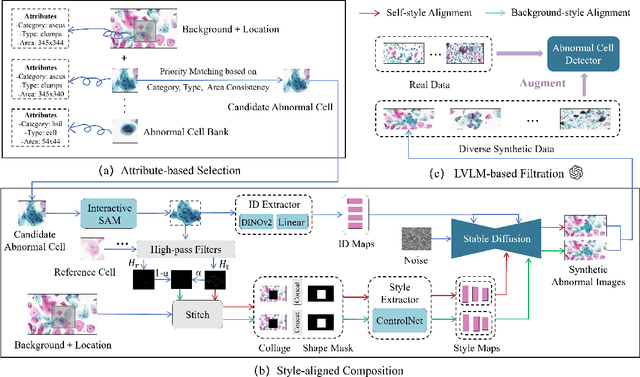
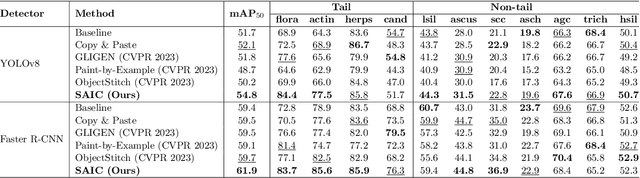
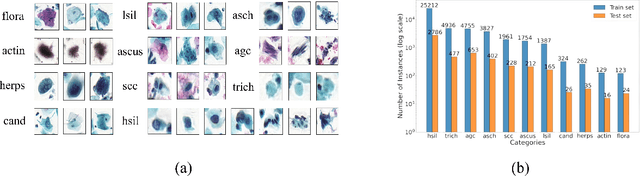

Challenges such as the lack of high-quality annotations, long-tailed data distributions, and inconsistent staining styles pose significant obstacles to training neural networks to detect abnormal cells in cytopathology robustly. This paper proposes a style-aligned image composition (SAIC) method that composes high-fidelity and style-preserved pathological images to enhance the effectiveness and robustness of detection models. Without additional training, SAIC first selects an appropriate candidate from the abnormal cell bank based on attribute guidance. Then, it employs a high-frequency feature reconstruction to achieve a style-aligned and high-fidelity composition of abnormal cells and pathological backgrounds. Finally, it introduces a large vision-language model to filter high-quality synthesis images. Experimental results demonstrate that incorporating SAIC-synthesized images effectively enhances the performance and robustness of abnormal cell detection for tail categories and styles, thereby improving overall detection performance. The comprehensive quality evaluation further confirms the generalizability and practicality of SAIC in clinical application scenarios. Our code will be released at https://github.com/Joey-Qi/SAIC.