 Add to Chrome
 Add to Firefox
 Add to Edge
Confidence Calibration for Multimodal LLMs: An Empirical Study through Medical VQA
Jun 18, 2026
Multimodal Large Language Models (MLLMs) show great potential in medical tasks, but their elicited confidence often misaligns with actual accuracy, potentially leading to misdiagnosis or overlooking correct advice. This study presents the first comprehensive analysis of the relationship between accuracy and confidence in medical MLLMs. It proposes a novel method that combines Multi-Strategy Fusion-Based Interrogation (MS-FBI) with auxiliary expert LLM assessment, aiming to improve confidence calibration in Medical Visual Question Answering (VQA). Experiments demonstrate that our method reduces the Expected Calibration Error (ECE) by an average of 40\% across three Medical VQA datasets, significantly enhancing MLLMs' reliability. The findings highlight the importance of domain-specific calibration for MLLMs in healthcare, offering a more trustworthy solution for AI-assisted diagnosis.

Style-Aligned Image Composition for Robust Detection of Abnormal Cells in Cytopathology
Jun 26, 2025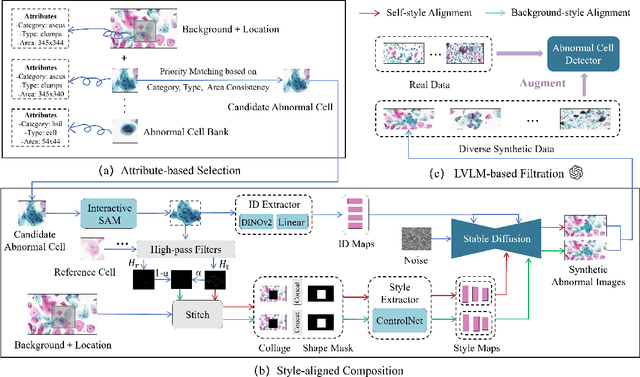
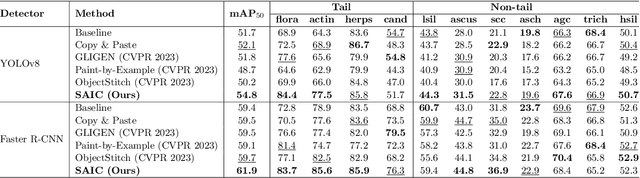
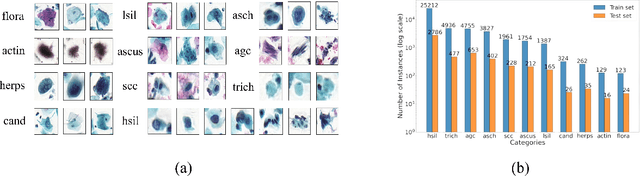

Challenges such as the lack of high-quality annotations, long-tailed data distributions, and inconsistent staining styles pose significant obstacles to training neural networks to detect abnormal cells in cytopathology robustly. This paper proposes a style-aligned image composition (SAIC) method that composes high-fidelity and style-preserved pathological images to enhance the effectiveness and robustness of detection models. Without additional training, SAIC first selects an appropriate candidate from the abnormal cell bank based on attribute guidance. Then, it employs a high-frequency feature reconstruction to achieve a style-aligned and high-fidelity composition of abnormal cells and pathological backgrounds. Finally, it introduces a large vision-language model to filter high-quality synthesis images. Experimental results demonstrate that incorporating SAIC-synthesized images effectively enhances the performance and robustness of abnormal cell detection for tail categories and styles, thereby improving overall detection performance. The comprehensive quality evaluation further confirms the generalizability and practicality of SAIC in clinical application scenarios. Our code will be released at https://github.com/Joey-Qi/SAIC.