 Add to Chrome
 Add to Firefox
 Add to Edge
Towards Accurate and Fast Clinical Body Composition: A Resource-Efficient Hierarchical Segmentation Framework for Multi-Source CT
Jul 08, 2026
Background: Automated 3D segmentation of muscles and adipose tissue from CT is vital for body composition analysis, but multi-source data heterogeneity and high CPU memory demands hinder clinical deployment. Methods: We propose a coarse-to-fine hierarchical framework to segment ten tissue structures. Efficiency is optimized using Dynamic Spacing and Anisotropic Patching, a Group Inference mechanism for low-memory sliding-window processing, and Topology-Aware Asymmetric Resampling for fast post-processing. Results: The framework was trained on 1,558 CT volumes from seven public and two private datasets, and evaluated on an independent test cohort (N=105), per-structure Dice coefficients ranged from 0.924 to 0.982. Eight major structures met the +-10% relative error clinical acceptance limit. On a 12-core CPU workstation, the GPU-free pipeline averaged 44.5 seconds per volume with 4.73 GB peak memory. Conclusion: This framework balances accuracy and efficiency, enabling robust, large-scale body composition analysis on standard CPU workstations.

Deep Learning-Based Airway Segmentation in Systemic Lupus Erythematosus Patients with Interstitial Lung Disease (SLE-ILD): A Comparative High-Resolution CT Analysis
Mar 18, 2026To characterize lobar and segmental airway volume differences between systemic lupus erythematosus (SLE) patients with interstitial lung disease (ILD) and those without ILD (non-ILD) using a deep learning-based approach on non-contrast chest high-resolution CT (HRCT). Methods: A retrospective analysis was conducted on 106 SLE patients (27 SLE-ILD, 79 SLE-non-ILD) who underwent HRCT. A customized deep learning framework based on the U-Net architecture was developed to automatically segment airway structures at the lobar and segmental levels via HRCT. Volumetric measurements of lung lobes and segments derived from the segmentations were statistically compared between the two groups using two-sample t-tests (significance threshold: p < 0.05). Results: At lobar level, significant airway volume enlargement in SLE-ILD patients was observed in the right upper lobe (p=0.009) and left upper lobe (p=0.039) compared to SLE-non-ILD. At the segmental level, significant differences were found in segments including R1 (p=0.016), R3 (p<0.001), and L3 (p=0.038), with the most marked changes in the upper lung zones, while lower zones showed non-significant trends. Conclusion: Our study demonstrates that an automated deep learning-based approach can effectively quantify airway volumes on HRCT scans and reveal significant, region-specific airway dilation in patients with SLE-ILD compared to those without ILD. The pattern of involvement, predominantly affecting the upper lobes and specific segments, highlights a distinct topographic phenotype of SLE-ILD and implicates airway structural alterations as a potential biomarker for disease presence. This AI-powered quantitative imaging biomarker holds promise for enhancing the early detection and monitoring of ILD in the SLE population, ultimately contributing to more personalized patient management.
Bronchovascular Tree-Guided Weakly Supervised Learning Method for Pulmonary Segment Segmentation
May 20, 2025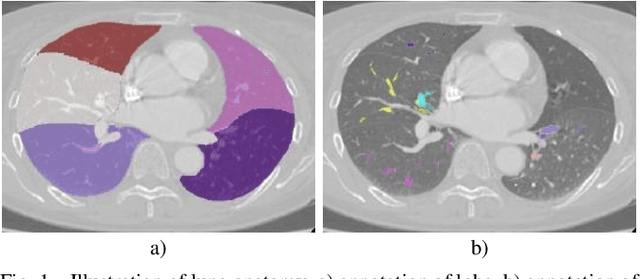
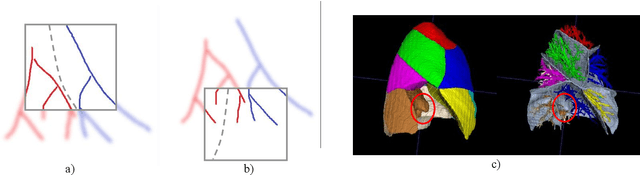
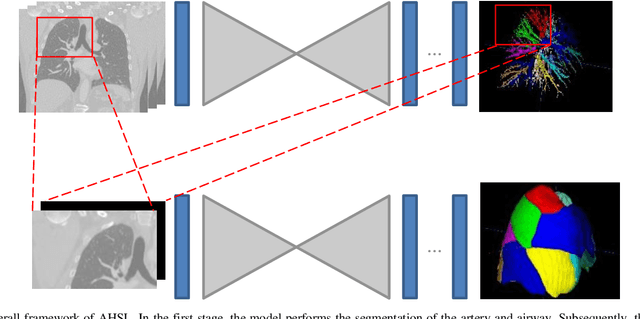
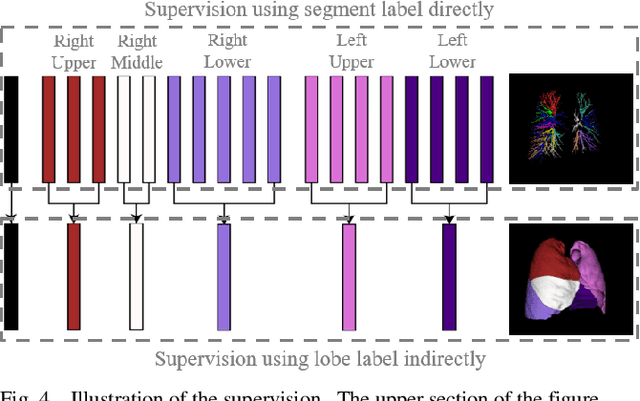
Pulmonary segment segmentation is crucial for cancer localization and surgical planning. However, the pixel-wise annotation of pulmonary segments is laborious, as the boundaries between segments are indistinguishable in medical images. To this end, we propose a weakly supervised learning (WSL) method, termed Anatomy-Hierarchy Supervised Learning (AHSL), which consults the precise clinical anatomical definition of pulmonary segments to perform pulmonary segment segmentation. Since pulmonary segments reside within the lobes and are determined by the bronchovascular tree, i.e., artery, airway and vein, the design of the loss function is founded on two principles. First, segment-level labels are utilized to directly supervise the output of the pulmonary segments, ensuring that they accurately encompass the appropriate bronchovascular tree. Second, lobe-level supervision indirectly oversees the pulmonary segment, ensuring their inclusion within the corresponding lobe. Besides, we introduce a two-stage segmentation strategy that incorporates bronchovascular priori information. Furthermore, a consistency loss is proposed to enhance the smoothness of segment boundaries, along with an evaluation metric designed to measure the smoothness of pulmonary segment boundaries. Visual inspection and evaluation metrics from experiments conducted on a private dataset demonstrate the effectiveness of our method.