 Add to Chrome
 Add to Firefox
 Add to Edge
Building artificial intelligence virtual tissue (AIVT) for tissue state representation, feature prediction, and dynamic simulation
Jun 29, 2026
Modeling tissue states and their transitions is essential for understanding tissue homeostasis in health and pathological remodeling in disease. However, conventional computational modeling approaches are inadequate to capture the complexity of tissues as spatially organized, multiscale biological systems. Artificial intelligence (AI) has shown a remarkable ability for representing intricate systems, creating new opportunities to characterize tissue states and their transitions. Here, we propose the concept of AI virtual tissue (AIVT), an AI framework grounded in spatial multimodal data for modeling tissues in health and disease. AIVT is designed to learn unified, spatially resolved, and dynamically manipulatable representations of tissue state, enabling tissue state representation and analysis, molecular and morphological feature prediction, and simulation of spatiotemporal tissue dynamics. We outline the fundamental assumptions, core capabilities, architectural components, as well as data and algorithm foundations of AIVT as a framework for AI-driven tissue modeling.

Reliable Deep Diffusion Tensor Estimation: Rethinking the Power of Data-Driven Optimization Routine
Sep 04, 2024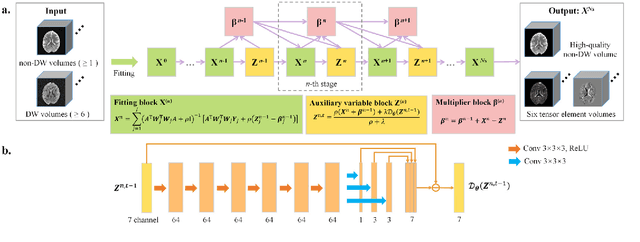
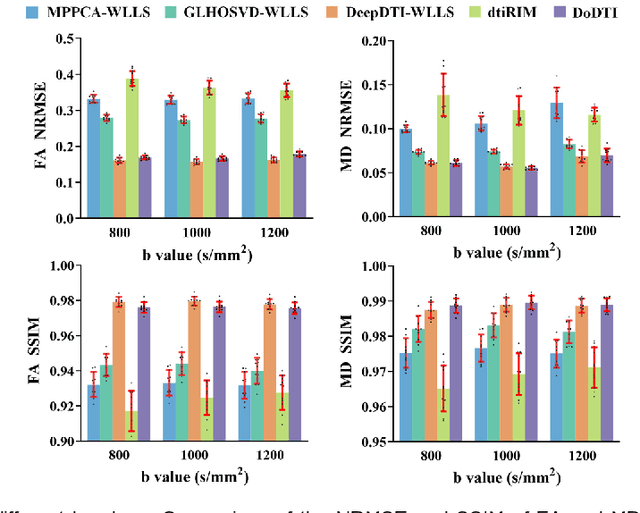
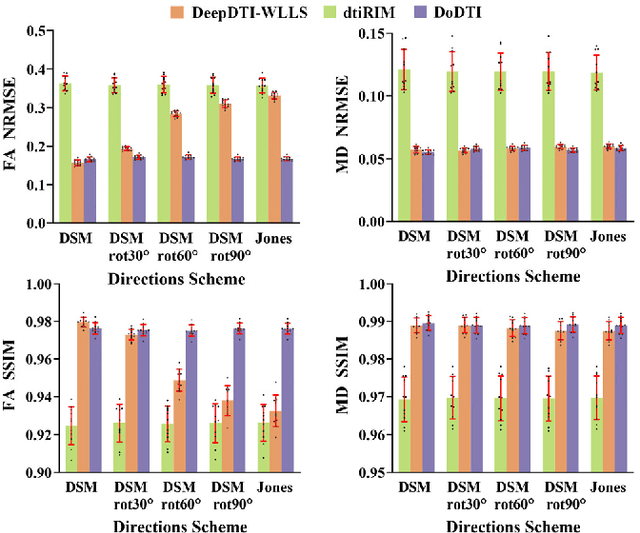
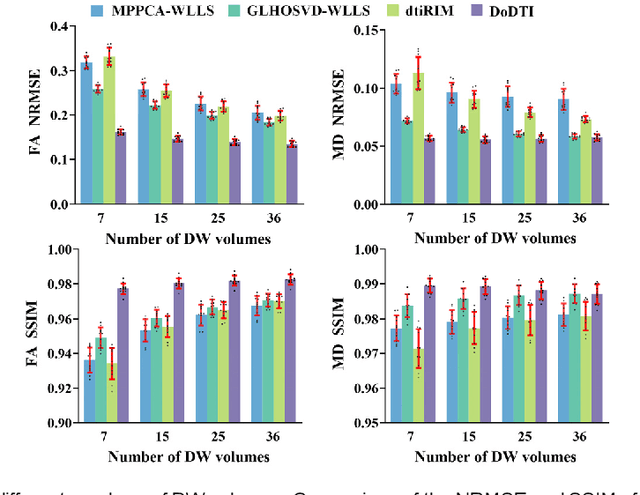
Diffusion tensor imaging (DTI) holds significant importance in clinical diagnosis and neuroscience research. However, conventional model-based fitting methods often suffer from sensitivity to noise, leading to decreased accuracy in estimating DTI parameters. While traditional data-driven deep learning methods have shown potential in terms of accuracy and efficiency, their limited generalization to out-of-training-distribution data impedes their broader application due to the diverse scan protocols used across centers, scanners, and studies. This work aims to tackle these challenges and promote the use of DTI by introducing a data-driven optimization-based method termed DoDTI. DoDTI combines the weighted linear least squares fitting algorithm and regularization by denoising technique. The former fits DW images from diverse acquisition settings into diffusion tensor field, while the latter applies a deep learning-based denoiser to regularize the diffusion tensor field instead of the DW images, which is free from the limitation of fixed-channel assignment of the network. The optimization object is solved using the alternating direction method of multipliers and then unrolled to construct a deep neural network, leveraging a data-driven strategy to learn network parameters. Extensive validation experiments are conducted utilizing both internally simulated datasets and externally obtained in-vivo datasets. The results, encompassing both qualitative and quantitative analyses, showcase that the proposed method attains state-of-the-art performance in DTI parameter estimation. Notably, it demonstrates superior generalization, accuracy, and efficiency, rendering it highly reliable for widespread application in the field.