 Add to Chrome
 Add to Firefox
 Add to Edge
Unsupervised Denoising of Diffusion-Weighted Images with Bias and Variance Corrected Noise Modeling
Feb 22, 2026
Diffusion magnetic resonance imaging (dMRI) plays a vital role in both clinical diagnostics and neuroscience research. However, its inherently low signal-to-noise ratio (SNR), especially under high diffusion weighting, significantly degrades image quality and impairs downstream analysis. Recent self-supervised and unsupervised denoising methods offer a practical solution by enhancing image quality without requiring clean references. However, most of these methods do not explicitly account for the non-Gaussian noise characteristics commonly present in dMRI magnitude data during the supervised learning process, potentially leading to systematic bias and heteroscedastic variance, particularly under low-SNR conditions. To overcome this limitation, we introduce noise-corrected training objectives that explicitly model Rician statistics. Specifically, we propose two alternative loss functions: one derived from the first-order moment to remove mean bias, and another from the second-order moment to correct squared-signal bias. Both losses include adaptive weighting to account for variance heterogeneity and can be used without changing the network architecture. These objectives are instantiated in an image-specific, unsupervised Deep Image Prior (DIP) framework. Comprehensive experiments on simulated and in-vivo dMRI show that the proposed losses effectively reduce Rician bias and suppress noise fluctuations, yielding higher image quality and more reliable diffusion metrics than state-of-the-art denoising baselines. These results underscore the importance of bias- and variance-aware noise modeling for robust dMRI analysis under low-SNR conditions.

Reliable Deep Diffusion Tensor Estimation: Rethinking the Power of Data-Driven Optimization Routine
Sep 04, 2024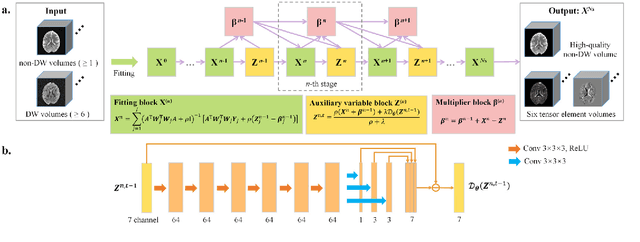
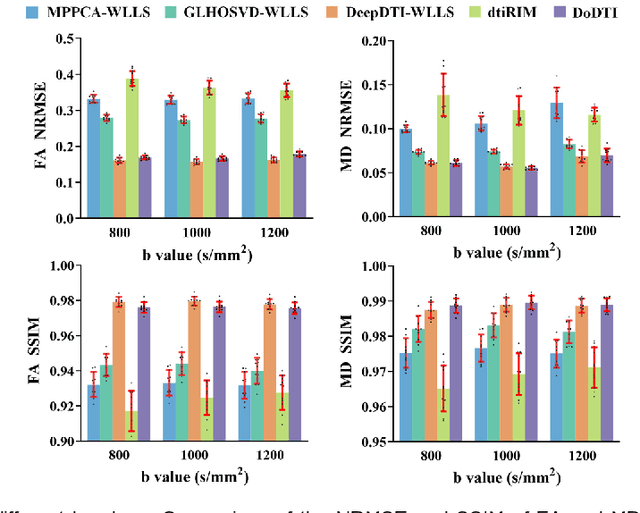
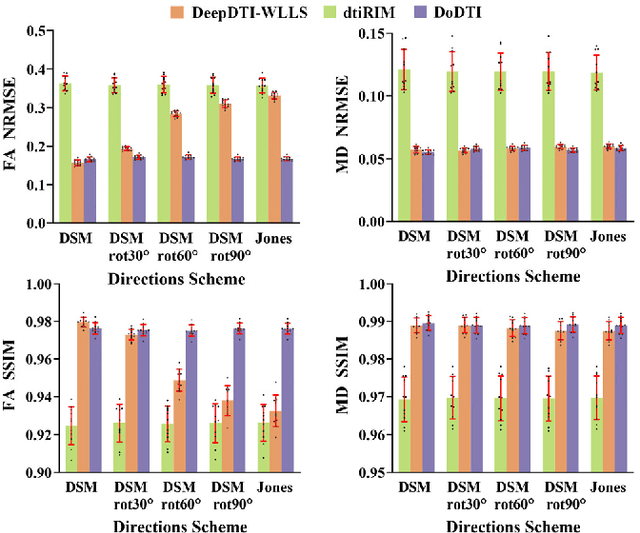
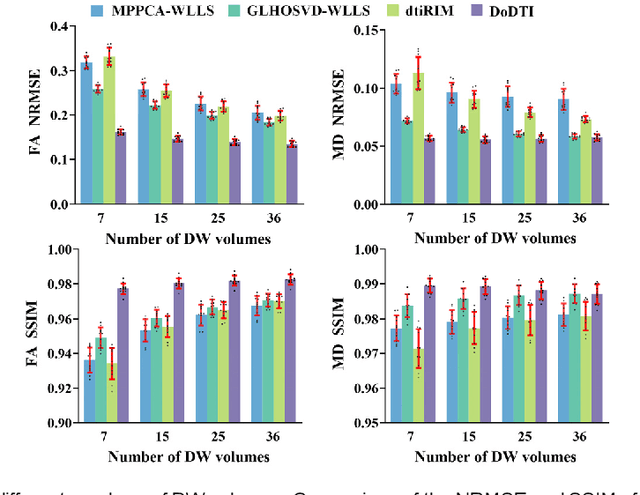
Diffusion tensor imaging (DTI) holds significant importance in clinical diagnosis and neuroscience research. However, conventional model-based fitting methods often suffer from sensitivity to noise, leading to decreased accuracy in estimating DTI parameters. While traditional data-driven deep learning methods have shown potential in terms of accuracy and efficiency, their limited generalization to out-of-training-distribution data impedes their broader application due to the diverse scan protocols used across centers, scanners, and studies. This work aims to tackle these challenges and promote the use of DTI by introducing a data-driven optimization-based method termed DoDTI. DoDTI combines the weighted linear least squares fitting algorithm and regularization by denoising technique. The former fits DW images from diverse acquisition settings into diffusion tensor field, while the latter applies a deep learning-based denoiser to regularize the diffusion tensor field instead of the DW images, which is free from the limitation of fixed-channel assignment of the network. The optimization object is solved using the alternating direction method of multipliers and then unrolled to construct a deep neural network, leveraging a data-driven strategy to learn network parameters. Extensive validation experiments are conducted utilizing both internally simulated datasets and externally obtained in-vivo datasets. The results, encompassing both qualitative and quantitative analyses, showcase that the proposed method attains state-of-the-art performance in DTI parameter estimation. Notably, it demonstrates superior generalization, accuracy, and efficiency, rendering it highly reliable for widespread application in the field.