 Add to Chrome
 Add to Firefox
 Add to Edge
TCHG: Tri-Trust Conditioned Heterogeneous Graph Learning for Reliable Dynamic Trust Prediction
Jun 15, 2026
Trust prediction infers latent user-user trust relations and provides important support for social recommendation, fake-review and manipulation detection, and risk identification. Graph neural networks have become a prominent approach to trust prediction because of their ability to learn network structures and complex trust dependencies. However, existing methods often rely on a unified representation of trust signals and do not disentangle heterogeneous trust evidence into separate evidence channels, failing to exploit the distinct roles that different evidence channels should play during trust modeling. To address this gap, this paper argues that trust evidence should not be treated as an undifferentiated input, but should be decomposed and used as functional control factors over graph propagation. We propose TCHG, a tri-trust conditioned heterogeneous graph learning framework that decomposes trust evidence into three channels and assigns them distinct functional roles in propagation: entity reliability governs message admission, interaction-behavior reliability modulates propagation strength, and contextual trust adjusts the propagation mode through context-conditioned operator selection. Since the three evidence channels evolve at different temporal scales, TCHG maintains independent temporal states with non-uniform decay rates to prevent rapidly changing contextual signals from overwriting slowly accumulated entity reliability. It further predicts trust probability and calibrates the output probability, improving predictive confidence under sparse or conflicting evidence. Extensive experiments on multiple public trust datasets show that TCHG achieves effective and reliable trust prediction compared with representative trust prediction and heterogeneous graph baselines.

FedCARE: Federated Unlearning with Conflict-Aware Projection and Relearning-Resistant Recovery
Jan 30, 2026Federated learning (FL) enables collaborative model training without centralizing raw data, but privacy regulations such as the right to be forgotten require FL systems to remove the influence of previously used training data upon request. Retraining a federated model from scratch is prohibitively expensive, motivating federated unlearning (FU). However, existing FU methods suffer from high unlearning overhead, utility degradation caused by entangled knowledge, and unintended relearning during post-unlearning recovery. In this paper, we propose FedCARE, a unified and low overhead FU framework that enables conflict-aware unlearning and relearning-resistant recovery. FedCARE leverages gradient ascent for efficient forgetting when target data are locally available and employs data free model inversion to construct class level proxies of shared knowledge. Based on these insights, FedCARE integrates a pseudo-sample generator, conflict-aware projected gradient ascent for utility preserving unlearning, and a recovery strategy that suppresses rollback toward the pre-unlearning model. FedCARE supports client, instance, and class level unlearning with modest overhead. Extensive experiments on multiple datasets and model architectures under both IID and non-IID settings show that FedCARE achieves effective forgetting, improved utility retention, and reduced relearning risk compared to state of the art FU baselines.
Synthetic Forgetting without Access: A Few-shot Zero-glance Framework for Machine Unlearning
Nov 17, 2025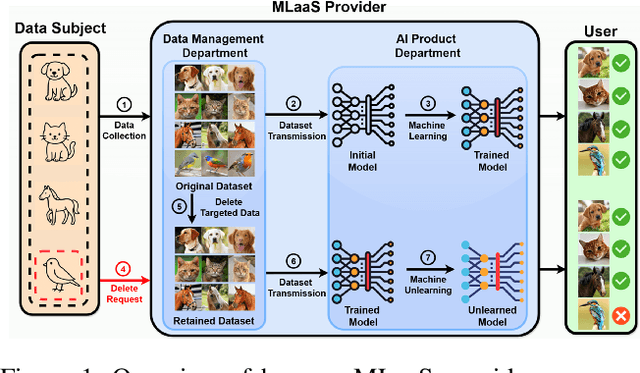
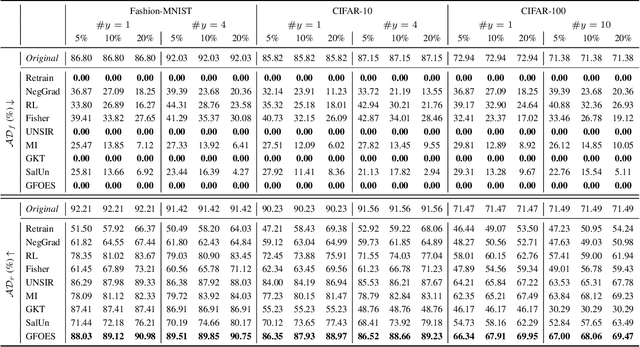
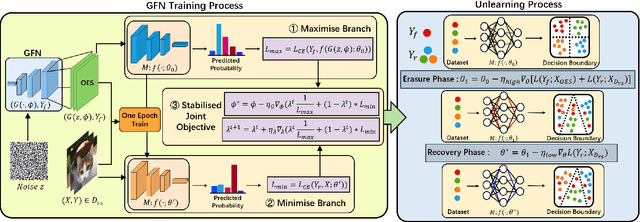
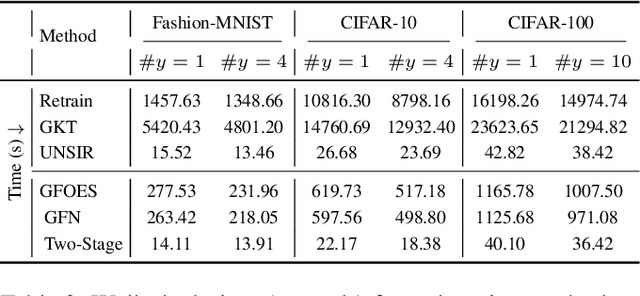
Machine unlearning aims to eliminate the influence of specific data from trained models to ensure privacy compliance. However, most existing methods assume full access to the original training dataset, which is often impractical. We address a more realistic yet challenging setting: few-shot zero-glance, where only a small subset of the retained data is available and the forget set is entirely inaccessible. We introduce GFOES, a novel framework comprising a Generative Feedback Network (GFN) and a two-phase fine-tuning procedure. GFN synthesises Optimal Erasure Samples (OES), which induce high loss on target classes, enabling the model to forget class-specific knowledge without access to the original forget data, while preserving performance on retained classes. The two-phase fine-tuning procedure enables aggressive forgetting in the first phase, followed by utility restoration in the second. Experiments on three image classification datasets demonstrate that GFOES achieves effective forgetting at both logit and representation levels, while maintaining strong performance using only 5% of the original data. Our framework offers a practical and scalable solution for privacy-preserving machine learning under data-constrained conditions.