 Add to Chrome
 Add to Firefox
 Add to Edge
OpenSage: Self-programming Agent Generation Engine
Feb 18, 2026
Agent development kits (ADKs) provide effective platforms and tooling for constructing agents, and their designs are critical to the constructed agents' performance, especially the functionality for agent topology, tools, and memory. However, current ADKs either lack sufficient functional support or rely on humans to manually design these components, limiting agents' generalizability and overall performance. We propose OpenSage, the first ADK that enables LLMs to automatically create agents with self-generated topology and toolsets while providing comprehensive and structured memory support. OpenSage offers effective functionality for agents to create and manage their own sub-agents and toolkits. It also features a hierarchical, graph-based memory system for efficient management and a specialized toolkit tailored to software engineering tasks. Extensive experiments across three state-of-the-art benchmarks with various backbone models demonstrate the advantages of OpenSage over existing ADKs. We also conduct rigorous ablation studies to demonstrate the effectiveness of our design for each component. We believe OpenSage can pave the way for the next generation of agent development, shifting the focus from human-centered to AI-centered paradigms.

When eBPF Meets Machine Learning: On-the-fly OS Kernel Compartmentalization
Jan 11, 2024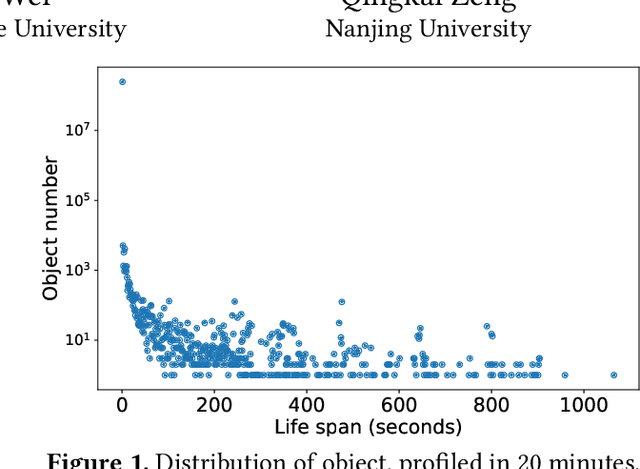
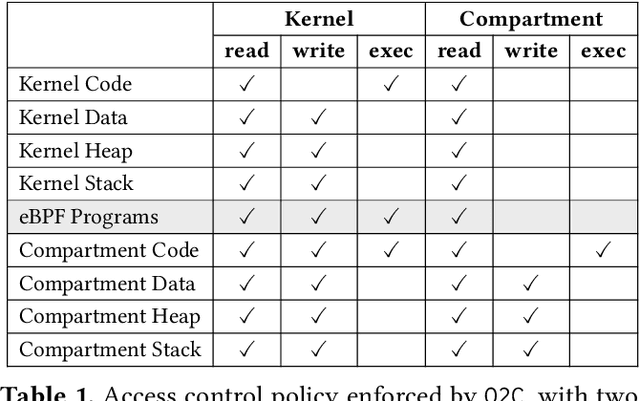
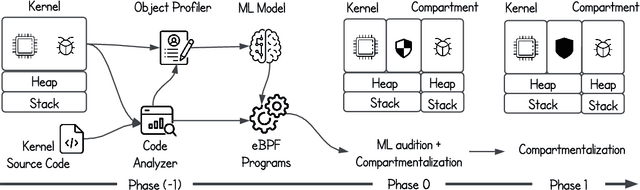
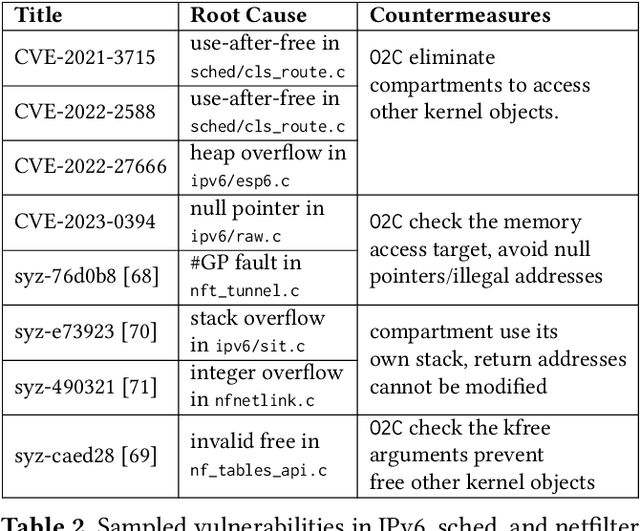
Compartmentalization effectively prevents initial corruption from turning into a successful attack. This paper presents O2C, a pioneering system designed to enforce OS kernel compartmentalization on the fly. It not only provides immediate remediation for sudden threats but also maintains consistent system availability through the enforcement process. O2C is empowered by the newest advancements of the eBPF ecosystem which allows to instrument eBPF programs that perform enforcement actions into the kernel at runtime. O2C takes the lead in embedding a machine learning model into eBPF programs, addressing unique challenges in on-the-fly compartmentalization. Our comprehensive evaluation shows that O2C effectively confines damage within the compartment. Further, we validate that decision tree is optimally suited for O2C owing to its advantages in processing tabular data, its explainable nature, and its compliance with the eBPF ecosystem. Last but not least, O2C is lightweight, showing negligible overhead and excellent sacalability system-wide.