 Add to Chrome
 Add to Firefox
 Add to Edge
Crowd4D: Scene-Aware Monocular 4D Crowd Reconstruction
Jul 21, 2026
Recovering scene-consistent 4D crowd motion from monocular video in large-scale scenes remains challenging due to severe depth ambiguity and complex scene geometry. Existing monocular crowd reconstruction methods typically rely on single-plane assumptions, leading to unreliable metric scale and spatial drift under complex terrain. We propose Crowd4D, the first scene-aware 4D crowd reconstruction framework that jointly optimizes the crowd and scene from a monocular RGB video in large-scale scenes. Crowd4D explicitly incorporates scene geometry and ensures consistency across image and scene spaces via a multi-stage optimization strategy. A key bottleneck of this task lies in accurate human-scene alignment, particularly in scale and position. However, human and scene reconstructions are typically decoupled. To address this, we introduce the Human-Scene Interaction Proxy, abbreviated as HSIP, as an intermediate representation derived from Scene Interaction Point Clouds and a Scene Interaction Surface, abbreviated as SIPC and SIS. These representations encode explicit scene-aware geometric priors and redefine the optimization space for large-scale monocular 4D crowd reconstruction. To further improve temporal stability under occlusions, we introduce Crowd Structural Coherence Regularization, abbreviated as CSCR, which leverages HSIP-based spatial priors to impose soft temporal consistency on pairwise relative displacements and directions within local crowd neighborhoods. Extensive experiments demonstrate that Crowd4D consistently outperforms existing state-of-the-art methods and enables robust monocular 4D crowd reconstruction in complex, large-scale real-world scenes.

Medical Imaging AI Competitions Lack Fairness
Dec 19, 2025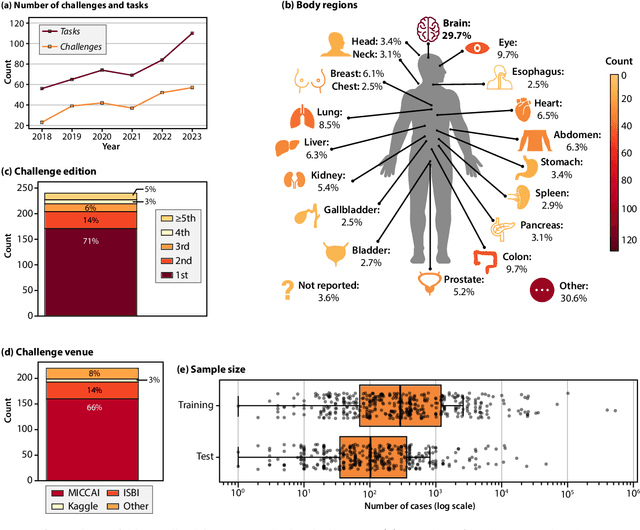
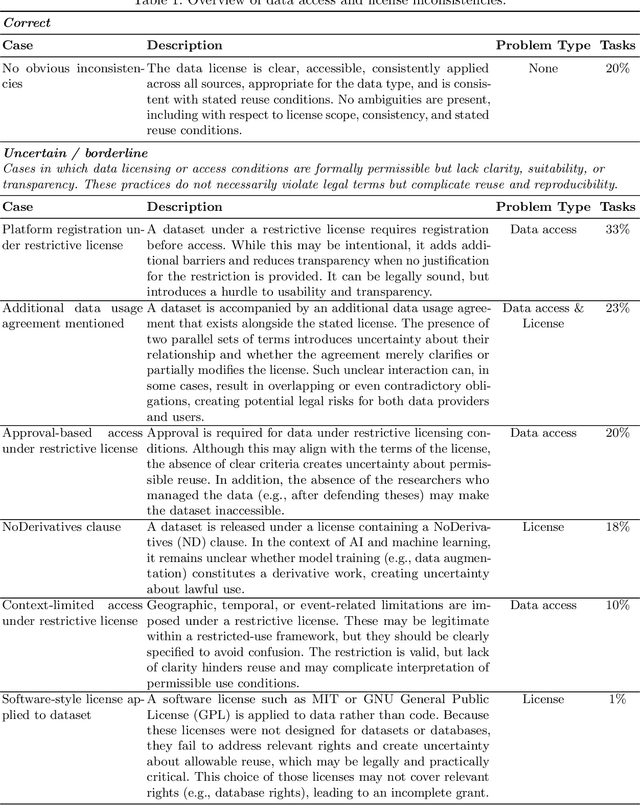
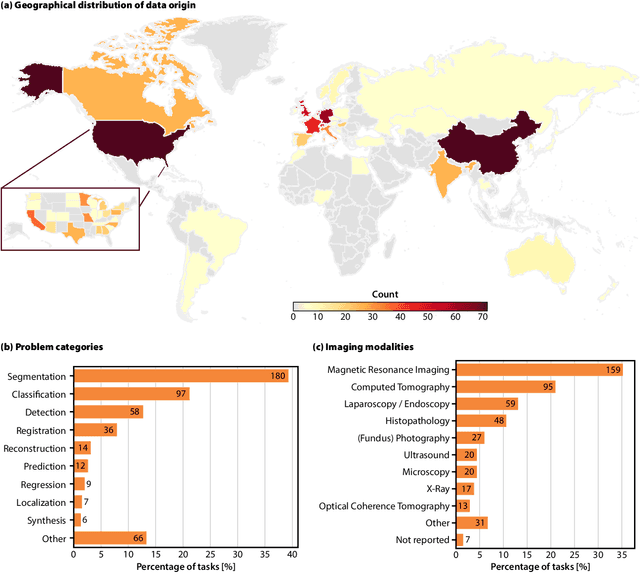
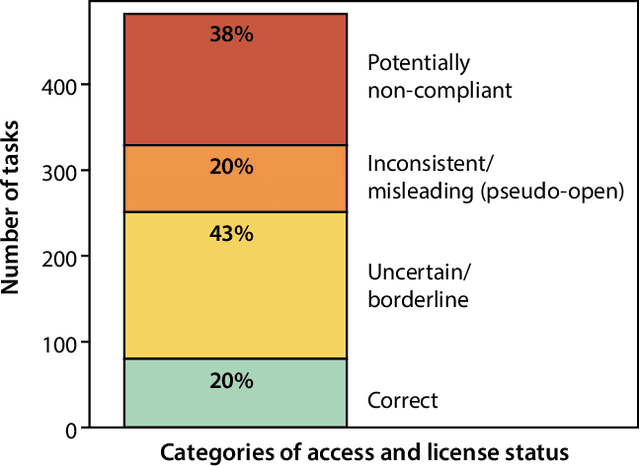
Benchmarking competitions are central to the development of artificial intelligence (AI) in medical imaging, defining performance standards and shaping methodological progress. However, it remains unclear whether these benchmarks provide data that are sufficiently representative, accessible, and reusable to support clinically meaningful AI. In this work, we assess fairness along two complementary dimensions: (1) whether challenge datasets are representative of real-world clinical diversity, and (2) whether they are accessible and legally reusable in line with the FAIR principles. To address this question, we conducted a large-scale systematic study of 241 biomedical image analysis challenges comprising 458 tasks across 19 imaging modalities. Our findings show substantial biases in dataset composition, including geographic location, modality-, and problem type-related biases, indicating that current benchmarks do not adequately reflect real-world clinical diversity. Despite their widespread influence, challenge datasets were frequently constrained by restrictive or ambiguous access conditions, inconsistent or non-compliant licensing practices, and incomplete documentation, limiting reproducibility and long-term reuse. Together, these shortcomings expose foundational fairness limitations in our benchmarking ecosystem and highlight a disconnect between leaderboard success and clinical relevance.