 Add to Chrome
 Add to Firefox
 Add to Edge
WindINR: Latent-State INR for Fast Local Wind Query and Correction in Complex Terrain
May 10, 2026
Many downstream decisions in complex terrain require fast wind estimates at a small number of user-specified locations and heights for a given forecast valid time, rather than another dense forecast field on a fixed grid. We present WindINR, a latent-state implicit neural representation framework for continuous high-resolution local wind query and sparse-observation correction. WindINR maps static terrain descriptors, a low-resolution background field, and continuous query coordinates to a high-resolution wind state through a latent-conditioned decoder. To enable rapid inference-time correction, WindINR separates reusable representation learning from sample-specific latent-state correction. During training, a privileged encoder infers a reference latent state from high-resolution supervision, a deployable latent predictor estimates an initial latent state from inference-time inputs alone, and their discrepancies are summarized into a dataset-adaptive Gaussian prior over latent corrections. At inference time, within the WindINR module, network weights remain fixed and only the latent state is updated by minimizing a regularized correction objective using sparse observations and their uncertainty. In controlled OSSEs over the Senja region, including a UAV-aided approach scenario and random-observation robustness tests, WindINR improves local high-resolution wind estimates by updating only a compact latent state rather than the full network. The corrected representation remains continuously queryable at arbitrary coordinates and, in our CPU benchmark, yields about a $2.6\times$ online-correction speedup over full-network fine-tuning, suggesting a practical interface between kilometer-scale background products, sparse local observations, and wind queries in complex terrain.

VAE-Var: Variational-Autoencoder-Enhanced Variational Assimilation
May 22, 2024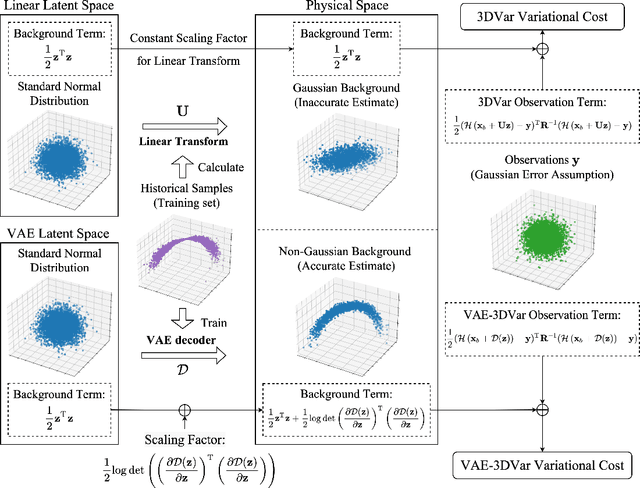
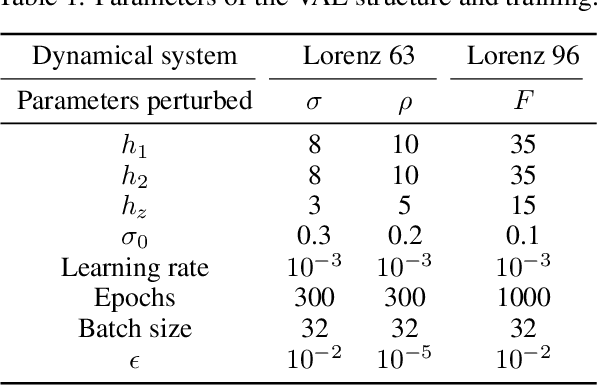
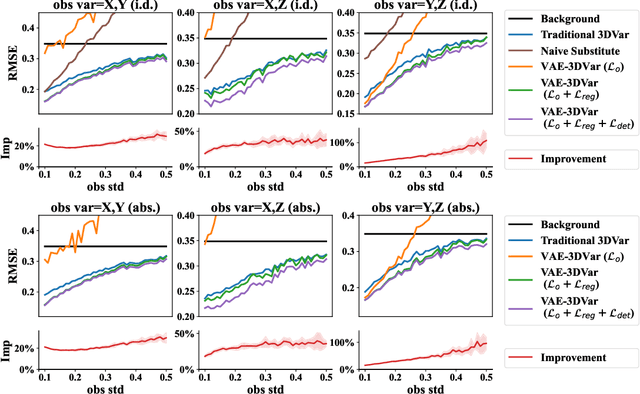
Data assimilation refers to a set of algorithms designed to compute the optimal estimate of a system's state by refining the prior prediction (known as background states) using observed data. Variational assimilation methods rely on the maximum likelihood approach to formulate a variational cost, with the optimal state estimate derived by minimizing this cost. Although traditional variational methods have achieved great success and have been widely used in many numerical weather prediction centers, they generally assume Gaussian errors in the background states, which limits the accuracy of these algorithms due to the inherent inaccuracies of this assumption. In this paper, we introduce VAE-Var, a novel variational algorithm that leverages a variational autoencoder (VAE) to model a non-Gaussian estimate of the background error distribution. We theoretically derive the variational cost under the VAE estimation and present the general formulation of VAE-Var; we implement VAE-Var on low-dimensional chaotic systems and demonstrate through experimental results that VAE-Var consistently outperforms traditional variational assimilation methods in terms of accuracy across various observational settings.