 Add to Chrome
 Add to Firefox
 Add to Edge
Towards Secure Retrieval-Augmented Generation: A Comprehensive Review of Threats, Defenses and Benchmarks
Mar 23, 2026
Retrieval-Augmented Generation (RAG) significantly mitigates the hallucinations and domain knowledge deficiency in large language models by incorporating external knowledge bases. However, the multi-module architecture of RAG introduces complex system-level security vulnerabilities. Guided by the RAG workflow, this paper analyzes the underlying vulnerability mechanisms and systematically categorizes core threat vectors such as data poisoning, adversarial attacks, and membership inference attacks. Based on this threat assessment, we construct a taxonomy of RAG defense technologies from a dual perspective encompassing both input and output stages. The input-side analysis reviews data protection mechanisms including dynamic access control, homomorphic encryption retrieval, and adversarial pre-filtering. The output-side examination summarizes advanced leakage prevention techniques such as federated learning isolation, differential privacy perturbation, and lightweight data sanitization. To establish a unified benchmark for future experimental design, we consolidate authoritative test datasets, security standards, and evaluation frameworks. To the best of our knowledge, this paper presents the first end-to-end survey dedicated to the security of RAG systems. Distinct from existing literature that isolates specific vulnerabilities, we systematically map the entire pipeline-providing a unified analysis of threat models, defense mechanisms, and evaluation benchmarks. By enabling deep insights into potential risks, this work seeks to foster the development of highly robust and trustworthy next-generation RAG systems.

QS-ADN: Quasi-Supervised Artifact Disentanglement Network for Low-Dose CT Image Denoising by Local Similarity Among Unpaired Data
Feb 08, 2023Deep learning has been successfully applied to low-dose CT (LDCT) image denoising for reducing potential radiation risk. However, the widely reported supervised LDCT denoising networks require a training set of paired images, which is expensive to obtain and cannot be perfectly simulated. Unsupervised learning utilizes unpaired data and is highly desirable for LDCT denoising. As an example, an artifact disentanglement network (ADN) relies on unparied images and obviates the need for supervision but the results of artifact reduction are not as good as those through supervised learning.An important observation is that there is often hidden similarity among unpaired data that can be utilized. This paper introduces a new learning mode, called quasi-supervised learning, to empower the ADN for LDCT image denoising.For every LDCT image, the best matched image is first found from an unpaired normal-dose CT (NDCT) dataset. Then, the matched pairs and the corresponding matching degree as prior information are used to construct and train our ADN-type network for LDCT denoising.The proposed method is different from (but compatible with) supervised and semi-supervised learning modes and can be easily implemented by modifying existing networks. The experimental results show that the method is competitive with state-of-the-art methods in terms of noise suppression and contextual fidelity. The code and working dataset are publicly available at https://github.com/ruanyuhui/ADN-QSDL.git.
Continual Graph Learning: A Survey
Jan 28, 2023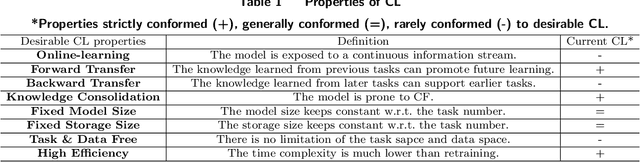
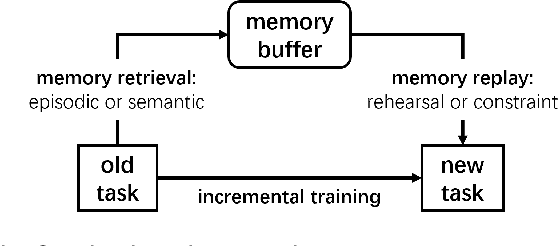
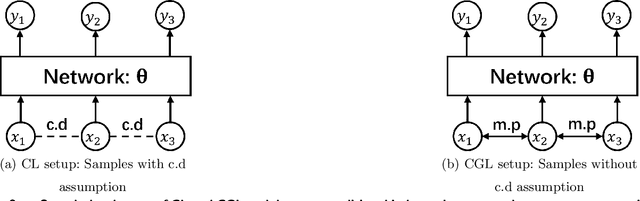
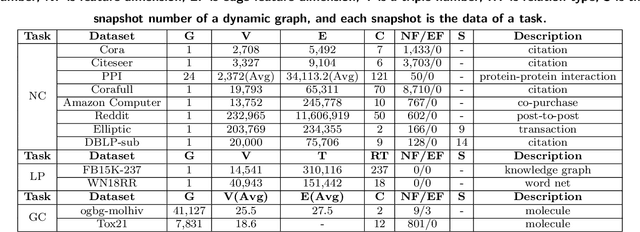
Research on continual learning (CL) mainly focuses on data represented in the Euclidean space, while research on graph-structured data is scarce. Furthermore, most graph learning models are tailored for static graphs. However, graphs usually evolve continually in the real world. Catastrophic forgetting also emerges in graph learning models when being trained incrementally. This leads to the need to develop robust, effective and efficient continual graph learning approaches. Continual graph learning (CGL) is an emerging area aiming to realize continual learning on graph-structured data. This survey is written to shed light on this emerging area. It introduces the basic concepts of CGL and highlights two unique challenges brought by graphs. Then it reviews and categorizes recent state-of-the-art approaches, analyzing their strategies to tackle the unique challenges in CGL. Besides, it discusses the main concerns in each family of CGL methods, offering potential solutions. Finally, it explores the open issues and potential applications of CGL.