 Add to Chrome
 Add to Firefox
 Add to Edge
Privacy-Preserving Industrial Ergonomics: mmWave-Based Automated REBA Scoring and Pose Estimation
Jul 01, 2026
Work-related Musculoskeletal Disorders (WMSDs) require continuous ergonomic assessments. While Rapid Entire Body Assessment (REBA) is a gold-standard observation tool, manual monitoring is labor-intensive, and vision-based automation leads to privacy concerns. This paper proposes a novel end-to-end multi-task learning framework for privacy-preserving ergonomic assessment using millimetre-wave (mmWave) radar. A spatio-temporal backbone reconstructs 3D human skeletons, which serves as the biomechanical foundation for a subsequent regression head to generate REBA risk scores. To overcome the sparsity of radar point clouds, we utilise a multi-objective loss function incorporating biomechanical limits and temporal smoothness constraints. Furthermore, we implement an oversampling strategy to address the imbalance of high-risk postures in existing datasets. Experimental results on MMFi dataset demonstrate that our framework achieves a Categorical Accuracy of 77.78% and real-time performance with an inference latency of 5.70 ms. Our method reaches a High-risk REBA MAE of 0.93, which significantly outperforms both direct regression and two-stage pipelines in high-risk scenarios, providing a robust solution for non-invasive industrial ergonomic assessment.

Continual Graph Learning: A Survey
Jan 28, 2023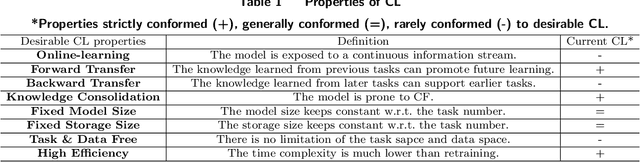
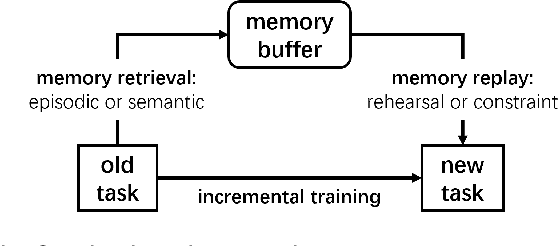
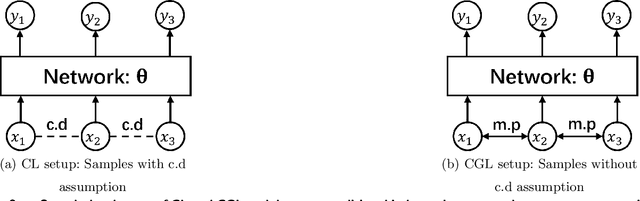
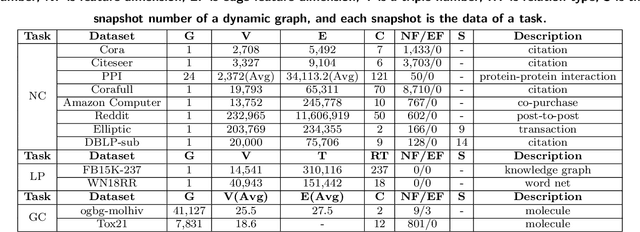
Research on continual learning (CL) mainly focuses on data represented in the Euclidean space, while research on graph-structured data is scarce. Furthermore, most graph learning models are tailored for static graphs. However, graphs usually evolve continually in the real world. Catastrophic forgetting also emerges in graph learning models when being trained incrementally. This leads to the need to develop robust, effective and efficient continual graph learning approaches. Continual graph learning (CGL) is an emerging area aiming to realize continual learning on graph-structured data. This survey is written to shed light on this emerging area. It introduces the basic concepts of CGL and highlights two unique challenges brought by graphs. Then it reviews and categorizes recent state-of-the-art approaches, analyzing their strategies to tackle the unique challenges in CGL. Besides, it discusses the main concerns in each family of CGL methods, offering potential solutions. Finally, it explores the open issues and potential applications of CGL.
Seen to Unseen: When Fuzzy Inference System Predicts IoT Device Positioning Labels That Had Not Appeared in Training Phase
Sep 21, 2022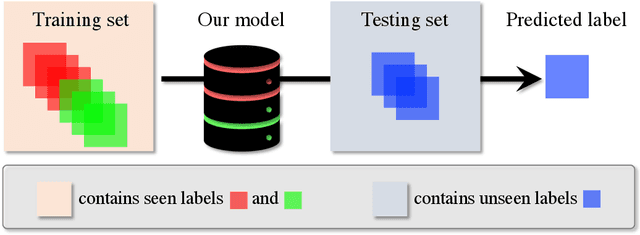
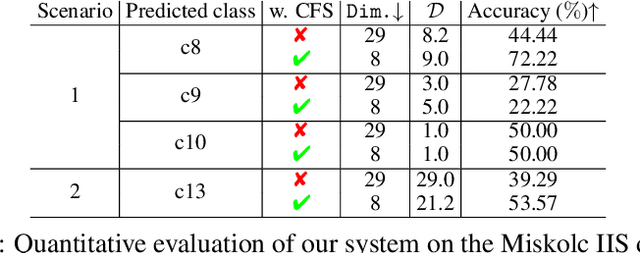
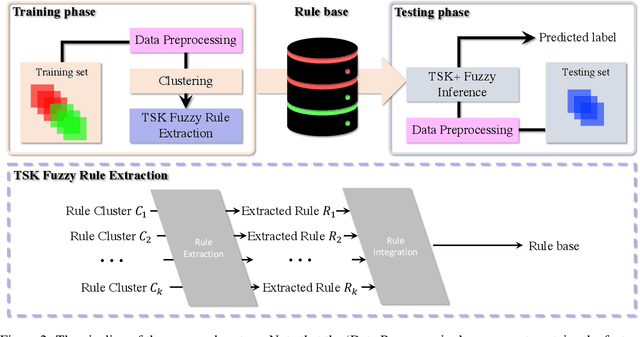
Situating at the core of Artificial Intelligence (AI), Machine Learning (ML), and more specifically, Deep Learning (DL) have embraced great success in the past two decades. However, unseen class label prediction is far less explored due to missing classes being invisible in training ML or DL models. In this work, we propose a fuzzy inference system to cope with such a challenge by adopting TSK+ fuzzy inference engine in conjunction with the Curvature-based Feature Selection (CFS) method. The practical feasibility of our system has been evaluated by predicting the positioning labels of networking devices within the realm of the Internet of Things (IoT). Competitive prediction performance confirms the efficiency and efficacy of our system, especially when a large number of continuous class labels are unseen during the model training stage.