 Add to Chrome
 Add to Firefox
 Add to Edge
Scene Graph-guided SegCaptioning Transformer with Fine-grained Alignment for Controllable Video Segmentation and Captioning
Mar 21, 2026
Recent advancements in multimodal large models have significantly bridged the representation gap between diverse modalities, catalyzing the evolution of video multimodal interpretation, which enhances users' understanding of video content by generating correlated modalities. However, most existing video multimodal interpretation methods primarily concentrate on global comprehension with limited user interaction. To address this, we propose a novel task, Controllable Video Segmentation and Captioning (SegCaptioning), which empowers users to provide specific prompts, such as a bounding box around an object of interest, to simultaneously generate correlated masks and captions that precisely embody user intent. An innovative framework Scene Graph-guided Fine-grained SegCaptioning Transformer (SG-FSCFormer) is designed that integrates a Prompt-guided Temporal Graph Former to effectively captures and represents user intent through an adaptive prompt adaptor, ensuring that the generated content well aligns with the user's requirements. Furthermore, our model introduces a Fine-grained Mask-linguistic Decoder to collaboratively predict high-quality caption-mask pairs using a Multi-entity Contrastive loss, as well as provide fine-grained alignment between each mask and its corresponding caption tokens, thereby enhancing users' comprehension of videos. Comprehensive experiments conducted on two benchmark datasets demonstrate that SG-FSCFormer achieves remarkable performance, effectively capturing user intent and generating precise multimodal outputs tailored to user specifications. Our code is available at https://github.com/XuZhang1211/SG-FSCFormer.

Cross-modal Context-aware Learning for Visual Prompt Guided Multimodal Image Understanding in Remote Sensing
Dec 12, 2025Recent advances in image understanding have enabled methods that leverage large language models for multimodal reasoning in remote sensing. However, existing approaches still struggle to steer models to the user-relevant regions when only simple, generic text prompts are available. Moreover, in large-scale aerial imagery many objects exhibit highly similar visual appearances and carry rich inter-object relationships, which further complicates accurate recognition. To address these challenges, we propose Cross-modal Context-aware Learning for Visual Prompt-Guided Multimodal Image Understanding (CLV-Net). CLV-Net lets users supply a simple visual cue, a bounding box, to indicate a region of interest, and uses that cue to guide the model to generate correlated segmentation masks and captions that faithfully reflect user intent. Central to our design is a Context-Aware Mask Decoder that models and integrates inter-object relationships to strengthen target representations and improve mask quality. In addition, we introduce a Semantic and Relationship Alignment module: a Cross-modal Semantic Consistency Loss enhances fine-grained discrimination among visually similar targets, while a Relationship Consistency Loss enforces alignment between textual relations and visual interactions. Comprehensive experiments on two benchmark datasets show that CLV-Net outperforms existing methods and establishes new state-of-the-art results. The model effectively captures user intent and produces precise, intention-aligned multimodal outputs.
Test-time Adaptation for Cross-modal Retrieval with Query Shift
Oct 21, 2024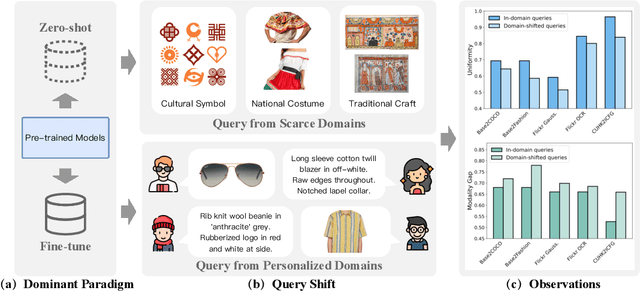

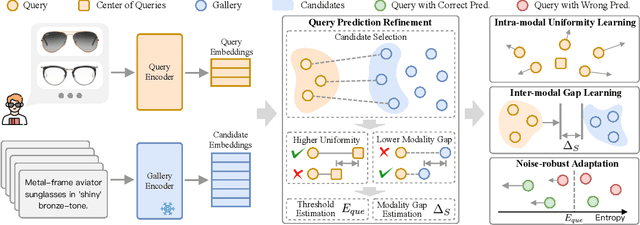

The success of most existing cross-modal retrieval methods heavily relies on the assumption that the given queries follow the same distribution of the source domain. However, such an assumption is easily violated in real-world scenarios due to the complexity and diversity of queries, thus leading to the query shift problem. Specifically, query shift refers to the online query stream originating from the domain that follows a different distribution with the source one. In this paper, we observe that query shift would not only diminish the uniformity (namely, within-modality scatter) of the query modality but also amplify the gap between query and gallery modalities. Based on the observations, we propose a novel method dubbed Test-time adaptation for Cross-modal Retrieval (TCR). In brief, TCR employs a novel module to refine the query predictions (namely, retrieval results of the query) and a joint objective to prevent query shift from disturbing the common space, thus achieving online adaptation for the cross-modal retrieval models with query shift. Expensive experiments demonstrate the effectiveness of the proposed TCR against query shift. The code will be released upon acceptance.
FlexDelta: A flexure-based fully decoupled parallel $xyz$ positioning stage with long stroke
Jul 19, 2023Decoupled parallel $xyz$ positioning stages with large stroke have been desired in high-speed and precise positioning fields. However, currently such stages are either short in stroke or unqualified in parasitic motion and coupling rate. This paper proposes a novel flexure-based decoupled parallel $xyz$ positioning stage (FlexDelta) and conducts its conceptual design, modeling, and experimental study. Firstly, the working principle of FlexDelta is introduced, followed by its mechanism design with flexure. Secondly, the stiffness model of flexure is established via matrix-based Castigliano's second theorem, and the influence of its lateral stiffness on the stiffness model of FlexDelta is comprehensively investigated and then optimally designed. Finally, experimental study was carried out based on the prototype fabricated. The results reveal that the positioning stage features centimeter-stroke in three axes, with coupling rate less than 0.53%, parasitic motion less than 1.72 mrad over full range. And its natural frequencies are 20.8 Hz, 20.8 Hz, and 22.4 Hz for $x$, $y$, and $z$ axis respectively. Multi-axis path tracking tests were also carried out, which validates its dynamic performance with micrometer error.