 Add to Chrome
 Add to Firefox
 Add to Edge
How Organizations Use AI: Evidence from ChatGPT
Aug 12, 2026
We study how organizations use frontier generative AI by linking ChatGPT Enterprise account records to usage, worker roles, task classifications, and public-company financial data through March 2026. These linked data enable a privacy-preserving analysis of adoption, worker roles, and message-level tasks at scale: for instance, the worker-level sample we analyze at the six-month adoption horizon includes over 1,500 organizations and over 17 million messages. We document four facts about enterprise AI adoption and use. First, ChatGPT Enterprise usage has grown rapidly due to a combination of new firm adoption and growing intensity among existing adopters. Second, U.S.-based public company adoption is concentrated among larger, more valuable, and more R&D- and SG&A-intensive firms. Third, active use within adopting firms spans job functions and seniority levels, with especially high usage intensity among early-career workers. Fourth, ChatGPT Enterprise usage encompasses a broad range of knowledge work tasks, including writing, technical work, communication, and information synthesis. In aggregate, these results suggest that firms differ widely in the speed, breadth and purpose of their enterprise AI adoption, and that they are still actively learning how to integrate AI into organizational workflows.

What Matters for Scalable and Robust Learning in End-to-End Driving Planners?
Mar 16, 2026End-to-end autonomous driving has gained significant attention for its potential to learn robust behavior in interactive scenarios and scale with data. Popular architectures often build on separate modules for perception and planning connected through latent representations, such as bird's eye view feature grids, to maintain end-to-end differentiability. This paradigm emerged mostly on open-loop datasets, with evaluation focusing not only on driving performance, but also intermediate perception tasks. Unfortunately, architectural advances that excel in open-loop often fail to translate to scalable learning of robust closed-loop driving. In this paper, we systematically re-examine the impact of common architectural patterns on closed-loop performance: (1) high-resolution perceptual representations, (2) disentangled trajectory representations, and (3) generative planning. Crucially, our analysis evaluates the combined impact of these patterns, revealing both unexpected limitations as well as underexplored synergies. Building on these insights, we introduce BevAD, a novel lightweight and highly scalable end-to-end driving architecture. BevAD achieves 72.7% success rate on the Bench2Drive benchmark and demonstrates strong data-scaling behavior using pure imitation learning. Our code and models are publicly available here: https://dmholtz.github.io/bevad/
SpaceDrive: Infusing Spatial Awareness into VLM-based Autonomous Driving
Dec 11, 2025End-to-end autonomous driving methods built on vision language models (VLMs) have undergone rapid development driven by their universal visual understanding and strong reasoning capabilities obtained from the large-scale pretraining. However, we find that current VLMs struggle to understand fine-grained 3D spatial relationships which is a fundamental requirement for systems interacting with the physical world. To address this issue, we propose SpaceDrive, a spatial-aware VLM-based driving framework that treats spatial information as explicit positional encodings (PEs) instead of textual digit tokens, enabling joint reasoning over semantic and spatial representations. SpaceDrive employs a universal positional encoder to all 3D coordinates derived from multi-view depth estimation, historical ego-states, and text prompts. These 3D PEs are first superimposed to augment the corresponding 2D visual tokens. Meanwhile, they serve as a task-agnostic coordinate representation, replacing the digit-wise numerical tokens as both inputs and outputs for the VLM. This mechanism enables the model to better index specific visual semantics in spatial reasoning and directly regress trajectory coordinates rather than generating digit-by-digit, thereby enhancing planning accuracy. Extensive experiments validate that SpaceDrive achieves state-of-the-art open-loop performance on the nuScenes dataset and the second-best Driving Score of 78.02 on the Bench2Drive closed-loop benchmark over existing VLM-based methods.
The Engagement-Diversity Connection: Evidence from a Field Experiment on Spotify
Mar 17, 2020
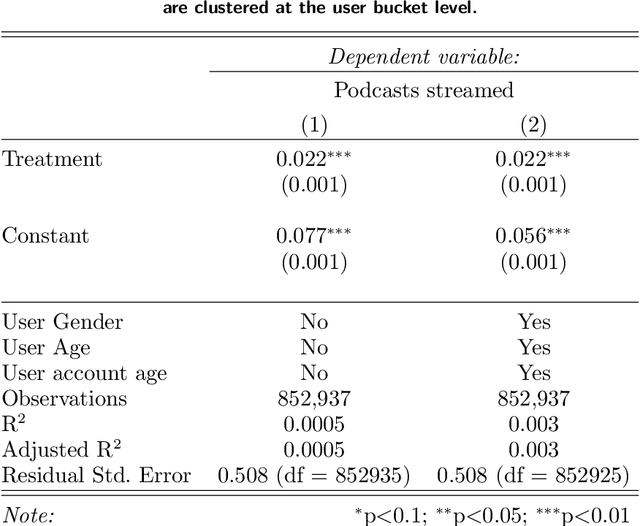
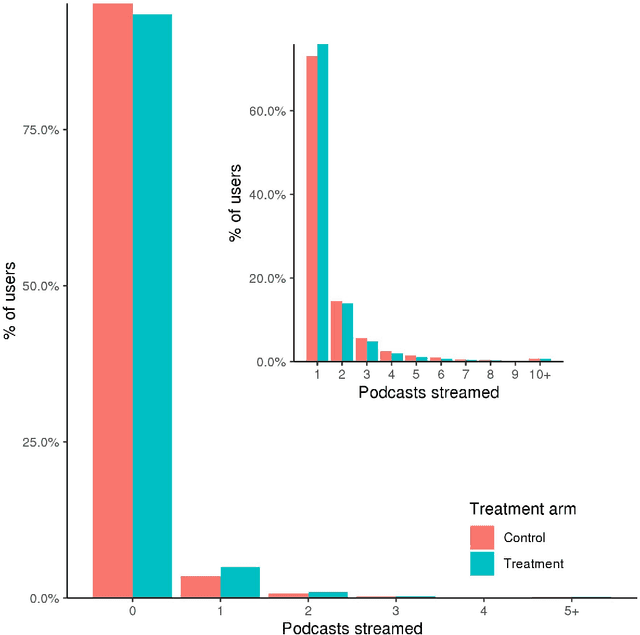
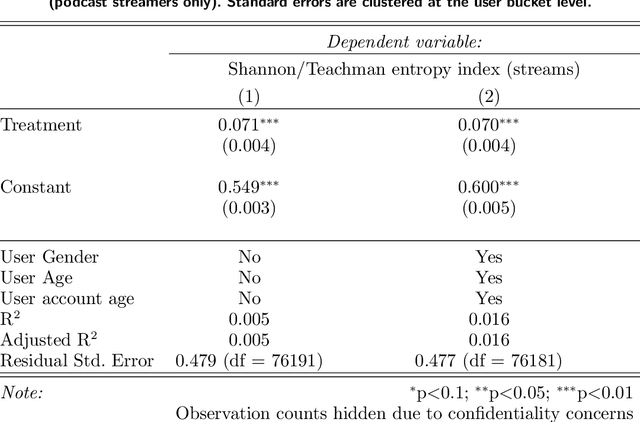
It remains unknown whether personalized recommendations increase or decrease the diversity of content people consume. We present results from a randomized field experiment on Spotify testing the effect of personalized recommendations on consumption diversity. In the experiment, both control and treatment users were given podcast recommendations, with the sole aim of increasing podcast consumption. Treatment users' recommendations were personalized based on their music listening history, whereas control users were recommended popular podcasts among users in their demographic group. We find that, on average, the treatment increased podcast streams by 28.90%. However, the treatment also decreased the average individual-level diversity of podcast streams by 11.51%, and increased the aggregate diversity of podcast streams by 5.96%, indicating that personalized recommendations have the potential to create patterns of consumption that are homogenous within and diverse across users, a pattern reflecting Balkanization. Our results provide evidence of an "engagement-diversity trade-off" when recommendations are optimized solely to drive consumption: while personalized recommendations increase user engagement, they also affect the diversity of consumed content. This shift in consumption diversity can affect user retention and lifetime value, and impact the optimal strategy for content producers. We also observe evidence that our treatment affected streams from sections of Spotify's app not directly affected by the experiment, suggesting that exposure to personalized recommendations can affect the content that users consume organically. We believe these findings highlight the need for academics and practitioners to continue investing in personalization methods that explicitly take into account the diversity of content recommended.