 Add to Chrome
 Add to Firefox
 Add to Edge
TabSHAP
Apr 22, 2026
Large Language Models (LLMs) fine-tuned on serialized tabular data are emerging as powerful alternatives to traditional tree-based models, particularly for heterogeneous or context-rich datasets. However, their deployment in high-stakes domains is hindered by a lack of faithful interpretability; existing methods often rely on global linear proxies or scalar probability shifts that fail to capture the model's full probabilistic uncertainty. In this work, we introduce TabSHAP, a model-agnostic interpretability framework designed to directly attribute local query decision logic in LLM-based tabular classifiers. By adapting a Shapley-style sampled-coalition estimator with Jensen-Shannon divergence between full-input and masked-input class distributions, TabSHAP quantifies the distributional impact of each feature rather than simple prediction flips. To align with tabular semantics, we mask at the level of serialized key:value fields (atomic in the prompt string), not individual subword tokens. Experimental validation on the Adult Income and Heart Disease benchmarks demonstrates that TabSHAP isolates critical diagnostic features, achieving significantly higher faithfulness than random baselines and XGBoost proxies. We further run a distance-metric ablation on the same test instances and TabSHAP settings: attributions are recomputed with KL or L1 replacing JSD in the similarity step (results cached per metric), and we compare deletion faithfulness across all three.

FigCaps-HF: A Figure-to-Caption Generative Framework and Benchmark with Human Feedback
Jul 20, 2023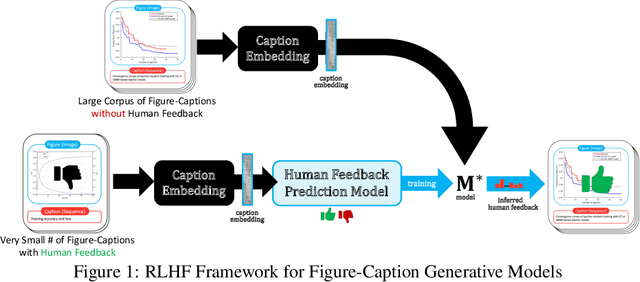
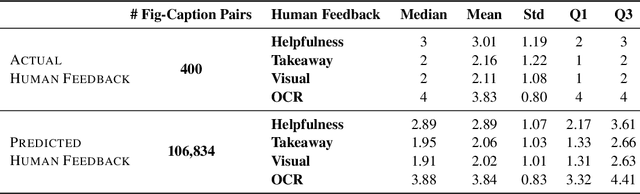

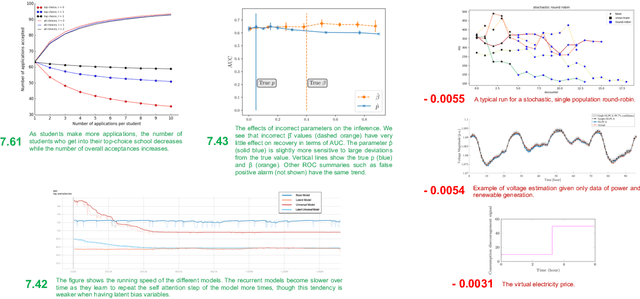
Captions are crucial for understanding scientific visualizations and documents. Existing captioning methods for scientific figures rely on figure-caption pairs extracted from documents for training, many of which fall short with respect to metrics like helpfulness, explainability, and visual-descriptiveness [15] leading to generated captions being misaligned with reader preferences. To enable the generation of high-quality figure captions, we introduce FigCaps-HF a new framework for figure-caption generation that can incorporate domain expert feedback in generating captions optimized for reader preferences. Our framework comprises of 1) an automatic method for evaluating quality of figure-caption pairs, 2) a novel reinforcement learning with human feedback (RLHF) method to optimize a generative figure-to-caption model for reader preferences. We demonstrate the effectiveness of our simple learning framework by improving performance over standard fine-tuning across different types of models. In particular, when using BLIP as the base model, our RLHF framework achieves a mean gain of 35.7%, 16.9%, and 9% in ROUGE, BLEU, and Meteor, respectively. Finally, we release a large-scale benchmark dataset with human feedback on figure-caption pairs to enable further evaluation and development of RLHF techniques for this problem.