 Add to Chrome
 Add to Firefox
 Add to Edge
TabSHAP
Apr 22, 2026
Large Language Models (LLMs) fine-tuned on serialized tabular data are emerging as powerful alternatives to traditional tree-based models, particularly for heterogeneous or context-rich datasets. However, their deployment in high-stakes domains is hindered by a lack of faithful interpretability; existing methods often rely on global linear proxies or scalar probability shifts that fail to capture the model's full probabilistic uncertainty. In this work, we introduce TabSHAP, a model-agnostic interpretability framework designed to directly attribute local query decision logic in LLM-based tabular classifiers. By adapting a Shapley-style sampled-coalition estimator with Jensen-Shannon divergence between full-input and masked-input class distributions, TabSHAP quantifies the distributional impact of each feature rather than simple prediction flips. To align with tabular semantics, we mask at the level of serialized key:value fields (atomic in the prompt string), not individual subword tokens. Experimental validation on the Adult Income and Heart Disease benchmarks demonstrates that TabSHAP isolates critical diagnostic features, achieving significantly higher faithfulness than random baselines and XGBoost proxies. We further run a distance-metric ablation on the same test instances and TabSHAP settings: attributions are recomputed with KL or L1 replacing JSD in the similarity step (results cached per metric), and we compare deletion faithfulness across all three.

Investigating Spatial Attention Bias in Vision-Language Models
Dec 20, 2025Vision-Language Models have demonstrated remarkable capabilities in understanding visual content, yet systematic biases in their spatial processing remain largely unexplored. This work identifies and characterizes a systematic spatial attention bias where VLMs consistently prioritize describing left-positioned content before right-positioned content in horizontally concatenated images. Through controlled experiments on image pairs using both open-source and closed-source models, we demonstrate that this bias persists across different architectures, with models describing left-positioned content first in approximately 97% of cases under neutral prompting conditions. Testing on an Arabic-finetuned model reveals that the bias persists despite right-to-left language training, ruling out language reading direction as the primary cause. Investigation of training dataset annotation guidelines from PixMo and Visual Genome reveals no explicit left-first ordering instructions, suggesting the bias is consistent with architectural factors rather than explicit training data instructions. These findings reveal fundamental limitations in how current VLMs process spatial information.
An evaluation of LLMs and Google Translate for translation of selected Indian languages via sentiment and semantic analyses
Mar 27, 2025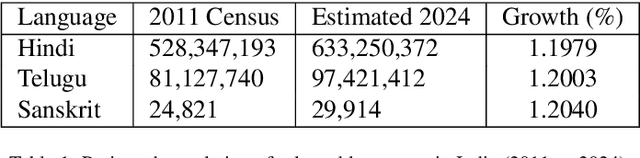
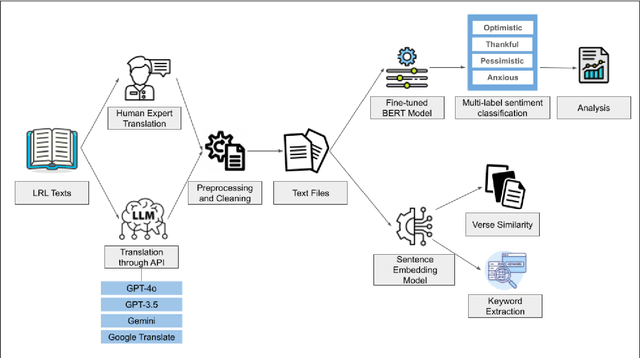

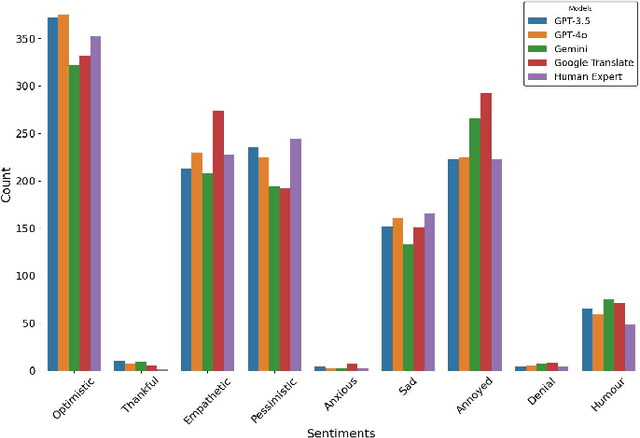
Large Language models (LLMs) have been prominent for language translation, including low-resource languages. There has been limited study about the assessment of the quality of translations generated by LLMs, including Gemini, GPT and Google Translate. In this study, we address this limitation by using semantic and sentiment analysis of selected LLMs for Indian languages, including Sanskrit, Telugu and Hindi. We select prominent texts that have been well translated by experts and use LLMs to generate their translations to English, and then we provide a comparison with selected expert (human) translations. Our findings suggest that while LLMs have made significant progress in translation accuracy, challenges remain in preserving sentiment and semantic integrity, especially in figurative and philosophical contexts. The sentiment analysis revealed that GPT-4o and GPT-3.5 are better at preserving the sentiments for the Bhagavad Gita (Sanskrit-English) translations when compared to Google Translate. We observed a similar trend for the case of Tamas (Hindi-English) and Maha P (Telugu-English) translations. GPT-4o performs similarly to GPT-3.5 in the translation in terms of sentiments for the three languages. We found that LLMs are generally better at translation for capturing sentiments when compared to Google Translate.