 Add to Chrome
 Add to Firefox
 Add to Edge
When Confidence Lacks Concepts: Interpretable OOD Detection via Representation Perturbations
Jun 15, 2026
Deep neural networks have achieved remarkable performance across medical imaging tasks, yet their tendency to overgeneralize under distributional shifts poses a major obstacle to safe clinical deployment. Out-of-Distribution (OOD) detection methods aim to mitigate this risk, but most existing approaches rely on opaque internal signals with poorly understood semantic meaning, limiting trust in safety-critical settings. In this work, we propose an interpretable OOD detection framework that probes the stability of model predictions under class-conditioned semantic perturbations. Leveraging sparse autoencoders (SAEs), we learn class-specific concept vectors from in-distribution data that disentangle dense intermediate representations into sparse, semantically meaningful components. At inference, we perturb deeper-layer representations using the concept vectors associated with the model's predicted class and measure the class logits stability. We hypothesize that in-distribution samples exhibit low sensitivity to such perturbations, as their representations align with class-specific semantic directions, whereas OOD samples show amplified deviations due to representational misalignment. By framing OOD detection as a concept conditioned stability analysis, our approach provides both a discriminative OOD signal and an interpretable lens into the internal mechanisms driving model uncertainty, making it particularly suitable for high stakes medical applications.

NERO: Explainable Out-of-Distribution Detection with Neuron-level Relevance
Jun 18, 2025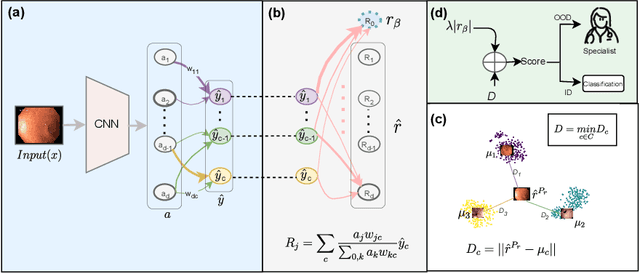
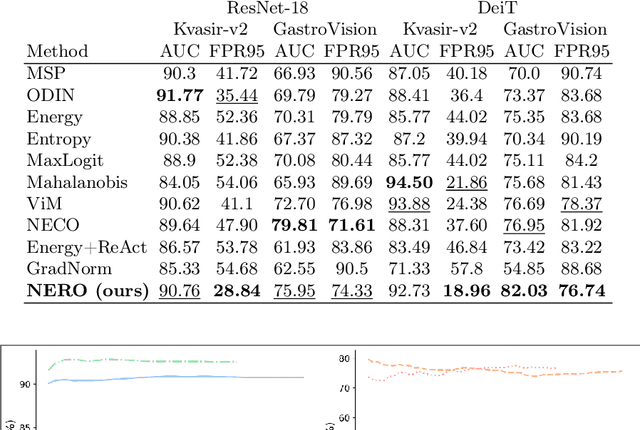
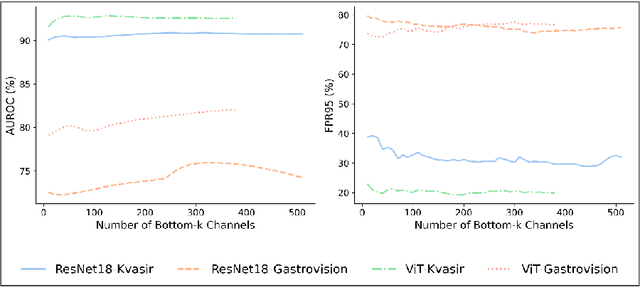
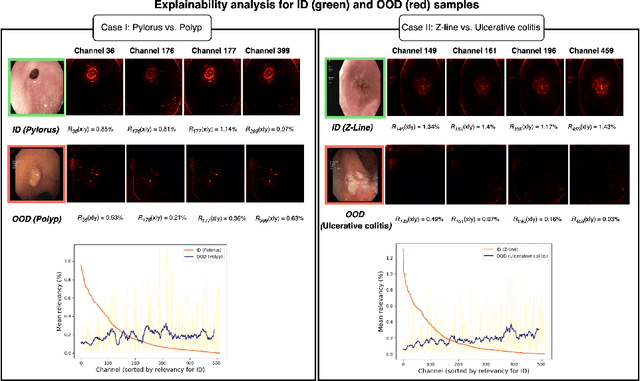
Ensuring reliability is paramount in deep learning, particularly within the domain of medical imaging, where diagnostic decisions often hinge on model outputs. The capacity to separate out-of-distribution (OOD) samples has proven to be a valuable indicator of a model's reliability in research. In medical imaging, this is especially critical, as identifying OOD inputs can help flag potential anomalies that might otherwise go undetected. While many OOD detection methods rely on feature or logit space representations, recent works suggest these approaches may not fully capture OOD diversity. To address this, we propose a novel OOD scoring mechanism, called NERO, that leverages neuron-level relevance at the feature layer. Specifically, we cluster neuron-level relevance for each in-distribution (ID) class to form representative centroids and introduce a relevance distance metric to quantify a new sample's deviation from these centroids, enhancing OOD separability. Additionally, we refine performance by incorporating scaled relevance in the bias term and combining feature norms. Our framework also enables explainable OOD detection. We validate its effectiveness across multiple deep learning architectures on the gastrointestinal imaging benchmarks Kvasir and GastroVision, achieving improvements over state-of-the-art OOD detection methods.