 Add to Chrome
 Add to Firefox
 Add to Edge
iStructTab: Structured Feature Sequencing for Multimodal Learning of Image and Tabular Data
Aug 05, 2026
Multimodal learning of images and tabular data is often impaired by ineffective representations, resulting in redundancy, dispersion, and generalization problems. To tackle this challenge, we introduce Graph-Enhanced Descriptor Sequencing (GEDS), a structured feature sequencing algorithm grounded in principles from the Column Permutation Problem (CPP). GEDS refines statistical descriptors of the features through similarity graph-based computations, systematically determining an effective feature sequencing. We incorporate GEDS within an order-aware efficient transformer framework, utilizing order-aware memory tokens that explicitly adhere to the derived feature sequencing via a dedicated loss function. Experimental results across multimodal benchmarks demonstrate that iStructTab effectively minimizes feature dispersion, improving predictive performance and robustness, and highlighting the significance of structured feature sequencing in multimodal learning.
* This paper has been accepted for presentation at the 28th International Conference on Pattern Recognition (ICPR 2026) in Lyon, France Code: https://github.com/zadid6pretam/iStructTab PyPI: pip install istructtab

Pediatric Bone Age Prediction Using Deep Learning
Jul 18, 2026Pediatric bone age prediction is a crucial task in clinical practice that can help diagnose endocrine disorders and provide insight into a child's growth and development. However, conventional bone age prediction methods are often labor-intensive and require specialized radiological expertise. This paper presents a Deep Learning (DL)-based approach to pediatric bone age prediction using EfficientNet with Additive Attention, a state-of-the-art neural network architecture for image classification and regression tasks. The method utilizes over 12,000 X-ray images from the RSNA bone age dataset. It involves image preprocessing, transforming them into three-channel images, and training a Convolutional Neural Network (CNN) to automatically learn the features of hand bone images. This approach provides a more effective and accurate solution for predicting bone age, which is critical in diagnosing pediatric endocrine diseases. This work uses two variations of the EfficientNet model (B0 and B4), where EfficientNetB4 is also finetuned with the Additive Attention mechanism. These three models predict the age for the original age, and their comparison is shown in curves. The predicted ages depict that in most cases, EfficientNetB4 and EfficientNetB4 with Additive Attention (EN-AA) successfully predicted the bone ages more accurately regarding the original age, and their performance was better than the EfficientNetB0. Specific performance metrics are provided to underscore this improvement. Learning curves for training and validation loss confirm effective learning without overfitting or underfitting, further validating our approach's efficacy in pediatric endocrine disease diagnosis.
Investigation of Polycystic Ovary Syndrome (PCOS) Diagnosis Using Machine Learning Approaches
Jul 18, 2026Polycystic Ovarian Syndrome (PCOS) is a widespread hormone problem for women of childbearing age. Women with PCOS may not ovulate; they might have high levels of androgens and have many small cysts on the ovaries. It can cause missed or irregular menstrual periods, excess hair growth, acne, infertility, and weight gain. Machine Learning (ML) can effectively diagnose this disease at an earlier stage as tons of medical data are available now. Traditional approaches to detect PCOS encompass a combination of clinical evaluation, medical history assessment, physical examination, and laboratory tests. These approaches aim to identify the characteristic symptoms and hormonal imbalances associated with PCOS. Physical examination requires good resources and costs time and money. In recent times, data-driven techniques have substantially advanced disease prediction within the medical field. We aim to utilize ML approaches, incorporating unique feature selection algorithms, to predict PCOS. This paper introduces a data-driven approach to PCOS diagnosis, combining Feature Engineering and ML. Several feature selection approaches have been considered to select sets of features for training the ML model, including CatBoost, Extreme Gradient Boosting (XGBoost), Light Gradient Boosting Machine (LGBM), AdaBoost, Random Forest (RF). Results demonstrate that AdaBoost, with ten features selected by RF Feature Importance and Highest Correlation (HC), provides the highest test accuracy.
AquaAugmentor: A Novel Feature Augmentation Algorithm for Water Potability Prediction
Jul 17, 2026Access to potable water is crucial for health, economic development, and sustainability. However, accurately classifying water quality remains a significant challenge due to the complexity and variability of water source data. This paper addresses the challenge of predicting water potability through machine learning and deep learning algorithms. It introduces a novel feature augmentation algorithm, AquaAugmentor, to enhance the predictive performance of these models for low-dimensional datasets. Utilizing a dataset that includes chemical attributes of water, such as pH, hardness, solids, chloramines, sulfate, and others. This study evaluates the performance of the models with and without AquaAugmentor. Each model applied to classify water as potable or non-potable and its performance is then evaluated and compared based on test accuracy and AUC score. The results highlight the strengths and limitations of our proposed algorithm, providing insights into the most effective techniques for improving the predictive performance of water quality classification. This study contributes to the broader efforts of ensuring safe water access and serves as a framework for employing machine learning in environmental quality assessments. The findings aim to assist researchers, policymakers, and public health officials in making informed decisions based on reliable machine learning predictions.
* Published in 2024 6th International Conference on Sustainable Technologies for Industry 5.0 (STI), 14-15 December, Dhaka, Bangladesh
BSTabDiff: Block-Subunit Diffusion Priors for High-Dimensional Tabular Data Generation
Jun 08, 2026High-Dimensional Low-Sample Size (HDLSS) tabular domains (e.g., omics) are characterized by $n \ll m$, where $n$ = number of samples, and $m$ = number of features. Such domains often exhibit strong local correlation groups, sparse cross-group dependencies, heavy-tailed non-Gaussian marginals, heteroscedastic noise, and structured missingness, making direct density learning in $\mathbb{R}^m$ ill-conditioned since $n \ll m$. We propose BSTabDiff, a block-subunit generative framework that partitions the $m$ observed features into $M$ latent blocks ($M \ll m$) and generates each block via a shared low-dimensional subunit variable, concentrating global dependence learning in the compact block-latent space $\mathbb{R}^M$ while decoding to the full feature space with copula-driven dependence, flexible per-feature marginals, and explicit missingness mechanisms. BSTabDiff supports modern deep priors on block latents, including diffusion and normalizing flows, enabling stable synthesis and controllable benchmark generation in the HDLSS regime. Empirically, BSTabDiff produces more realistic and stable high-dimensional synthetic data when compared with unstructured tabular generators on HDLSS data.
GOTabPFN: From Feature Ordering to Compact Tokenization for Tabular Foundation Models on High-Dimensional Data
Jun 03, 2026We investigate how to make small tabular foundation models effective for High-Dimensional, Low-Sample Size (HDLSS) tabular prediction without retraining large backbones. We introduce Graph-guided Ordering with Local Refinement (GO-LR), show its equivalence to weighted Minimum Linear Arrangement, and interpret the practical solver as a TSP-path-style surrogate. We propose GOTabPFN,which builds on GO-LR, and a Neuro-Inspired Subunit Compression (NSC) unit to pool locally adjacent ordered features into meta-features, yielding a compact representation that makes TabPFN-style prediction practical in HDLSS regimes. Across tabular benchmarks, GOTabPFN improves stability and accuracy under tight token budgets.
DynaTab: Dynamic Feature Ordering as Neural Rewiring for High-Dimensional Tabular Data
May 05, 2026High-dimensional tabular data lacks a natural feature order, limiting the applicability of permutation-sensitive deep learning models. We propose DynaTab, a dynamic feature ordering-enabled architecture inspired by neural rewiring. We introduce a lightweight criterion that predicts when feature permutation will benefit a dataset by quantifying its intrinsic complexity. DynaTab dynamically reorders features via a neural rewiring algorithm and processes them through a compact, dynamic order-aware combination of separate learned positional embedding, importance-based gating, and masked attention layers, compatible with any sequence-sensitive backbone. Trained end-to-end with bespoke dynamic feature ordering (DFO) and dispersion losses, DynaTab achieves statistically significant gains, particularly on high-dimensional datasets, where it is benchmarked against 45 state-of-the-art baselines across 36 different real-world tabular datasets. Our results position DynaTab as a compelling new paradigm for high-dimensional tabular deep learning.
TabSeq: A Framework for Deep Learning on Tabular Data via Sequential Ordering
Oct 17, 2024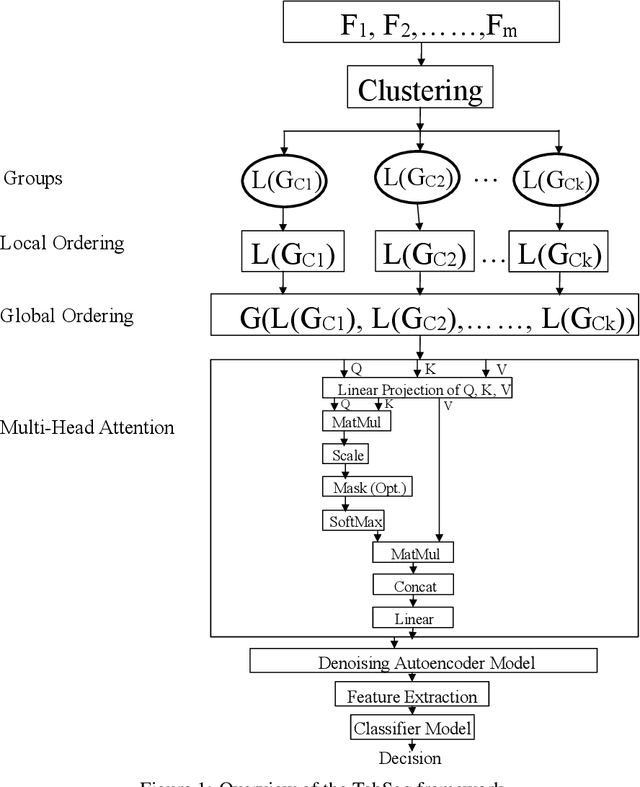


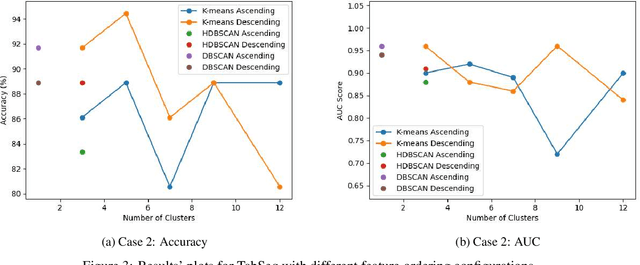
Effective analysis of tabular data still poses a significant problem in deep learning, mainly because features in tabular datasets are often heterogeneous and have different levels of relevance. This work introduces TabSeq, a novel framework for the sequential ordering of features, addressing the vital necessity to optimize the learning process. Features are not always equally informative, and for certain deep learning models, their random arrangement can hinder the model's learning capacity. Finding the optimum sequence order for such features could improve the deep learning models' learning process. The novel feature ordering technique we provide in this work is based on clustering and incorporates both local ordering and global ordering. It is designed to be used with a multi-head attention mechanism in a denoising autoencoder network. Our framework uses clustering to align comparable features and improve data organization. Multi-head attention focuses on essential characteristics, whereas the denoising autoencoder highlights important aspects by rebuilding from distorted inputs. This method improves the capability to learn from tabular data while lowering redundancy. Our research, demonstrating improved performance through appropriate feature sequence rearrangement using raw antibody microarray and two other real-world biomedical datasets, validates the impact of feature ordering. These results demonstrate that feature ordering can be a viable approach to improved deep learning of tabular data.
Cardiovascular Disease Risk Prediction via Social Media
Sep 28, 2023Researchers use Twitter and sentiment analysis to predict Cardiovascular Disease (CVD) risk. We developed a new dictionary of CVD-related keywords by analyzing emotions expressed in tweets. Tweets from eighteen US states, including the Appalachian region, were collected. Using the VADER model for sentiment analysis, users were classified as potentially at CVD risk. Machine Learning (ML) models were employed to classify individuals' CVD risk and applied to a CDC dataset with demographic information to make the comparison. Performance evaluation metrics such as Test Accuracy, Precision, Recall, F1 score, Mathew's Correlation Coefficient (MCC), and Cohen's Kappa (CK) score were considered. Results demonstrated that analyzing tweets' emotions surpassed the predictive power of demographic data alone, enabling the identification of individuals at potential risk of developing CVD. This research highlights the potential of Natural Language Processing (NLP) and ML techniques in using tweets to identify individuals with CVD risks, providing an alternative approach to traditional demographic information for public health monitoring.