 Add to Chrome
 Add to Firefox
 Add to Edge
From Clicks to Intent: Cross-Platform Session Embeddings with LLM-Distilled Taxonomy for Financial Services Recommendations
Jun 24, 2026
Sequential user behavior modeling is widely adopted in industrial recommender systems; however, significant gaps remain in financial services, where pre-login web interactions and authenticated in-app experiences differ drastically. Specifically, pre-login web users typically explore new products, whereas logged-in app users focus on account servicing. Due to the challenge of cross-channel entity resolution (e.g., matching anonymous web sessions to authenticated mobile accounts), web-based intent signals remain underutilized for post-authentication personalization. Existing methods for capturing web-based intent are often ad-hoc and narrow, lacking the flexibility to support both quantitative downstream recommendations and qualitative understanding at scale. In this work, we propose a scalable and dual-purpose intent prediction framework for web-based interactions and demonstrate its applicability for personalization. Our approach transforms raw web clickstreams into two outputs: a self-supervised Transformer encodes multi-modal clickstreams into a compact session embedding, while an LLM-based taxonomy generation and distillation pipeline produces interpretable intent labels. Our system demonstrates that self-supervised clickstream representations combined with LLM-distilled taxonomies can jointly serve quantitative tasks and qualitative understanding in production: on the mobile homepage tile ranking task, the session embedding improves macro Recall@1 by 1.88% and reduces Log Loss by 13.38% over production baselines. On the user conversion prediction task, the embedding outperforms the LLM labels by 4.3% on micro F1, while the distillation layer delivers interpretable labels at ultra-low latency with only a 7% performance drop.

FinTRec: Transformer Based Unified Contextual Ads Targeting and Personalization for Financial Applications
Nov 18, 2025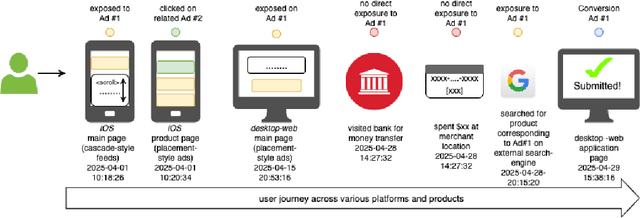

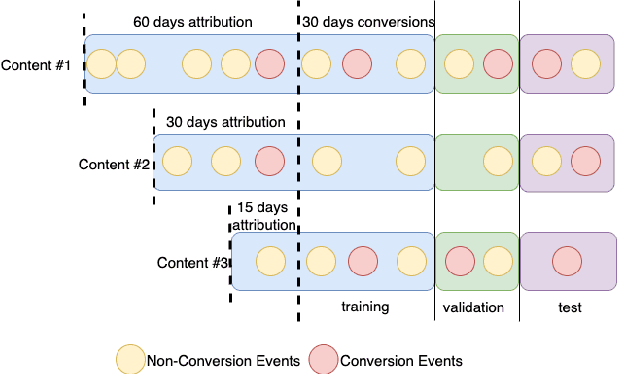
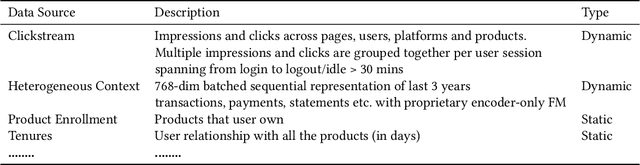
Transformer-based architectures are widely adopted in sequential recommendation systems, yet their application in Financial Services (FS) presents distinct practical and modeling challenges for real-time recommendation. These include:a) long-range user interactions (implicit and explicit) spanning both digital and physical channels generating temporally heterogeneous context, b) the presence of multiple interrelated products require coordinated models to support varied ad placements and personalized feeds, while balancing competing business goals. We propose FinTRec, a transformer-based framework that addresses these challenges and its operational objectives in FS. While tree-based models have traditionally been preferred in FS due to their explainability and alignment with regulatory requirements, our study demonstrate that FinTRec offers a viable and effective shift toward transformer-based architectures. Through historic simulation and live A/B test correlations, we show FinTRec consistently outperforms the production-grade tree-based baseline. The unified architecture, when fine-tuned for product adaptation, enables cross-product signal sharing, reduces training cost and technical debt, while improving offline performance across all products. To our knowledge, this is the first comprehensive study of unified sequential recommendation modeling in FS that addresses both technical and business considerations.
Improving Opinion-based Question Answering Systems Through Label Error Detection and Overwrite
Jun 13, 2023Label error is a ubiquitous problem in annotated data. Large amounts of label error substantially degrades the quality of deep learning models. Existing methods to tackle the label error problem largely focus on the classification task, and either rely on task specific architecture or require non-trivial additional computations, which is undesirable or even unattainable for industry usage. In this paper, we propose LEDO: a model-agnostic and computationally efficient framework for Label Error Detection and Overwrite. LEDO is based on Monte Carlo Dropout combined with uncertainty metrics, and can be easily generalized to multiple tasks and data sets. Applying LEDO to an industry opinion-based question answering system demonstrates it is effective at improving accuracy in all the core models. Specifically, LEDO brings 1.1% MRR gain for the retrieval model, 1.5% PR AUC improvement for the machine reading comprehension model, and 0.9% rise in the Average Precision for the ranker, on top of the strong baselines with a large-scale social media dataset. Importantly, LEDO is computationally efficient compared to methods that require loss function change, and cost-effective as the resulting data can be used in the same continuous training pipeline for production. Further analysis shows that these gains come from an improved decision boundary after cleaning the label errors existed in the training data.