 Add to Chrome
 Add to Firefox
 Add to Edge
Workspace Topology as an Attack Vector in Agentic Coding Assistants
Aug 14, 2026
Agentic coding assistants are finding widespread use, not just in new code development but in quickly ingesting and leveraging third-party code. This opens up a risk of malicious code being ingested as these coding tools operate with broad filesystem access inside developer workspaces. In this paper, we extensively study the impact of different dimensions of a novel attack surface we term workspace topology -- defined via directory depth, codebase modularity, in-file injection position and context framing -- on the attack success rate of adversarial prompt injection attempts. We perform an empirical study of indirect prompt injection (IPI) across a diverse set of open-source repositories spanning 10 languages and 6 engineering domains, evaluating three IPI entry points against open-weight models operating open source code harnesses. We find that workspace topology measurably affects IPI success. Specifically, changes in codebase modularity can significantly alter the Attack Success Rate (ASR), with highly modular environments demonstrating significantly lower attack success rates. Furthermore, context framing and introduction of security-cues in the workspace can also alter the ASR. Our findings offer practical value for the evaluation and security testing of coding agents across diverse settings, while underscoring the importance of an uncontaminated testing environment to obtain reliable results and conclusions.

From Clicks to Intent: Cross-Platform Session Embeddings with LLM-Distilled Taxonomy for Financial Services Recommendations
Jun 24, 2026Sequential user behavior modeling is widely adopted in industrial recommender systems; however, significant gaps remain in financial services, where pre-login web interactions and authenticated in-app experiences differ drastically. Specifically, pre-login web users typically explore new products, whereas logged-in app users focus on account servicing. Due to the challenge of cross-channel entity resolution (e.g., matching anonymous web sessions to authenticated mobile accounts), web-based intent signals remain underutilized for post-authentication personalization. Existing methods for capturing web-based intent are often ad-hoc and narrow, lacking the flexibility to support both quantitative downstream recommendations and qualitative understanding at scale. In this work, we propose a scalable and dual-purpose intent prediction framework for web-based interactions and demonstrate its applicability for personalization. Our approach transforms raw web clickstreams into two outputs: a self-supervised Transformer encodes multi-modal clickstreams into a compact session embedding, while an LLM-based taxonomy generation and distillation pipeline produces interpretable intent labels. Our system demonstrates that self-supervised clickstream representations combined with LLM-distilled taxonomies can jointly serve quantitative tasks and qualitative understanding in production: on the mobile homepage tile ranking task, the session embedding improves macro Recall@1 by 1.88% and reduces Log Loss by 13.38% over production baselines. On the user conversion prediction task, the embedding outperforms the LLM labels by 4.3% on micro F1, while the distillation layer delivers interpretable labels at ultra-low latency with only a 7% performance drop.
CoT-Guard: Small Models for Strong Monitoring
May 12, 2026Monitoring the chain-of-thought (CoT) of reasoning models is a promising approach for detecting covert misbehavior (i.e., hidden objectives) in code generation tasks. While large models (GPT-5, Gemini-3-Flash) can serve as effective CoT monitors, they are expensive to deploy due to the lengthy reasoning traces and high API cost, emphasizing the need for smaller, cheaper alternatives. Nevertheless, we find that current small models (4B--8B) struggle to detect hidden objectives despite access to the CoT, frequently misattributing them as part of the user query. To address this, we propose a post-training pipeline combining supervised fine-tuning (SFT) and reinforcement learning (RL), where SFT narrows the gap for in-domain tasks by distilling detection behavior from stronger monitors, and RL on hard and subtly crafted hidden objectives helps the model generalize to out-of-domain monitoring tasks. To validate this generalization, we evaluate under a realistic threat model motivated by practical supply-chain attacks, where the adversary is a third-party LLM router injecting hidden objectives into code-generation requests through either prompt manipulation or code manipulation attacks. To push beyond objectives that large monitors already saturate, we also introduce four new challenging tasks even for strong monitors. Finally, we introduce CoT-Guard, a 4B-parameter monitor that demonstrates superior generalization performance under both prompt and code manipulation attacks, achieving a G-mean^2 (i.e., TNR x TPR) of 75% and outperforming GPT-5.4 (56%), GPT-5-mini (41%), and Qwen3-32B (54%), while closing the gap to Gemini-3-Flash (83%). These results demonstrate that CoT-Guard provides a practical and cost-effective user-side defense, substantially improving hidden-objective detection while avoiding the deployment cost of large monitors.
Towards Scalable Meta-Learning of near-optimal Interpretable Models via Synthetic Model Generations
Nov 06, 2025Decision trees are widely used in high-stakes fields like finance and healthcare due to their interpretability. This work introduces an efficient, scalable method for generating synthetic pre-training data to enable meta-learning of decision trees. Our approach samples near-optimal decision trees synthetically, creating large-scale, realistic datasets. Using the MetaTree transformer architecture, we demonstrate that this method achieves performance comparable to pre-training on real-world data or with computationally expensive optimal decision trees. This strategy significantly reduces computational costs, enhances data generation flexibility, and paves the way for scalable and efficient meta-learning of interpretable decision tree models.
Enhancing Table Representations with LLM-powered Synthetic Data Generation
Nov 04, 2024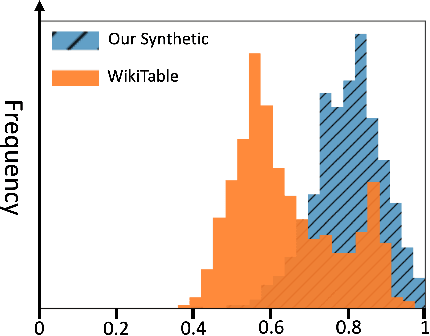


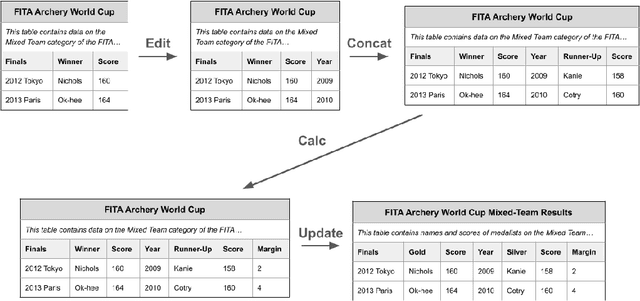
In the era of data-driven decision-making, accurate table-level representations and efficient table recommendation systems are becoming increasingly crucial for improving table management, discovery, and analysis. However, existing approaches to tabular data representation often face limitations, primarily due to their focus on cell-level tasks and the lack of high-quality training data. To address these challenges, we first formulate a clear definition of table similarity in the context of data transformation activities within data-driven enterprises. This definition serves as the foundation for synthetic data generation, which require a well-defined data generation process. Building on this, we propose a novel synthetic data generation pipeline that harnesses the code generation and data manipulation capabilities of Large Language Models (LLMs) to create a large-scale synthetic dataset tailored for table-level representation learning. Through manual validation and performance comparisons on the table recommendation task, we demonstrate that the synthetic data generated by our pipeline aligns with our proposed definition of table similarity and significantly enhances table representations, leading to improved recommendation performance.