 Add to Chrome
 Add to Firefox
 Add to Edge
FinTRec: Transformer Based Unified Contextual Ads Targeting and Personalization for Financial Applications
Nov 18, 2025
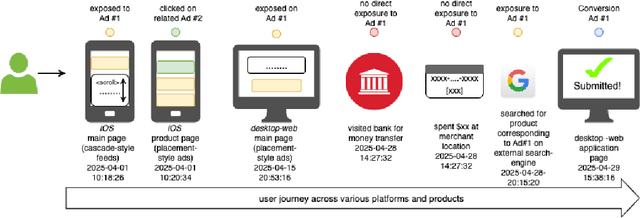

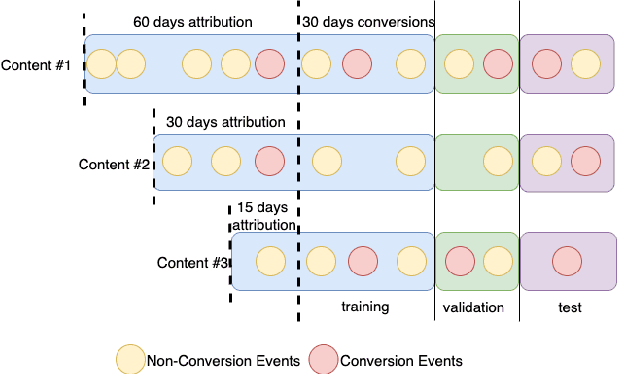
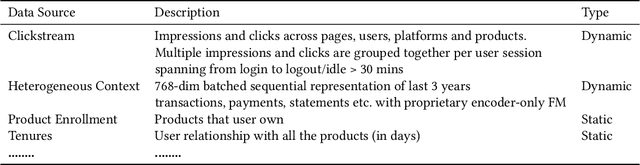
Transformer-based architectures are widely adopted in sequential recommendation systems, yet their application in Financial Services (FS) presents distinct practical and modeling challenges for real-time recommendation. These include:a) long-range user interactions (implicit and explicit) spanning both digital and physical channels generating temporally heterogeneous context, b) the presence of multiple interrelated products require coordinated models to support varied ad placements and personalized feeds, while balancing competing business goals. We propose FinTRec, a transformer-based framework that addresses these challenges and its operational objectives in FS. While tree-based models have traditionally been preferred in FS due to their explainability and alignment with regulatory requirements, our study demonstrate that FinTRec offers a viable and effective shift toward transformer-based architectures. Through historic simulation and live A/B test correlations, we show FinTRec consistently outperforms the production-grade tree-based baseline. The unified architecture, when fine-tuned for product adaptation, enables cross-product signal sharing, reduces training cost and technical debt, while improving offline performance across all products. To our knowledge, this is the first comprehensive study of unified sequential recommendation modeling in FS that addresses both technical and business considerations.

Dynamic Customer Embeddings for Financial Service Applications
Jun 22, 2021


As financial services (FS) companies have experienced drastic technology driven changes, the availability of new data streams provides the opportunity for more comprehensive customer understanding. We propose Dynamic Customer Embeddings (DCE), a framework that leverages customers' digital activity and a wide range of financial context to learn dense representations of customers in the FS industry. Our method examines customer actions and pageviews within a mobile or web digital session, the sequencing of the sessions themselves, and snapshots of common financial features across our organization at the time of login. We test our customer embeddings using real world data in three prediction problems: 1) the intent of a customer in their next digital session, 2) the probability of a customer calling the call centers after a session, and 3) the probability of a digital session to be fraudulent. DCE showed performance lift in all three downstream problems.