 Add to Chrome
 Add to Firefox
 Add to Edge
Respect Your Zero-Shot Uncertainty: Conservative Calibration for Test-Time-Adapted Vision-Language Models
Aug 06, 2026
Test-time adaptation (TTA) can improve the recognition accuracy of vision-language models under distribution shift, but often degrades calibration, making predictive confidence unreliable for downstream decision-making. Many existing label-free calibration approaches are either coupled to prompt optimization or rely on logit-range statistics that provide only a coarse characterization of the predictive distribution. We show that TTA can increase confidence and reduce entropy even when the top-1 prediction and its correctness remain unchanged, a failure mode we term prediction-preserving sharpening. Across diverse TTA methods and benchmarks, larger entropy reductions relative to paired zero-shot predictions are associated with greater increases in Expected Calibration Error (ECE). On entropy-reduced samples, confidence gains also tend to exceed accuracy gains. Based on these findings, we propose Zero-Shot-Anchored Entropy Calibration (ZAEC), a label-free post-hoc method that uses zero-shot entropy as a sample-specific uncertainty reference. ZAEC selectively restores the zero-shot entropy of sharpened predictions through minimal temperature scaling while leaving all other predictions unchanged. It requires no labeled calibration data or learned parameters and preserves class rankings and classification accuracy. Across five TTA methods and 15 datasets, ZAEC achieves the lowest post-hoc macro-average ECE on ViT-B/16, with consistent gains on RN50.

Uncertainty-Aware Global-View Reconstruction for Multi-View Multi-Label Feature Selection
Mar 18, 2025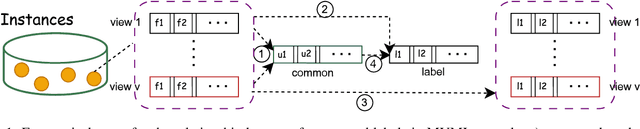
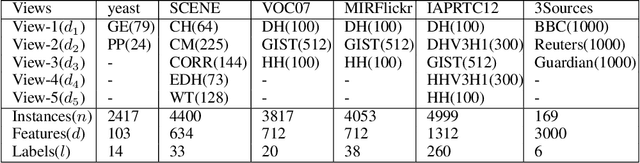
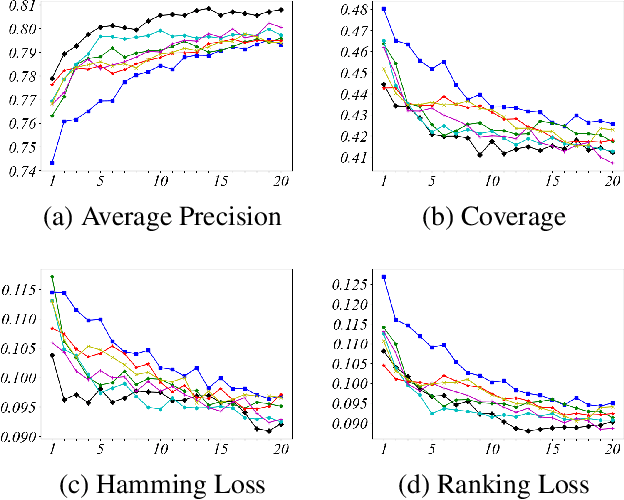
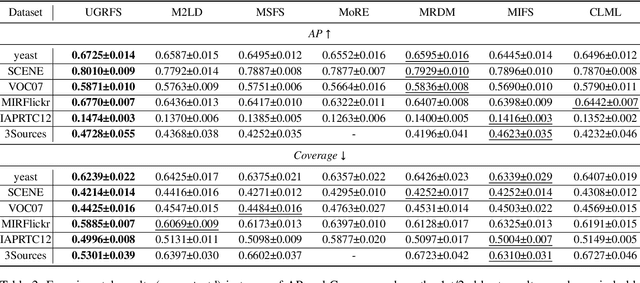
In recent years, multi-view multi-label learning (MVML) has gained popularity due to its close resemblance to real-world scenarios. However, the challenge of selecting informative features to ensure both performance and efficiency remains a significant question in MVML. Existing methods often extract information separately from the consistency part and the complementary part, which may result in noise due to unclear segmentation. In this paper, we propose a unified model constructed from the perspective of global-view reconstruction. Additionally, while feature selection methods can discern the importance of features, they typically overlook the uncertainty of samples, which is prevalent in realistic scenarios. To address this, we incorporate the perception of sample uncertainty during the reconstruction process to enhance trustworthiness. Thus, the global-view is reconstructed through the graph structure between samples, sample confidence, and the view relationship. The accurate mapping is established between the reconstructed view and the label matrix. Experimental results demonstrate the superior performance of our method on multi-view datasets.