 Add to Chrome
 Add to Firefox
 Add to Edge
Respect Your Zero-Shot Uncertainty: Conservative Calibration for Test-Time-Adapted Vision-Language Models
Aug 06, 2026
Test-time adaptation (TTA) can improve the recognition accuracy of vision-language models under distribution shift, but often degrades calibration, making predictive confidence unreliable for downstream decision-making. Many existing label-free calibration approaches are either coupled to prompt optimization or rely on logit-range statistics that provide only a coarse characterization of the predictive distribution. We show that TTA can increase confidence and reduce entropy even when the top-1 prediction and its correctness remain unchanged, a failure mode we term prediction-preserving sharpening. Across diverse TTA methods and benchmarks, larger entropy reductions relative to paired zero-shot predictions are associated with greater increases in Expected Calibration Error (ECE). On entropy-reduced samples, confidence gains also tend to exceed accuracy gains. Based on these findings, we propose Zero-Shot-Anchored Entropy Calibration (ZAEC), a label-free post-hoc method that uses zero-shot entropy as a sample-specific uncertainty reference. ZAEC selectively restores the zero-shot entropy of sharpened predictions through minimal temperature scaling while leaving all other predictions unchanged. It requires no labeled calibration data or learned parameters and preserves class rankings and classification accuracy. Across five TTA methods and 15 datasets, ZAEC achieves the lowest post-hoc macro-average ECE on ViT-B/16, with consistent gains on RN50.

Von Mises-Fisher Mixture Model with Dynamic Shrinkage for Realistic Test-Time Transduction
Jul 17, 2026A range of methods aim to enhance the performance of vision-language models (VLMs) at test time. Among them, transduction has emerged as a promising paradigm due to its strong compatibility and efficiency. However, realistic evaluations often involve highly imbalanced class distributions, which cause performance degradation or even collapse. In this work, we systematically revisit transduction from the perspective of penalized likelihood estimation (PLE), showing that PLE with a KL-divergence anchor term naturally yields an adaptive shrinkage behavior between prior anchors and empirical estimates. From this viewpoint, the brittleness of transductive methods can be attributed to the absence of anchoring mechanism and static modeling of the shrinkage strength. Therefore, we propose Mixture of Von Mises-Fisher Models with Dynamic Shrinkage (MOON). MOON is built upon a mixture of von Mises-Fisher distributions to model feature representations on the unit hypersphere. To handle imbalance, MOON dynamically adjusts the shrinkage strength using zero-shot priors at both instance and class levels. Thus, it suppresses unreliable assignments and prevents harmful updates from outlier classes, thereby mitigating negative transfer. MOON is model-agnostic, training-free, and requires no task-specific hyperparameter tuning. Extensive experiments further validate the advantage of MOON in both performance and efficiency. Our code is available at https://github.com/walawalagoose/MOON
* Accepted by ICML 2026
What Drives Test-Time Adaptation for CLIP? A Controlled Empirical Study from an Update Perspective
Jun 12, 2026Vision-Language Models (VLMs) such as CLIP have become a standard backbone for open-vocabulary recognition, yet their zero-shot predictions remain vulnerable to distribution shifts encountered at deployment. Test-Time Adaptation (TTA) has recently been extended to CLIP as a lightweight solution, leading to a rapidly growing body of TTA4CLIP methods. However, empirical progress in this area has largely outpaced our understanding of what truly drives adaptation, where their gains originate, and under which shifts they remain reliable. In this paper, we take a step back from the pursuit of state-of-the-art accuracy and conduct a systematic controlled study of TTA4CLIP. We first organize existing methods into three unified paradigms according to what is updated at test time. We then introduce TTABC, an open-source TTA Benchmark for CLIP, which standardizes evaluation protocols and integrates more than 20 representative methods. Our controlled empirical analysis focuses on three key areas. First, we determine the driving factors in parameter-based methods, revealing that adaptation gains are primarily driven by test-time evidence and reliable proxies rather than heavy optimization. Second, we explore evidence utilization beyond heavy parameter tuning, showing that competitive and efficient performance can be achieved through cross- or current-sample evidence and lightweight prototype updates. Finally, we demonstrate that there is no silver bullet for TTA: no single adaptation paradigm is universally optimal, and the preferred paradigm depends on the nature of shift. We hope our benchmark and study provide a clearer understanding of the current TTA4CLIP landscape and establish a foundation for further research.
Skill-Conditioned Gated Self-Distillation for LLM Reasoning
May 27, 2026On-policy self-distillation (SD) improves LLM reasoning by using teacher-side privileged information (PI) to turn sparse verifier outcomes into dense token-level supervision. Existing methods usually assume trusted PI, such as reference answers or successful traces. We ask whether PI can instead come from an experience-derived skill bank, where retrieved skills are compact and reusable but may also be irrelevant or misleading. We propose Skill-Conditioned Gated Self-Distillation (SGSD), which formulates skill-based SD as teacher hypothesis validation rather than unconditional imitation. SGSD retrieves skill-mistake pairs, constructs a multi-teacher pool, and lets all skill-conditioned teachers score the same plain-prompt student rollout. The verifier validates each teacher's polarity: supporting a success or suppressing a failure gives positive supervision, while the opposite stance is reversed. A robust gated objective then distills informative teacher-student disagreements while suppressing uncertain or extreme signals. Experiments on multiple mathematical reasoning benchmarks show that SGSD consistently improves over GRPO and remains competitive with answer-conditioned OPSD under a weaker PI assumption. For example, on Qwen3-1.7B, SGSD outperforms GRPO by 6.2% and OPSD by 1.7% on average on AIME24, AIME25, and HMMT25. Our code is available at https://github.com/walawalagoose/SGSD.
Neural Collapse in Test-Time Adaptation
Dec 11, 2025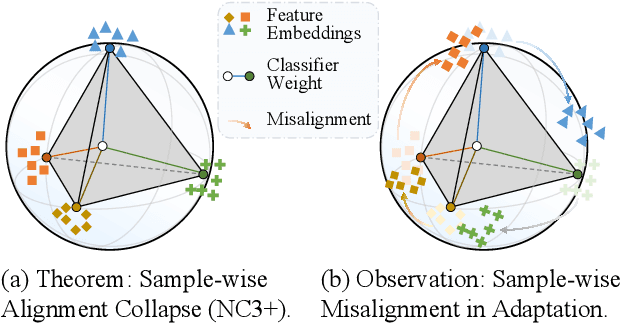
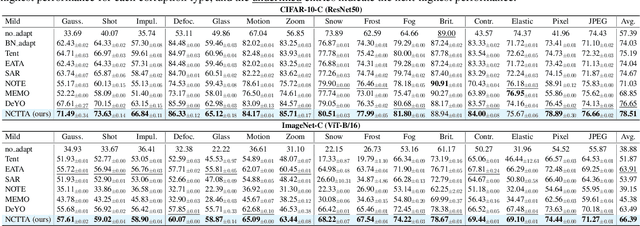
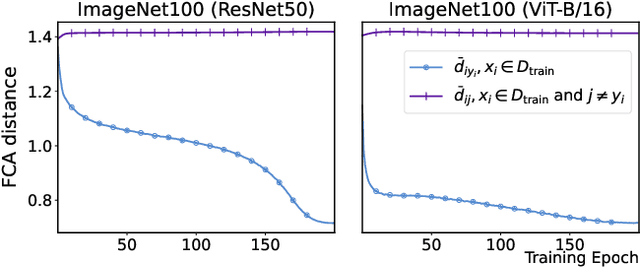
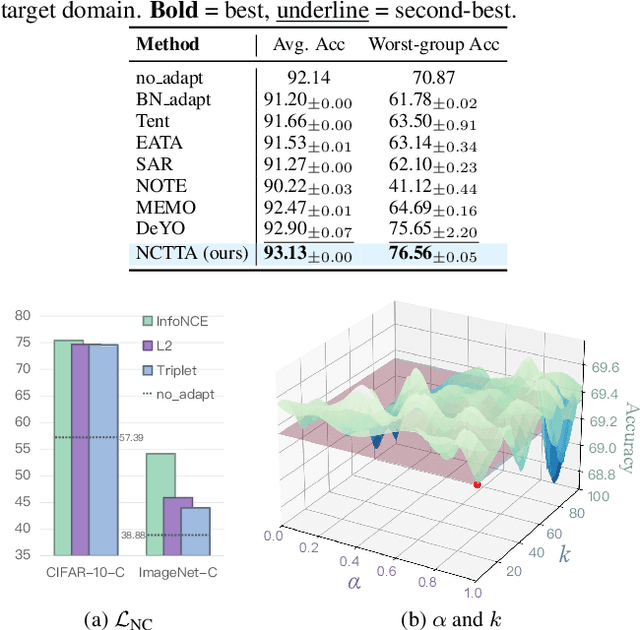
Test-Time Adaptation (TTA) enhances model robustness to out-of-distribution (OOD) data by updating the model online during inference, yet existing methods lack theoretical insights into the fundamental causes of performance degradation under domain shifts. Recently, Neural Collapse (NC) has been proposed as an emergent geometric property of deep neural networks (DNNs), providing valuable insights for TTA. In this work, we extend NC to the sample-wise level and discover a novel phenomenon termed Sample-wise Alignment Collapse (NC3+), demonstrating that a sample's feature embedding, obtained by a trained model, aligns closely with the corresponding classifier weight. Building on NC3+, we identify that the performance degradation stems from sample-wise misalignment in adaptation which exacerbates under larger distribution shifts. This indicates the necessity of realigning the feature embeddings with their corresponding classifier weights. However, the misalignment makes pseudo-labels unreliable under domain shifts. To address this challenge, we propose NCTTA, a novel feature-classifier alignment method with hybrid targets to mitigate the impact of unreliable pseudo-labels, which blends geometric proximity with predictive confidence. Extensive experiments demonstrate the effectiveness of NCTTA in enhancing robustness to domain shifts. For example, NCTTA outperforms Tent by 14.52% on ImageNet-C.