 Add to Chrome
 Add to Firefox
 Add to Edge
TinyGLASS: Real-Time Self-Supervised In-Sensor Anomaly Detection
Mar 17, 2026
Anomaly detection plays a key role in industrial quality control, where defects must be identified despite the scarcity of labeled faulty samples. Recent self-supervised approaches, such as GLASS, learn normal visual patterns using only defect-free data and have shown strong performance on industrial benchmarks. However, their computational requirements limit deployment on resource-constrained edge platforms. This work introduces TinyGLASS, a lightweight adaptation of the GLASS framework designed for real-time in-sensor anomaly detection on the Sony IMX500 intelligent vision sensor. The proposed architecture replaces the original WideResNet-50 backbone with a compact ResNet-18 and introduces deployment-oriented modifications that enable static graph tracing and INT8 quantization using Sony's Model Compression Toolkit. In addition to evaluating performance on the MVTec-AD benchmark, we investigate robustness to contaminated training data and introduce a custom industrial dataset, named MMS Dataset, for cross-device evaluation. Experimental results show that TinyGLASS achieves 8.7x parameter compression while maintaining competitive detection performance, reaching 94.2% image-level AUROC on MVTec-AD and operating at 20 FPS within the 8 MB memory constraints of the IMX500 platform. System profiling demonstrates low power consumption (4.0 mJ per inference), real-time end-to-end latency (20 FPS), and high energy efficiency (470 GMAC/J). Furthermore, the model maintains stable performance under moderate levels of training data contamination.

Block Expanded DINORET: Adapting Natural Domain Foundation Models for Retinal Imaging Without Catastrophic Forgetting
Sep 25, 2024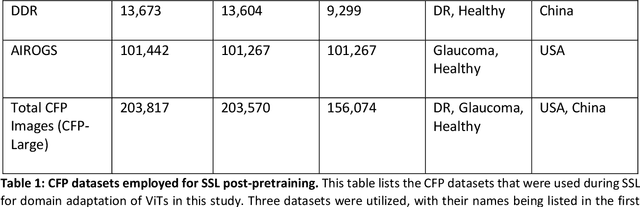
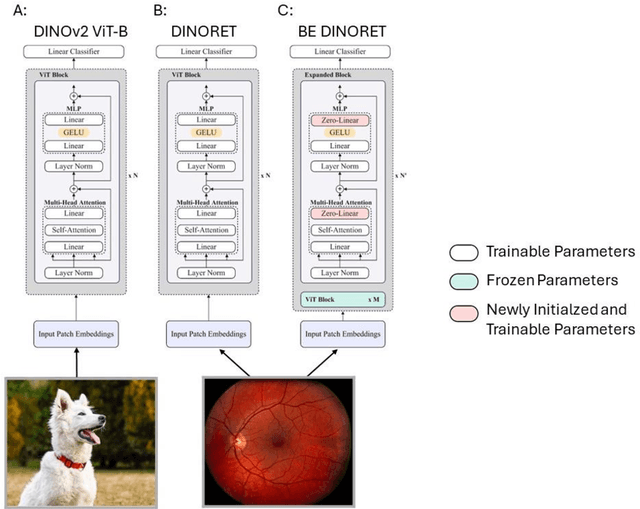
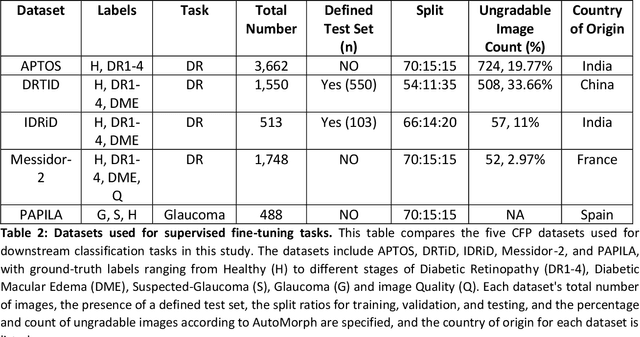
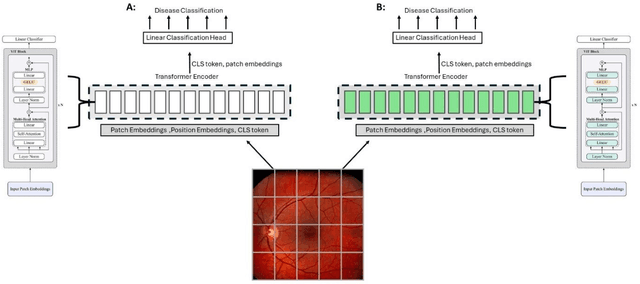
Integrating deep learning into medical imaging is poised to greatly advance diagnostic methods but it faces challenges with generalizability. Foundation models, based on self-supervised learning, address these issues and improve data efficiency. Natural domain foundation models show promise for medical imaging, but systematic research evaluating domain adaptation, especially using self-supervised learning and parameter-efficient fine-tuning, remains underexplored. Additionally, little research addresses the issue of catastrophic forgetting during fine-tuning of foundation models. We adapted the DINOv2 vision transformer for retinal imaging classification tasks using self-supervised learning and generated two novel foundation models termed DINORET and BE DINORET. Publicly available color fundus photographs were employed for model development and subsequent fine-tuning for diabetic retinopathy staging and glaucoma detection. We introduced block expansion as a novel domain adaptation strategy and assessed the models for catastrophic forgetting. Models were benchmarked to RETFound, a state-of-the-art foundation model in ophthalmology. DINORET and BE DINORET demonstrated competitive performance on retinal imaging tasks, with the block expanded model achieving the highest scores on most datasets. Block expansion successfully mitigated catastrophic forgetting. Our few-shot learning studies indicated that DINORET and BE DINORET outperform RETFound in terms of data-efficiency. This study highlights the potential of adapting natural domain vision models to retinal imaging using self-supervised learning and block expansion. BE DINORET offers robust performance without sacrificing previously acquired capabilities. Our findings suggest that these methods could enable healthcare institutions to develop tailored vision models for their patient populations, enhancing global healthcare inclusivity.