 Add to Chrome
 Add to Firefox
 Add to Edge
MolmoAct2: Action Reasoning Models for Real-world Deployment
May 04, 2026
Vision-Language-Action (VLA) models aim to provide a single generalist controller for robots, but today's systems fall short on the criteria that matter for real-world deployment. Frontier models are closed, open-weight alternatives are tied to expensive hardware, reasoning-augmented policies pay prohibitive latency for their grounding, and fine-tuned success rates remain below the threshold for dependable use. We present MolmoAct2, a fully open action reasoning model built for practical deployment, advancing its predecessor along five axes. We introduce MolmoER, a VLM backbone specialized for spatial and embodied reasoning, trained on a 3.3M-sample corpus with a specialize-then-rehearse recipe. We release three new datasets spanning low-to-medium cost platforms, including MolmoAct2-BimanualYAM, 720 hours of teleoperated bimanual trajectories that constitute the largest open bimanual dataset to date, together with quality-filtered Franka (DROID) and SO100/101 subsets. We provide OpenFAST, an open-weight, open-data action tokenizer trained on millions of trajectories across five embodiments. We redesign the architecture to graft a flow-matching continuous-action expert onto a discrete-token VLM via per-layer KV-cache conditioning. Finally, we propose MolmoThink, an adaptive-depth reasoning variant that re-predicts depth tokens only for scene regions that change between timesteps, retaining geometric grounding at a fraction of prior latency. In the most extensive empirical study of any open VLA to date, spanning 7 simulation and real-world benchmarks, MolmoAct2 outperforms strong baselines including Pi-05, while MolmoER surpasses GPT-5 and Gemini Robotics ER-1.5 across 13 embodied-reasoning benchmarks. We release model weights, training code, and complete training data. Project page: https://allenai.org/blog/molmoact2

MolmoWeb: Open Visual Web Agent and Open Data for the Open Web
Apr 09, 2026Web agents--autonomous systems that navigate and execute tasks on the web on behalf of users--have the potential to transform how people interact with the digital world. However, the most capable web agents today rely on proprietary models with undisclosed training data and recipes, limiting scientific understanding, reproducibility, and community-driven progress. We believe agents for the open web should be built in the open. To this end, we introduce (1) MolmoWebMix, a large and diverse mixture of browser task demonstrations and web-GUI perception data and (2) MolmoWeb, a family of fully open multimodal web agents. Specifically, MolmoWebMix combines over 100K synthetic task trajectories from multiple complementary generation pipelines with 30K+ human demonstrations, atomic web-skill trajectories, and GUI perception data, including referring expression grounding and screenshot question answering. MolmoWeb agents operate as instruction-conditioned visual-language action policies: given a task instruction and a webpage screenshot, they predict the next browser action, requiring no access to HTML, accessibility trees, or specialized APIs. Available in 4B and 8B size, on browser-use benchmarks like WebVoyager, Online-Mind2Web, and DeepShop, MolmoWeb agents achieve state-of-the-art results outperforming similar scale open-weight-only models such as Fara-7B, UI-Tars-1.5-7B, and Holo1-7B. MolmoWeb-8B also surpasses set-of-marks (SoM) agents built on much larger closed frontier models like GPT-4o. We further demonstrate consistent gains through test-time scaling via parallel rollouts with best-of-N selection, achieving 94.7% and 60.5% pass@4 (compared to 78.2% and 35.3% pass@1) on WebVoyager and Online-Mind2Web respectively. We will release model checkpoints, training data, code, and a unified evaluation harness to enable reproducibility and accelerate open research on web agents.
From Kernels to Attention: A Transformer Framework for Density and Score Estimation
Nov 08, 2025We introduce a unified attention-based framework for joint score and density estimation. Framing the problem as a sequence-to-sequence task, we develop a permutation- and affine-equivariant transformer that estimates both the probability density $f(x)$ and its score $\nabla_x \log f(x)$ directly from i.i.d. samples. Unlike traditional score-matching methods that require training a separate model for each distribution, our approach learns a single distribution-agnostic operator that generalizes across densities and sample sizes. The architecture employs cross-attention to connect observed samples with arbitrary query points, enabling generalization beyond the training data, while built-in symmetry constraints ensure equivariance to permutation and affine transformations. Analytically, we show that the attention weights can recover classical kernel density estimation (KDE), and verify it empirically, establishing a principled link between classical KDE and the transformer architecture. Empirically, the model achieves substantially lower error and better scaling than KDE and score-debiased KDE (SD-KDE), while exhibiting better runtime scaling. Together, these results establish transformers as general-purpose, data-adaptive operators for nonparametric density and score estimation.
REALEDIT: Reddit Edits As a Large-scale Empirical Dataset for Image Transformations
Feb 05, 2025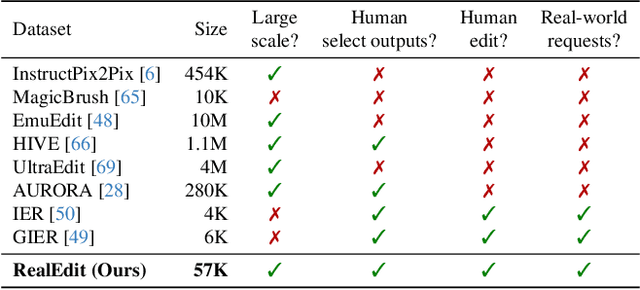
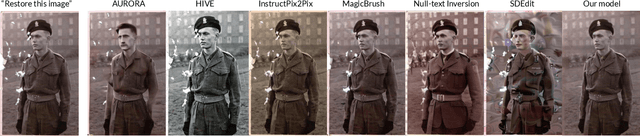


Existing image editing models struggle to meet real-world demands. Despite excelling in academic benchmarks, they have yet to be widely adopted for real user needs. Datasets that power these models use artificial edits, lacking the scale and ecological validity necessary to address the true diversity of user requests. We introduce REALEDIT, a large-scale image editing dataset with authentic user requests and human-made edits sourced from Reddit. REALEDIT includes a test set of 9300 examples to evaluate models on real user requests. Our results show that existing models fall short on these tasks, highlighting the need for realistic training data. To address this, we introduce 48K training examples and train our REALEDIT model, achieving substantial gains - outperforming competitors by up to 165 Elo points in human judgment and 92 percent relative improvement on the automated VIEScore metric. We deploy our model on Reddit, testing it on new requests, and receive positive feedback. Beyond image editing, we explore REALEDIT's potential in detecting edited images by partnering with a deepfake detection non-profit. Finetuning their model on REALEDIT data improves its F1-score by 14 percentage points, underscoring the dataset's value for broad applications.