 Add to Chrome
 Add to Firefox
 Add to Edge
Coresets Before Score Sets: Evaluation-Unsupervised Prompt Subset Selection for LLM Benchmarks
Jul 02, 2026
We study LLM benchmark coreset selection: selecting a small subset of prompts over multiple benchmarks whose induced model scores and rankings approximate those obtained from the full benchmark suite. In evaluation-unsupervised benchmark coreset selection (our approach), the selection algorithm uses no model evaluation outcomes, and operates on a fine granularity by producing subsets of prompts over multiple benchmarks rather than producing a sub-collection of entire benchmarks. We use submodular subset selection, and we develop and evaluate many different submodular functions for this purpose, including determinantal point process (DPP) based approaches, submodular mutual information functions, and facility location-based functions. On a new large-scale suite of 35 heterogeneous benchmarks spanning five different capability categories, 18 frontier LLMs, and over 61K prompts, we find that the facility location (FL) function operating exclusively on inexpensive semantic prompt embeddings preserves LLM scores better than twelve separate score-based and diversity-based baselines, across a range of coreset budgets. Moreover, we show our proposed objective is not limited to the evaluation-unsupervised regime: in the setting where only a handful of whole benchmarks must be selected and a large amount of model scores are available, the same objective matches or outperforms state-of-the-art baselines on the MMLU and MTEB leaderboards, while being substantially cheaper to compute. Together, our results suggest that submodularity, in general, is a strong and reliable tool for benchmark compression.

Nemotron 3 Ultra: Open, Efficient Mixture-of-Experts Hybrid Mamba-Transformer Model for Agentic Reasoning
Jun 12, 2026We introduce Nemotron 3 Ultra, a 550 billion total and 55 billion active parameter Mixture-of-Experts Hybrid Mamba-Attention language model. We pre-trained Nemotron 3 Ultra on 20 trillion text tokens, then extended the context length to 1M tokens, and post-trained using Supervised Fine Tuning (SFT), Reinforcement Learning (RL), and Multi-teacher On-Policy Distillation (MOPD). Nemotron 3 Ultra is our most capable model yet, employing multiple key technologies - LatentMoE, Multi Token Prediction (MTP), NVFP4 pre-training, multi-environment RLVR, MOPD, and reasoning budget control. Nemotron 3 Ultra achieves up to ~6x higher inference throughput as compared to state-of-the-art publicly available LLMs while attaining on-par accuracy. The state-of-the-art accuracy, high inference throughput, and 1M token context length make Nemotron 3 Ultra ideal for long-running autonomous agentic tasks. We open-source the base, post-trained, and quantized checkpoints, along with the training data and recipe on HuggingFace.
Nemotron 3 Nano Omni: Efficient and Open Multimodal Intelligence
Apr 27, 2026We introduce Nemotron 3 Nano Omni, the latest model in the Nemotron multimodal series and the first to natively support audio inputs alongside text, images, and video. Nemotron 3 Nano Omni delivers consistent accuracy improvements over its predecessor, Nemotron Nano V2 VL, across all modalities, enabled by advances in architecture, training data and recipes. In particular, Nemotron 3 delivers leading results in real-world document understanding, long audio-video comprehension, and agentic computer use. Built on the highly efficient Nemotron 3 Nano 30B-A3B backbone, Nemotron 3 Nano Omni further incorporates innovative multimodal token-reduction techniques to deliver substantially lower inference latency and higher throughput than other models of similar size. We are releasing model checkpoints in BF16, FP8, and FP4 formats, along with portions of the training data and codebase to facilitate further research and development.
Nemotron 3 Super: Open, Efficient Mixture-of-Experts Hybrid Mamba-Transformer Model for Agentic Reasoning
Apr 14, 2026We describe the pre-training, post-training, and quantization of Nemotron 3 Super, a 120 billion (active 12 billion) parameter hybrid Mamba-Attention Mixture-of-Experts model. Nemotron 3 Super is the first model in the Nemotron 3 family to 1) be pre-trained in NVFP4, 2) leverage LatentMoE, a new Mixture-of-Experts architecture that optimizes for both accuracy per FLOP and accuracy per parameter, and 3) include MTP layers for inference acceleration through native speculative decoding. We pre-trained Nemotron 3 Super on 25 trillion tokens followed by post-training using supervised fine tuning (SFT) and reinforcement learning (RL). The final model supports up to 1M context length and achieves comparable accuracy on common benchmarks, while also achieving up to 2.2x and 7.5x higher inference throughput compared to GPT-OSS-120B and Qwen3.5-122B, respectively. Nemotron 3 Super datasets, along with the base, post-trained, and quantized checkpoints, are open-sourced on HuggingFace.
NVIDIA Nemotron 3: Efficient and Open Intelligence
Dec 24, 2025We introduce the Nemotron 3 family of models - Nano, Super, and Ultra. These models deliver strong agentic, reasoning, and conversational capabilities. The Nemotron 3 family uses a Mixture-of-Experts hybrid Mamba-Transformer architecture to provide best-in-class throughput and context lengths of up to 1M tokens. Super and Ultra models are trained with NVFP4 and incorporate LatentMoE, a novel approach that improves model quality. The two larger models also include MTP layers for faster text generation. All Nemotron 3 models are post-trained using multi-environment reinforcement learning enabling reasoning, multi-step tool use, and support granular reasoning budget control. Nano, the smallest model, outperforms comparable models in accuracy while remaining extremely cost-efficient for inference. Super is optimized for collaborative agents and high-volume workloads such as IT ticket automation. Ultra, the largest model, provides state-of-the-art accuracy and reasoning performance. Nano is released together with its technical report and this white paper, while Super and Ultra will follow in the coming months. We will openly release the model weights, pre- and post-training software, recipes, and all data for which we hold redistribution rights.
Nemotron 3 Nano: Open, Efficient Mixture-of-Experts Hybrid Mamba-Transformer Model for Agentic Reasoning
Dec 23, 2025We present Nemotron 3 Nano 30B-A3B, a Mixture-of-Experts hybrid Mamba-Transformer language model. Nemotron 3 Nano was pretrained on 25 trillion text tokens, including more than 3 trillion new unique tokens over Nemotron 2, followed by supervised fine tuning and large-scale RL on diverse environments. Nemotron 3 Nano achieves better accuracy than our previous generation Nemotron 2 Nano while activating less than half of the parameters per forward pass. It achieves up to 3.3x higher inference throughput than similarly-sized open models like GPT-OSS-20B and Qwen3-30B-A3B-Thinking-2507, while also being more accurate on popular benchmarks. Nemotron 3 Nano demonstrates enhanced agentic, reasoning, and chat abilities and supports context lengths up to 1M tokens. We release both our pretrained Nemotron 3 Nano 30B-A3B Base and post-trained Nemotron 3 Nano 30B-A3B checkpoints on Hugging Face.
NVIDIA Nemotron Nano V2 VL
Nov 07, 2025We introduce Nemotron Nano V2 VL, the latest model of the Nemotron vision-language series designed for strong real-world document understanding, long video comprehension, and reasoning tasks. Nemotron Nano V2 VL delivers significant improvements over our previous model, Llama-3.1-Nemotron-Nano-VL-8B, across all vision and text domains through major enhancements in model architecture, datasets, and training recipes. Nemotron Nano V2 VL builds on Nemotron Nano V2, a hybrid Mamba-Transformer LLM, and innovative token reduction techniques to achieve higher inference throughput in long document and video scenarios. We are releasing model checkpoints in BF16, FP8, and FP4 formats and sharing large parts of our datasets, recipes and training code.
Utility-Learning Tension in Self-Modifying Agents
Oct 05, 2025As systems trend toward superintelligence, a natural modeling premise is that agents can self-improve along every facet of their own design. We formalize this with a five-axis decomposition and a decision layer, separating incentives from learning behavior and analyzing axes in isolation. Our central result identifies and introduces a sharp utility--learning tension, the structural conflict in self-modifying systems whereby utility-driven changes that improve immediate or expected performance can also erode the statistical preconditions for reliable learning and generalization. Our findings show that distribution-free guarantees are preserved iff the policy-reachable model family is uniformly capacity-bounded; when capacity can grow without limit, utility-rational self-changes can render learnable tasks unlearnable. Under standard assumptions common in practice, these axes reduce to the same capacity criterion, yielding a single boundary for safe self-modification. Numerical experiments across several axes validate the theory by comparing destructive utility policies against our proposed two-gate policies that preserve learnability.
NVIDIA Nemotron Nano 2: An Accurate and Efficient Hybrid Mamba-Transformer Reasoning Model
Aug 21, 2025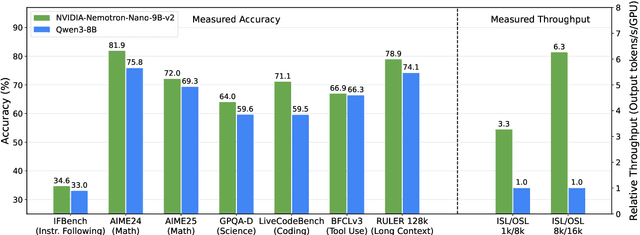

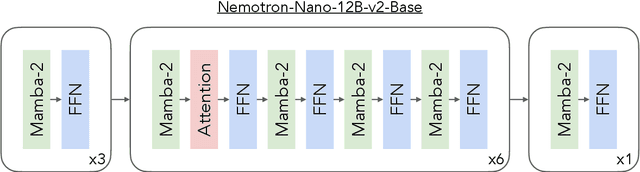
We introduce Nemotron-Nano-9B-v2, a hybrid Mamba-Transformer language model designed to increase throughput for reasoning workloads while achieving state-of-the-art accuracy compared to similarly-sized models. Nemotron-Nano-9B-v2 builds on the Nemotron-H architecture, in which the majority of the self-attention layers in the common Transformer architecture are replaced with Mamba-2 layers, to achieve improved inference speed when generating the long thinking traces needed for reasoning. We create Nemotron-Nano-9B-v2 by first pre-training a 12-billion-parameter model (Nemotron-Nano-12B-v2-Base) on 20 trillion tokens using an FP8 training recipe. After aligning Nemotron-Nano-12B-v2-Base, we employ the Minitron strategy to compress and distill the model with the goal of enabling inference on up to 128k tokens on a single NVIDIA A10G GPU (22GiB of memory, bfloat16 precision). Compared to existing similarly-sized models (e.g., Qwen3-8B), we show that Nemotron-Nano-9B-v2 achieves on-par or better accuracy on reasoning benchmarks while achieving up to 6x higher inference throughput in reasoning settings like 8k input and 16k output tokens. We are releasing Nemotron-Nano-9B-v2, Nemotron-Nano12B-v2-Base, and Nemotron-Nano-9B-v2-Base checkpoints along with the majority of our pre- and post-training datasets on Hugging Face.
Driving Safety Prediction and Safe Route Mapping Using In-vehicle and Roadside Data
Sep 12, 2022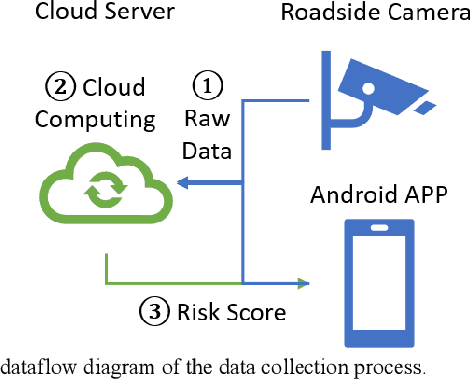
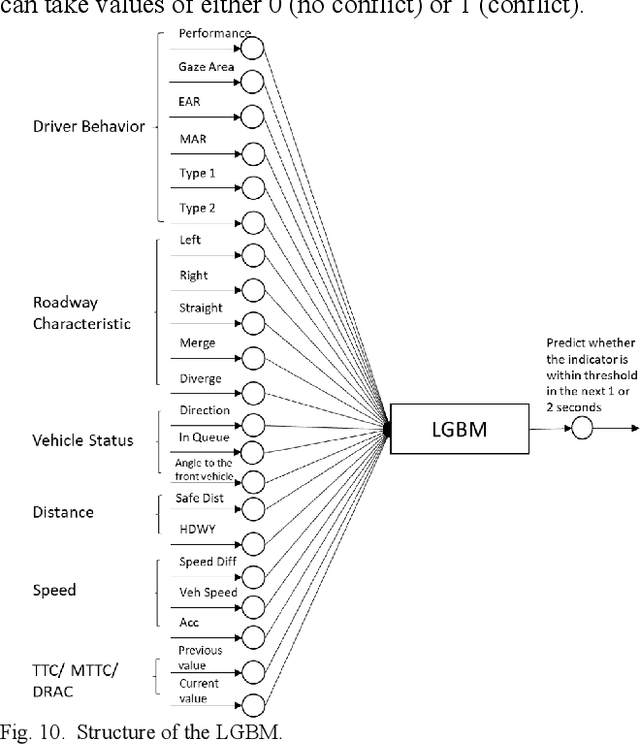
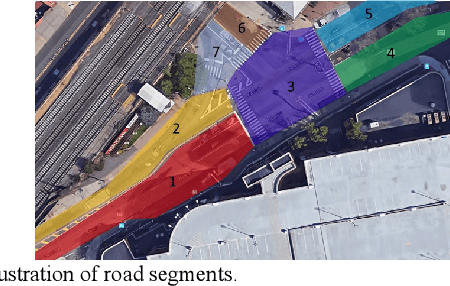
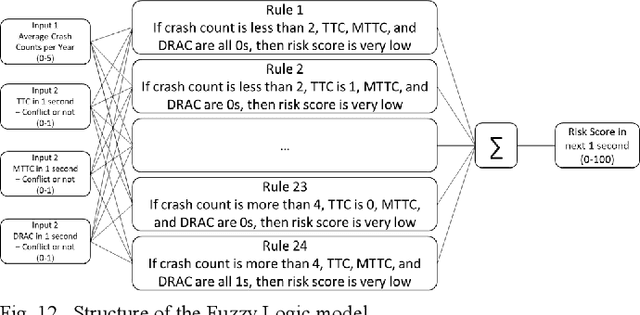
Risk assessment of roadways is commonly practiced based on historical crash data. Information on driver behaviors and real-time traffic situations is sometimes missing. In this paper, the Safe Route Mapping (SRM) model, a methodology for developing dynamic risk heat maps of roadways, is extended to consider driver behaviors when making predictions. An Android App is designed to gather drivers' information and upload it to a server. On the server, facial recognition extracts drivers' data, such as facial landmarks, gaze directions, and emotions. The driver's drowsiness and distraction are detected, and driving performance is evaluated. Meanwhile, dynamic traffic information is captured by a roadside camera and uploaded to the same server. A longitudinal-scanline-based arterial traffic video analytics is applied to recognize vehicles from the video to build speed and trajectory profiles. Based on these data, a LightGBM model is introduced to predict conflict indices for drivers in the next one or two seconds. Then, multiple data sources, including historical crash counts and predicted traffic conflict indicators, are combined using a Fuzzy logic model to calculate risk scores for road segments. The proposed SRM model is illustrated using data collected from an actual traffic intersection and a driving simulation platform. The prediction results show that the model is accurate, and the added driver behavior features will improve the model's performance. Finally, risk heat maps are generated for visualization purposes. The authorities can use the dynamic heat map to designate safe corridors and dispatch law enforcement and drivers for early warning and trip planning.