 Add to Chrome
 Add to Firefox
 Add to Edge
IKNO: Infinite-order Kernel Neural Operators
May 21, 2026
Neural operators have achieved significant success in modern scientific computing due to their flexibility and strong generalization capabilities. Existing models, however, primarily rely on first-order kernel integral approximations, which severely limit their expressivity. To address this, we propose the Infinite-order Kernel Neural Operator (IKNO), which constructs neural operators via infinite-order kernel integrals and admits an elegant closed-form finite approximation. We develop two complementary infinite-order neural operator constructions: IKNO-Vanilla, which applies the full-kernel resolvent on the product grid via Kronecker eigendecomposition, and IKNO-TP, an alternative tensor-product operator that composes per-axis resolvents. Furthermore, we develop fast computation schemes for both variants of IKNO, which achieve outstanding global information aggregation while maintaining high computational efficiency. Empirically, we evaluate our IKNO on both time-dependent and time-independent benchmarks with arbitrary input shapes, including large-scale industrial datasets. Extensive experiments demonstrate that the IKNO method consistently achieves the SOTA accuracy with significant improvements on nearly all benchmark datasets while maintaining scalability to very large point clouds.

GPT Paternity Test: GPT Generated Text Detection with GPT Genetic Inheritance
May 21, 2023
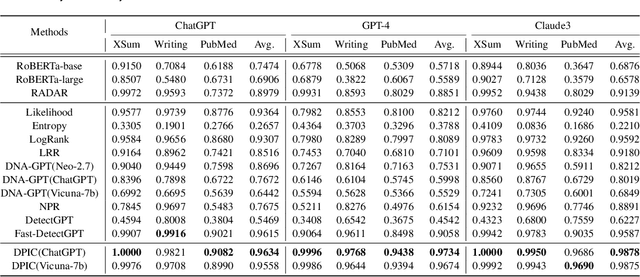
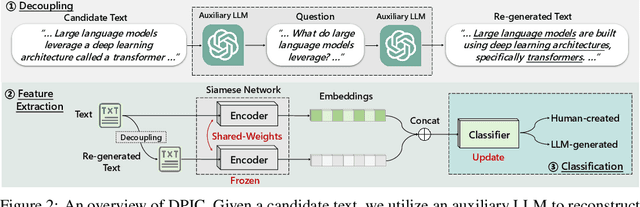
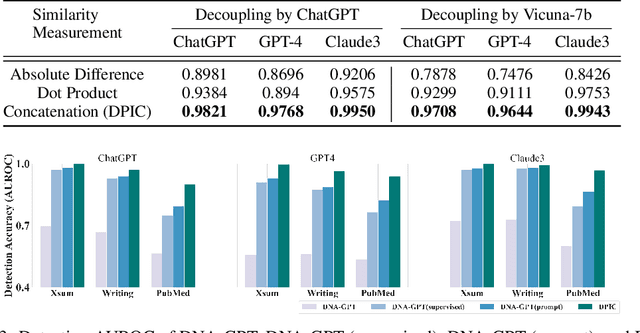
Large Language Models (LLMs) can generate texts that carry the risk of various misuses, including plagiarism, planting fake reviews on e-commerce platforms, or creating fake social media postings that can sway election results. Detecting whether a text is machine-generated has thus become increasingly important. While machine-learning-based detection strategies exhibit superior performance, they often lack generalizability, limiting their practicality. In this work, we introduce GPT Paternity Test (GPT-Pat), which reliably detects machine-generated text across varied datasets. Given a text under scrutiny, we leverage ChatGPT to generate a corresponding question and provide a re-answer to the question. By comparing the similarity between the original text and the generated re-answered text, it can be determined whether the text is machine-generated. GPT-Pat consists of a Siamese network to compute the similarity between the original text and the generated re-answered text and a binary classifier. Our method achieved an average accuracy of 94.57% on four generalization test sets, surpassing the state-of-the-art RoBERTa-based method by 12.34%. The accuracy drop of our method is only about half of that of the RoBERTa-based method when it is attacked by re-translation and polishing.