 Add to Chrome
 Add to Firefox
 Add to Edge
One-Eval: An Agentic System for Automated and Traceable LLM Evaluation
Mar 10, 2026
Reliable evaluation is essential for developing and deploying large language models, yet in practice it often requires substantial manual effort: practitioners must identify appropriate benchmarks, reproduce heterogeneous evaluation codebases, configure dataset schema mappings, and interpret aggregated metrics. To address these challenges, we present One-Eval, an agentic evaluation system that converts natural-language evaluation requests into executable, traceable, and customizable evaluation workflows. One-Eval integrates (i) NL2Bench for intent structuring and personalized benchmark planning, (ii) BenchResolve for benchmark resolution, automatic dataset acquisition, and schema normalization to ensure executability, and (iii) Metrics \& Reporting for task-aware metric selection and decision-oriented reporting beyond scalar scores. The system further incorporates human-in-the-loop checkpoints for review, editing, and rollback, while preserving sample evidence trails for debugging and auditability. Experiments show that One-Eval can execute end-to-end evaluations from diverse natural-language requests with minimal user effort, supporting more efficient and reproducible evaluation in industrial settings. Our framework is publicly available at https://github.com/OpenDCAI/One-Eval.

DataFlow: An LLM-Driven Framework for Unified Data Preparation and Workflow Automation in the Era of Data-Centric AI
Dec 18, 2025The rapidly growing demand for high-quality data in Large Language Models (LLMs) has intensified the need for scalable, reliable, and semantically rich data preparation pipelines. However, current practices remain dominated by ad-hoc scripts and loosely specified workflows, which lack principled abstractions, hinder reproducibility, and offer limited support for model-in-the-loop data generation. To address these challenges, we present DataFlow, a unified and extensible LLM-driven data preparation framework. DataFlow is designed with system-level abstractions that enable modular, reusable, and composable data transformations, and provides a PyTorch-style pipeline construction API for building debuggable and optimizable dataflows. The framework consists of nearly 200 reusable operators and six domain-general pipelines spanning text, mathematical reasoning, code, Text-to-SQL, agentic RAG, and large-scale knowledge extraction. To further improve usability, we introduce DataFlow-Agent, which automatically translates natural-language specifications into executable pipelines via operator synthesis, pipeline planning, and iterative verification. Across six representative use cases, DataFlow consistently improves downstream LLM performance. Our math, code, and text pipelines outperform curated human datasets and specialized synthetic baselines, achieving up to +3\% execution accuracy in Text-to-SQL over SynSQL, +7\% average improvements on code benchmarks, and 1--3 point gains on MATH, GSM8K, and AIME. Moreover, a unified 10K-sample dataset produced by DataFlow enables base models to surpass counterparts trained on 1M Infinity-Instruct data. These results demonstrate that DataFlow provides a practical and high-performance substrate for reliable, reproducible, and scalable LLM data preparation, and establishes a system-level foundation for future data-centric AI development.
SAS-Bench: A Fine-Grained Benchmark for Evaluating Short Answer Scoring with Large Language Models
May 15, 2025Subjective Answer Grading (SAG) plays a crucial role in education, standardized testing, and automated assessment systems, particularly for evaluating short-form responses in Short Answer Scoring (SAS). However, existing approaches often produce coarse-grained scores and lack detailed reasoning. Although large language models (LLMs) have demonstrated potential as zero-shot evaluators, they remain susceptible to bias, inconsistencies with human judgment, and limited transparency in scoring decisions. To overcome these limitations, we introduce SAS-Bench, a benchmark specifically designed for LLM-based SAS tasks. SAS-Bench provides fine-grained, step-wise scoring, expert-annotated error categories, and a diverse range of question types derived from real-world subject-specific exams. This benchmark facilitates detailed evaluation of model reasoning processes and explainability. We also release an open-source dataset containing 1,030 questions and 4,109 student responses, each annotated by domain experts. Furthermore, we conduct comprehensive experiments with various LLMs, identifying major challenges in scoring science-related questions and highlighting the effectiveness of few-shot prompting in improving scoring accuracy. Our work offers valuable insights into the development of more robust, fair, and educationally meaningful LLM-based evaluation systems.
Improving Low-Resource Sequence Labeling with Knowledge Fusion and Contextual Label Explanations
Jan 31, 2025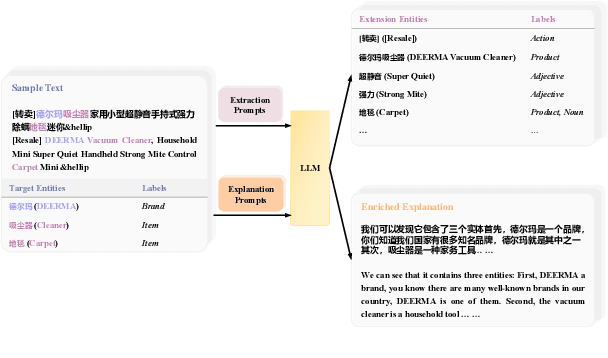
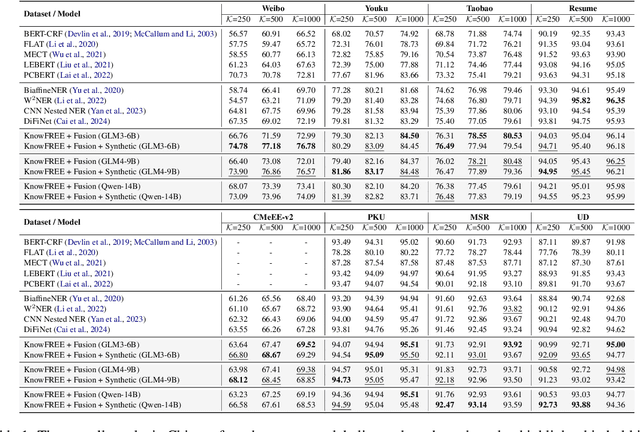
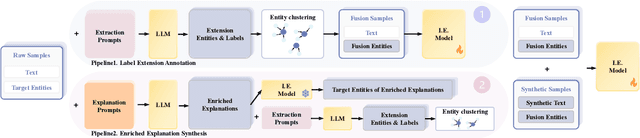
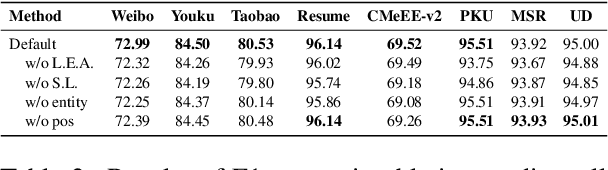
Sequence labeling remains a significant challenge in low-resource, domain-specific scenarios, particularly for character-dense languages like Chinese. Existing methods primarily focus on enhancing model comprehension and improving data diversity to boost performance. However, these approaches still struggle with inadequate model applicability and semantic distribution biases in domain-specific contexts. To overcome these limitations, we propose a novel framework that combines an LLM-based knowledge enhancement workflow with a span-based Knowledge Fusion for Rich and Efficient Extraction (KnowFREE) model. Our workflow employs explanation prompts to generate precise contextual interpretations of target entities, effectively mitigating semantic biases and enriching the model's contextual understanding. The KnowFREE model further integrates extension label features, enabling efficient nested entity extraction without relying on external knowledge during inference. Experiments on multiple Chinese domain-specific sequence labeling datasets demonstrate that our approach achieves state-of-the-art performance, effectively addressing the challenges posed by low-resource settings.