 Add to Chrome
 Add to Firefox
 Add to Edge
Toward Automated Detection of Documentation Inconsistencies in Electronic Health Records
Jul 24, 2026
Objective: To characterize the kinds of internal documentation inconsistencies a general-domain large language model (LLM) can surface from real-world discharge summaries, and to identify recurring failure modes that limit reliability at scale. Materials and Methods: We applied a two-stage LLM pipeline---open-ended candidate identification (Gemini 2.5 Pro) followed by context-grounded verification (Gemini 2.5 Flash)---to 3,000 randomly sampled MIMIC-IV-Note discharge summaries. A subset of the pipeline output was then reviewed manually by clinical experts. Results: Our pipeline surfaced 3,460 candidate inconsistencies, affecting 69.7% of admissions. Representative examples spanned demographics, allergies, procedures, diagnoses, laboratory, medications, and care-planning domains, with direct implications for clinical reasoning or patient safety. Expert review also revealed recurring failure modes that arise when verification requires temporal reasoning, evolving-diagnosis context, or knowledge of outpatient-prescribing conventions the model does not natively possess. Discussion: Detection is highly context-dependent: many flagged pairs require anchoring each statement to its source section and clinical domain, then assessing whether the conflict reflects a true contradiction or missing context. We propose a graded ontology spanning strict contradiction and ambiguity, with a schema characterizing each flagged case by category, section, domain, and inconsistency axis. Conclusion: This formative study establishes a methodological foundation and conceptual framework to guide subsequent validated, large-scale EHR-inconsistency analysis.

Models That Are Interpretable But Not Transparent
Feb 26, 2025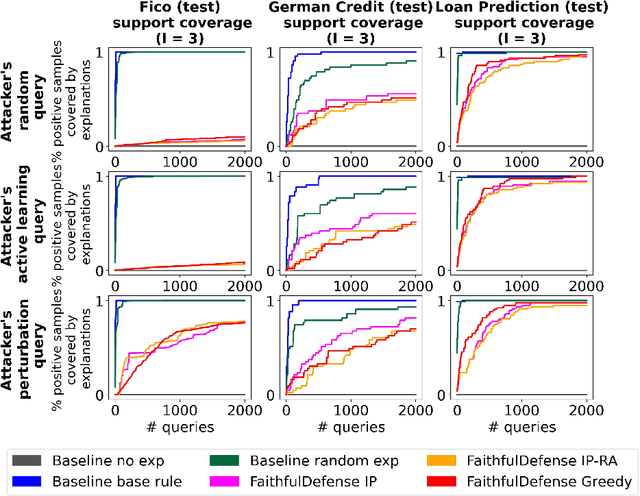
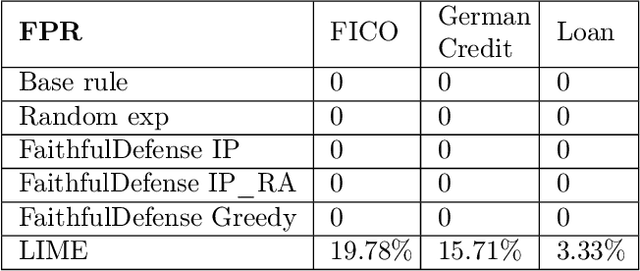
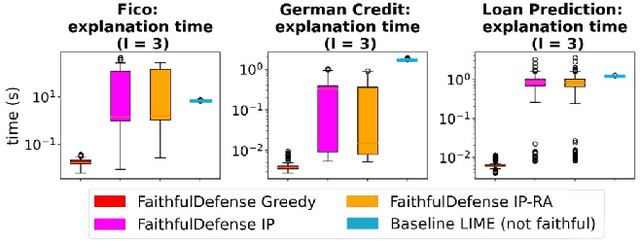
Faithful explanations are essential for machine learning models in high-stakes applications. Inherently interpretable models are well-suited for these applications because they naturally provide faithful explanations by revealing their decision logic. However, model designers often need to keep these models proprietary to maintain their value. This creates a tension: we need models that are interpretable--allowing human decision-makers to understand and justify predictions, but not transparent, so that the model's decision boundary is not easily replicated by attackers. Shielding the model's decision boundary is particularly challenging alongside the requirement of completely faithful explanations, since such explanations reveal the true logic of the model for an entire subspace around each query point. This work provides an approach, FaithfulDefense, that creates model explanations for logical models that are completely faithful, yet reveal as little as possible about the decision boundary. FaithfulDefense is based on a maximum set cover formulation, and we provide multiple formulations for it, taking advantage of submodularity.
Kuaiji: the First Chinese Accounting Large Language Model
Feb 24, 2024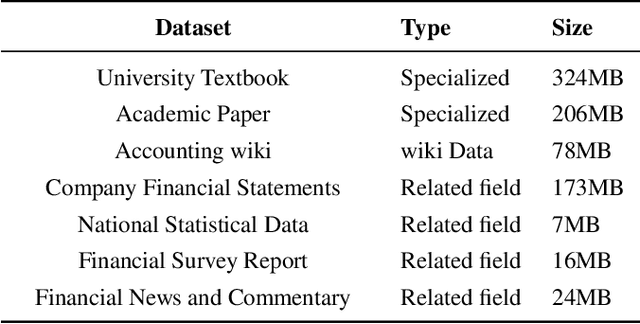
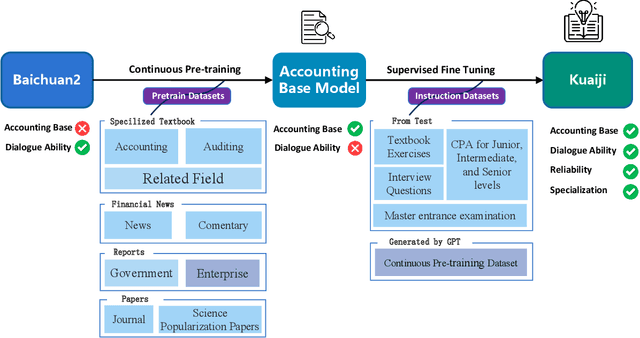
Large Language Models (LLMs) like ChatGPT and GPT-4 have demonstrated impressive proficiency in comprehending and generating natural language. However, they encounter difficulties when tasked with adapting to specialized domains such as accounting. To address this challenge, we introduce Kuaiji, a tailored Accounting Large Language Model. Kuaiji is meticulously fine-tuned using the Baichuan framework, which encompasses continuous pre-training and supervised fine-tuning processes. Supported by CAtAcctQA, a dataset containing large genuine accountant-client dialogues, Kuaiji exhibits exceptional accuracy and response speed. Our contributions encompass the creation of the first Chinese accounting dataset, the establishment of Kuaiji as a leading open-source Chinese accounting LLM, and the validation of its efficacy through real-world accounting scenarios.