 Add to Chrome
 Add to Firefox
 Add to Edge
Toward Automated Detection of Documentation Inconsistencies in Electronic Health Records
Jul 24, 2026
Objective: To characterize the kinds of internal documentation inconsistencies a general-domain large language model (LLM) can surface from real-world discharge summaries, and to identify recurring failure modes that limit reliability at scale. Materials and Methods: We applied a two-stage LLM pipeline---open-ended candidate identification (Gemini 2.5 Pro) followed by context-grounded verification (Gemini 2.5 Flash)---to 3,000 randomly sampled MIMIC-IV-Note discharge summaries. A subset of the pipeline output was then reviewed manually by clinical experts. Results: Our pipeline surfaced 3,460 candidate inconsistencies, affecting 69.7% of admissions. Representative examples spanned demographics, allergies, procedures, diagnoses, laboratory, medications, and care-planning domains, with direct implications for clinical reasoning or patient safety. Expert review also revealed recurring failure modes that arise when verification requires temporal reasoning, evolving-diagnosis context, or knowledge of outpatient-prescribing conventions the model does not natively possess. Discussion: Detection is highly context-dependent: many flagged pairs require anchoring each statement to its source section and clinical domain, then assessing whether the conflict reflects a true contradiction or missing context. We propose a graded ontology spanning strict contradiction and ambiguity, with a schema characterizing each flagged case by category, section, domain, and inconsistency axis. Conclusion: This formative study establishes a methodological foundation and conceptual framework to guide subsequent validated, large-scale EHR-inconsistency analysis.

Unsupervised Discovery of Clinical Disease Signatures Using Probabilistic Independence
Feb 08, 2024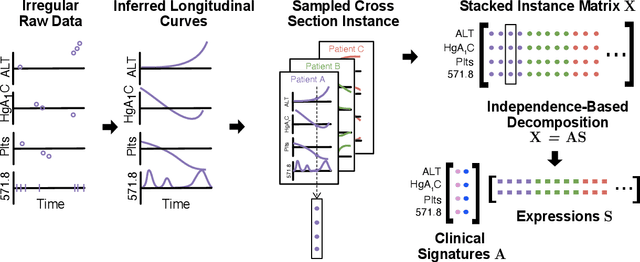
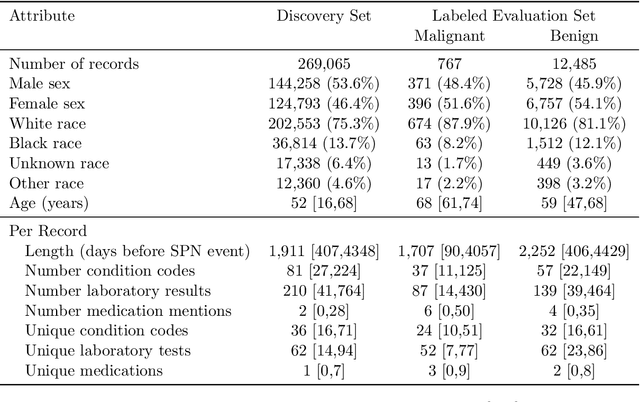

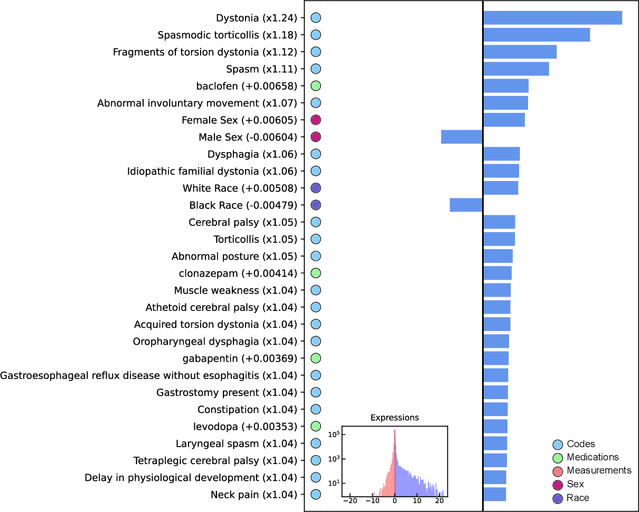
Insufficiently precise diagnosis of clinical disease is likely responsible for many treatment failures, even for common conditions and treatments. With a large enough dataset, it may be possible to use unsupervised machine learning to define clinical disease patterns more precisely. We present an approach to learning these patterns by using probabilistic independence to disentangle the imprint on the medical record of causal latent sources of disease. We inferred a broad set of 2000 clinical signatures of latent sources from 9195 variables in 269,099 Electronic Health Records. The learned signatures produced better discrimination than the original variables in a lung cancer prediction task unknown to the inference algorithm, predicting 3-year malignancy in patients with no history of cancer before a solitary lung nodule was discovered. More importantly, the signatures' greater explanatory power identified pre-nodule signatures of apparently undiagnosed cancer in many of those patients.
Why Do Clinical Probabilistic Models Fail To Transport Between Sites?
Nov 08, 2023The rising popularity of artificial intelligence in healthcare is highlighting the problem that a computational model achieving super-human clinical performance at its training sites may perform substantially worse at new sites. In this perspective, we present common sources for this failure to transport, which we divide into sources under the control of the experimenter and sources inherent to the clinical data-generating process. Of the inherent sources we look a little deeper into site-specific clinical practices that can affect the data distribution, and propose a potential solution intended to isolate the imprint of those practices on the data from the patterns of disease cause and effect that are the usual target of clinical models.