 Add to Chrome
 Add to Firefox
 Add to Edge
UniSpike: Accelerating Spiking Neural Networks on Neuromorphic Systems via Eliminating Address Redundancy
May 22, 2026
Many-core neuromorphic systems accelerate Spiking Neural Networks (SNNs), yet their packet-based spike communication can spend substantial traffic and energy repeatedly transmitting destination addresses. This overhead is amplified by the small payload of spike packets: in representative workloads, duplicate address transmissions account for up to 49% of the total traffic. This paper presents UniSpike, a hardware-software co-design that removes address redundancy by aggregating spikes destined for the same core into compact packets. UniSpike combines destination-centric spike scheduling, lightweight runtime packet assembly hardware, and destination-aware SNN partitioning. Across diverse SNN workloads, UniSpike reduces traffic by 1.93$\times$ on average, delivering 1.77$\times$ speedup and 1.50$\times$ energy efficiency improvement over state-of-the-art designs.

An Asynchronous Multi-core Accelerator for SNN inference
Jul 30, 2024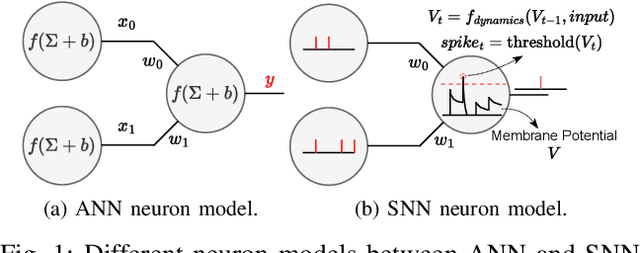
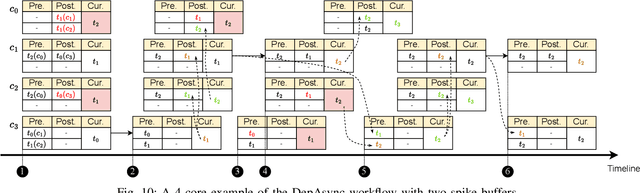
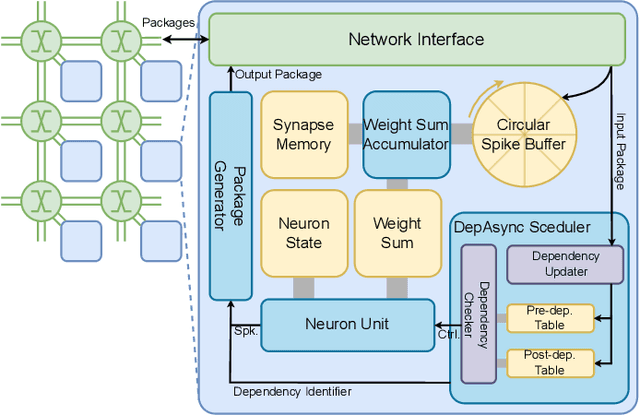
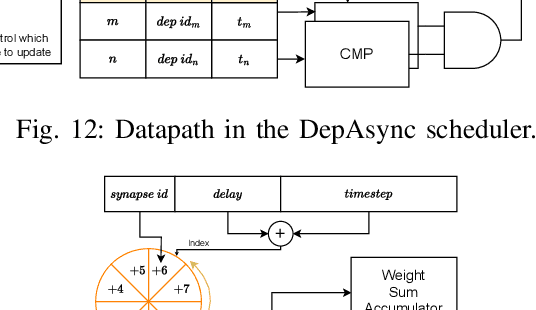
Spiking Neural Networks (SNNs) are extensively utilized in brain-inspired computing and neuroscience research. To enhance the speed and energy efficiency of SNNs, several many-core accelerators have been developed. However, maintaining the accuracy of SNNs often necessitates frequent explicit synchronization among all cores, which presents a challenge to overall efficiency. In this paper, we propose an asynchronous architecture for Spiking Neural Networks (SNNs) that eliminates the need for inter-core synchronization, thus enhancing speed and energy efficiency. This approach leverages the pre-determined dependencies of neuromorphic cores established during compilation. Each core is equipped with a scheduler that monitors the status of its dependencies, allowing it to safely advance to the next timestep without waiting for other cores. This eliminates the necessity for global synchronization and minimizes core waiting time despite inherent workload imbalances. Comprehensive evaluations using five different SNN workloads show that our architecture achieves a 1.86x speedup and a 1.55x increase in energy efficiency compared to state-of-the-art synchronization architectures.