 Add to Chrome
 Add to Firefox
 Add to Edge
Execution-bound advisory automation for agentic AI: a reproducible AIBOM-driven CSAF-VEX framework
Jun 16, 2026
A protocol driven framework is presented that binds SBOM and AIBOM artefacts to deterministic environment capture and structured runtime telemetry. Exploitability is computed from declared artefacts, observed activation conditions, and enforced execution policies. CSAF VEX advisories are generated from combined static and runtime evidence, cryptographically signed, and validated through deterministic replay. Evaluation uses approximately 10000 component entries across synthetic Agentic AI workloads 50 to 5000 components, incorporating OSV, GitHub Advisory, KEV, and EPSS datasets.

SBOMs into Agentic AIBOMs: Schema Extensions, Agentic Orchestration, and Reproducibility Evaluation
Mar 09, 2026Software supply-chain security requires provenance mechanisms that support reproducibility and vulnerability assessment under dynamic execution conditions. Conventional Software Bills of Materials (SBOMs) provide static dependency inventories but cannot capture runtime behaviour, environment drift, or exploitability context. This paper introduces agentic Artificial Intelligence Bills of Materials (AIBOMs), extending SBOMs into active provenance artefacts through autonomous, policy-constrained reasoning. We present an agentic AIBOM framework based on a multi-agent architecture comprising (i) a baseline environment reconstruction agent (MCP), (ii) a runtime dependency and drift-monitoring agent (A2A), and (iii) a policy-aware vulnerability and VEX reasoning agent (AGNTCY). These agents generate contextual exploitability assertions by combining runtime execution evidence, dependency usage, and environmental mitigations with ISO/IEC 20153:2025 Common Security Advisory Framework (CSAF) v2.0 semantics. Exploitability is expressed via structured VEX assertions rather than enforcement actions. The framework introduces minimal, standards-aligned schema extensions to CycloneDX and SPDX, capturing execution context, dependency evolution, and agent decision provenance while preserving interoperability. Evaluation across heterogeneous analytical workloads demonstrates improved runtime dependency capture, reproducibility fidelity, and stability of vulnerability interpretation compared with established provenance systems, with low computational overhead. Ablation studies confirm that each agent contributes distinct capabilities unavailable through deterministic automation.
Llama-3.1-FoundationAI-SecurityLLM-Base-8B Technical Report
Apr 28, 2025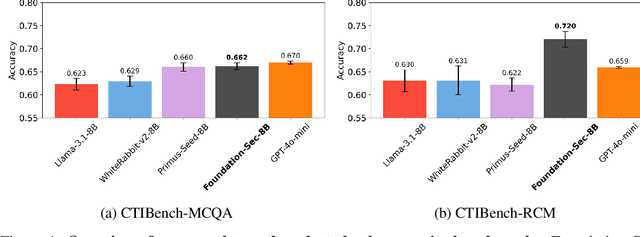
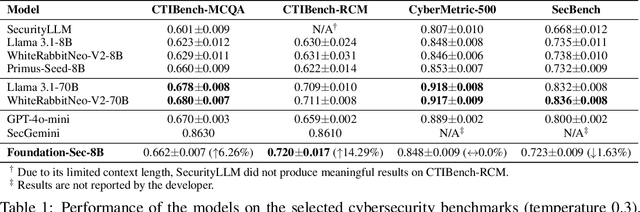
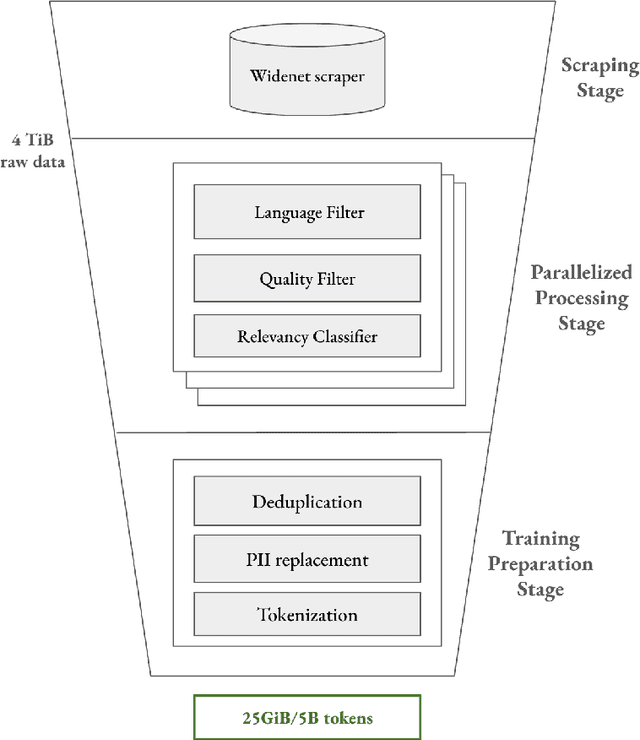

As transformer-based large language models (LLMs) increasingly permeate society, they have revolutionized domains such as software engineering, creative writing, and digital arts. However, their adoption in cybersecurity remains limited due to challenges like scarcity of specialized training data and complexity of representing cybersecurity-specific knowledge. To address these gaps, we present Foundation-Sec-8B, a cybersecurity-focused LLM built on the Llama 3.1 architecture and enhanced through continued pretraining on a carefully curated cybersecurity corpus. We evaluate Foundation-Sec-8B across both established and new cybersecurity benchmarks, showing that it matches Llama 3.1-70B and GPT-4o-mini in certain cybersecurity-specific tasks. By releasing our model to the public, we aim to accelerate progress and adoption of AI-driven tools in both public and private cybersecurity contexts.
Design of a dynamic and self-adapting system, supported with artificial intelligence, machine learning and real-time intelligence for predictive cyber risk analytics
May 19, 2020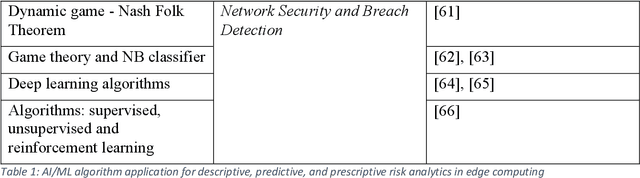
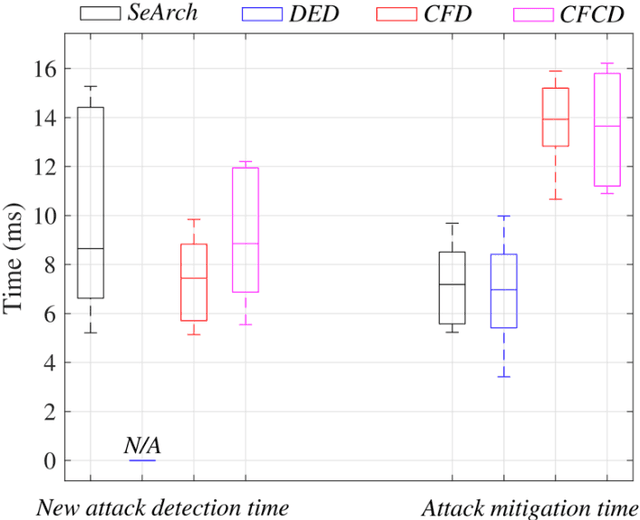
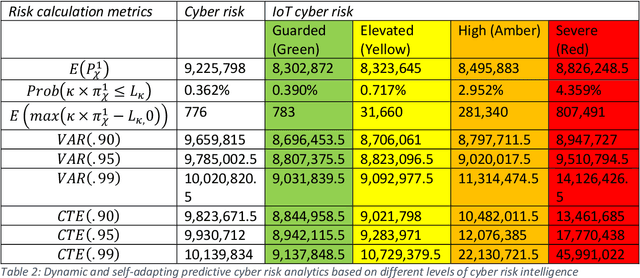
This paper surveys deep learning algorithms, IoT cyber security and risk models, and established mathematical formulas to identify the best approach for developing a dynamic and self-adapting system for predictive cyber risk analytics supported with Artificial Intelligence and Machine Learning and real-time intelligence in edge computing. The paper presents a new mathematical approach for integrating concepts for cognition engine design, edge computing and Artificial Intelligence and Machine Learning to automate anomaly detection. This engine instigates a step change by applying Artificial Intelligence and Machine Learning embedded at the edge of IoT networks, to deliver safe and functional real-time intelligence for predictive cyber risk analytics. This will enhance capacities for risk analytics and assists in the creation of a comprehensive and systematic understanding of the opportunities and threats that arise when edge computing nodes are deployed, and when Artificial Intelligence and Machine Learning technologies are migrated to the periphery of the internet and into local IoT networks.