 Add to Chrome
 Add to Firefox
 Add to Edge
Mechanistic Interpretability for Learning Assurance of a Vision-Based Landing System
May 20, 2026
EASA's learning-assurance guidance requires data-driven aviation systems to build and monitor their own situation representation, yet for neural networks the technical means to provide such evidence remain an open problem. We address this gap for a vision-based aircraft landing system: we propose that a minimally assurable model must at least be shown to separate content from style in its own situation representation. Showing that the model's predictions then rely largely on the contentful representation components leads to a concrete assurance path. To demonstrate this assurance path on a concrete model we train a vision transformer model for runway keypoint regression on the LARDv2 dataset. The model, which acts as the subject for our assurance demonstration, produces per-patch embeddings that we decompose into interpretable atoms via K-SVD sparse dictionary learning. A qualitative visualization confirms that contentful atoms track task-relevant runway structure and stylistic atoms track domain-specific appearance, and the regression head is shown to place almost all of its linear weight on contentful atoms. We further build on the content/style separation and define out-of-model-scope (OOMS) detection, a novel runtime assurance approach directly monitoring the model's situation representation. OOMS monitoring is complementary to operational design domain and output-space out-of-distribution monitoring and addresses concrete requirements of the recent EASA guidance. By directly analyzing a model's situation representation both at test time and runtime, this work delivers the first concrete piece of the representation-level evidence that EASA learning-assurance guidance demands, and points to mechanistic interpretability as a practical building block of future aviation safety cases.

Who Evaluates AI's Social Impacts? Mapping Coverage and Gaps in First and Third Party Evaluations
Nov 06, 2025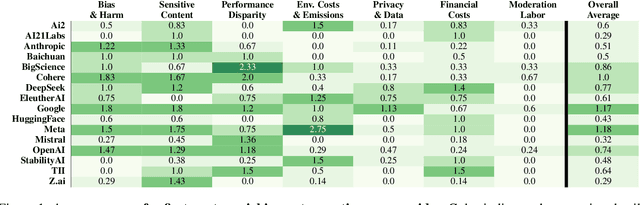
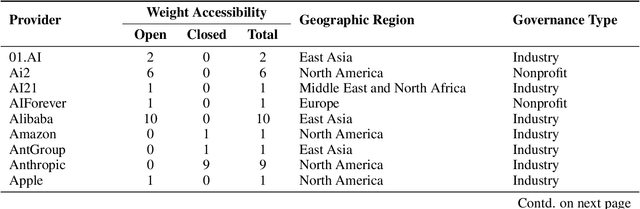
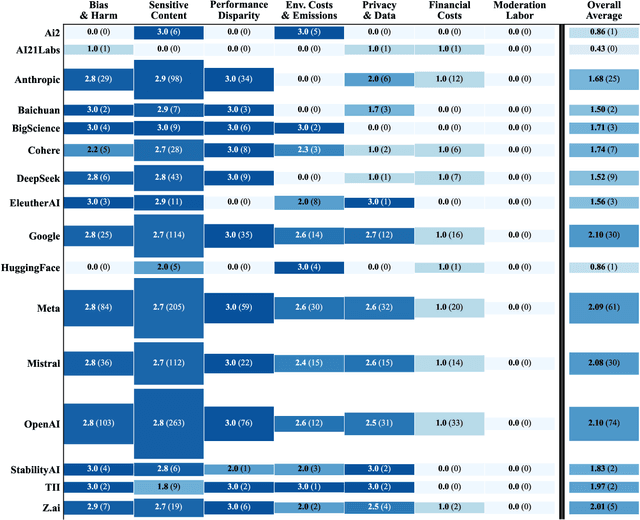
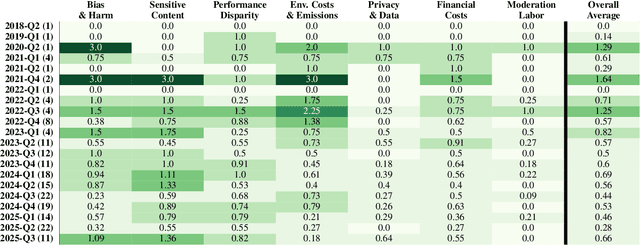
Foundation models are increasingly central to high-stakes AI systems, and governance frameworks now depend on evaluations to assess their risks and capabilities. Although general capability evaluations are widespread, social impact assessments covering bias, fairness, privacy, environmental costs, and labor practices remain uneven across the AI ecosystem. To characterize this landscape, we conduct the first comprehensive analysis of both first-party and third-party social impact evaluation reporting across a wide range of model developers. Our study examines 186 first-party release reports and 183 post-release evaluation sources, and complements this quantitative analysis with interviews of model developers. We find a clear division of evaluation labor: first-party reporting is sparse, often superficial, and has declined over time in key areas such as environmental impact and bias, while third-party evaluators including academic researchers, nonprofits, and independent organizations provide broader and more rigorous coverage of bias, harmful content, and performance disparities. However, this complementarity has limits. Only model developers can authoritatively report on data provenance, content moderation labor, financial costs, and training infrastructure, yet interviews reveal that these disclosures are often deprioritized unless tied to product adoption or regulatory compliance. Our findings indicate that current evaluation practices leave major gaps in assessing AI's societal impacts, highlighting the urgent need for policies that promote developer transparency, strengthen independent evaluation ecosystems, and create shared infrastructure to aggregate and compare third-party evaluations in a consistent and accessible way.