 Add to Chrome
 Add to Firefox
 Add to Edge
Revisiting Scene Graph Generation from the Perspective of Detector-Conditioned Reachability
Jul 07, 2026
Scene graph generation (SGG) approaches can be broadly classified into detector-based and query-based methods according to their underlying reasoning mechanisms. However, the discrepancy in their predictive behaviors, induced by these distinct mechanisms, has not been systematically analyzed. In this work, we design a controlled experimental setup to examine prediction discrepancies from the perspective of detector-conditioned reachability. The results suggest clear complementary clues. Motivated by this observation, we introduce a Dual-SGG method that consolidates both reasoning mechanisms via a dual-query design, thereby leveraging the complementary predictive behaviors of both detector-based and query-based methods. Extensive experiments on the Visual Genome, Open Images v6, and GQA-200 datasets demonstrate the effectiveness of the proposed method.

CARD: A Multi-Modal Automotive Dataset for Dense 3D Reconstruction in Challenging Road Topography
May 06, 2026Autonomous driving must operate across diverse surfaces to enable safe mobility. However, most driving datasets are captured on well-paved flat roads. Moreover, recent driving datasets primarily provide sparse LiDAR ground truth for images, which is insufficient for assessing fine-grained geometry in depth estimation and completion. To address these gaps, we introduce CARD, a multi-modal driving dataset that delivers quasi-dense 3D ground truth across continuous sequences rich in speed bumps, potholes, irregular surfaces and off-road segments. Our sensor suite includes synchronized global-shutter stereo cameras, front and rear LiDARs, 6-DoF poses from LiDAR-inertial odometry, per-wheel motion traces, and full calibration. Notably, our multi-LiDAR fusion yields ~500K valid depth pixels per frame, about 6.5x more than KITTI Depth Completion and 10x more on average than other public driving datasets. The dataset spans ~110 km and 4.7 hours across Germany and Italy. In addition, CARD provides 2D bounding boxes targeting road-topography irregularities, enabling accurate benchmarking for both geometry and perception tasks. Furthermore, we establish a standardized evaluation protocol for road surface irregularities on CARD and benchmark state-of-the-art depth estimation models to provide strong baselines. The CARD dataset is hosted on https://huggingface.co/CARD-Data.
ProtoFair: Fair Self-Supervised Contrastive Learning via Pseudo-Counterfactual Pairs
May 03, 2026Self-supervised learning methods learn high-quality visual representations, yet recent studies show that these representations often capture demographic biases present in the training data. Existing fairness-aware methods address this by redesigning the self-supervised objective itself, limiting portability across the rapidly evolving landscape of self-supervised learning (SSL) frameworks. We propose ProtoFair, a fairness-aware contrastive loss designed to work alongside existing SSL objectives without modifying them. ProtoFair leverages unsupervised prototype clustering to identify pseudo-counterfactual pairs: samples sharing the same cluster assignment but belonging to different sensitive groups. By pulling these content-matched, cross-group samples together in the embedding space, ProtoFair encourages the encoder to learn representations that are invariant to the sensitive attribute. The method requires only sensitive attribute annotations, no target labels, and integrates seamlessly with both SimCLR and SupCon. Experiments on CelebA and UTKFace demonstrate consistent fairness improvements while maintaining competitive accuracy.
Salience-SGG: Enhancing Unbiased Scene Graph Generation with Iterative Salience Estimation
Jan 13, 2026Scene Graph Generation (SGG) suffers from a long-tailed distribution, where a few predicate classes dominate while many others are underrepresented, leading to biased models that underperform on rare relations. Unbiased-SGG methods address this issue by implementing debiasing strategies, but often at the cost of spatial understanding, resulting in an over-reliance on semantic priors. We introduce Salience-SGG, a novel framework featuring an Iterative Salience Decoder (ISD) that emphasizes triplets with salient spatial structures. To support this, we propose semantic-agnostic salience labels guiding ISD. Evaluations on Visual Genome, Open Images V6, and GQA-200 show that Salience-SGG achieves state-of-the-art performance and improves existing Unbiased-SGG methods in their spatial understanding as demonstrated by the Pairwise Localization Average Precision
Mouse Lockbox Dataset: Behavior Recognition for Mice Solving Lockboxes
May 21, 2025Machine learning and computer vision methods have a major impact on the study of natural animal behavior, as they enable the (semi-)automatic analysis of vast amounts of video data. Mice are the standard mammalian model system in most research fields, but the datasets available today to refine such methods focus either on simple or social behaviors. In this work, we present a video dataset of individual mice solving complex mechanical puzzles, so-called lockboxes. The more than 110 hours of total playtime show their behavior recorded from three different perspectives. As a benchmark for frame-level action classification methods, we provide human-annotated labels for all videos of two different mice, that equal 13% of our dataset. Our keypoint (pose) tracking-based action classification framework illustrates the challenges of automated labeling of fine-grained behaviors, such as the manipulation of objects. We hope that our work will help accelerate the advancement of automated action and behavior classification in the computational neuroscience community. Our dataset is publicly available at https://doi.org/10.14279/depositonce-23850
Tracking Mouse from Incomplete Body-Part Observations and Deep-Learned Deformable-Mouse Model Motion-Track Constraint for Behavior Analysis
Jan 19, 2025Tracking mouse body parts in video is often incomplete due to occlusions such that - e.g. - subsequent action and behavior analysis is impeded. In this conceptual work, videos from several perspectives are integrated via global exterior camera orientation; body part positions are estimated by 3D triangulation and bundle adjustment. Consistency of overall 3D track reconstruction is achieved by introduction of a 3D mouse model, deep-learned body part movements, and global motion-track smoothness constraint. The resulting 3D body and body part track estimates are substantially more complete than the original single-frame-based body part detection, therefore, allowing improved animal behavior analysis.
* 10 pages
MonoPP: Metric-Scaled Self-Supervised Monocular Depth Estimation by Planar-Parallax Geometry in Automotive Applications
Nov 29, 2024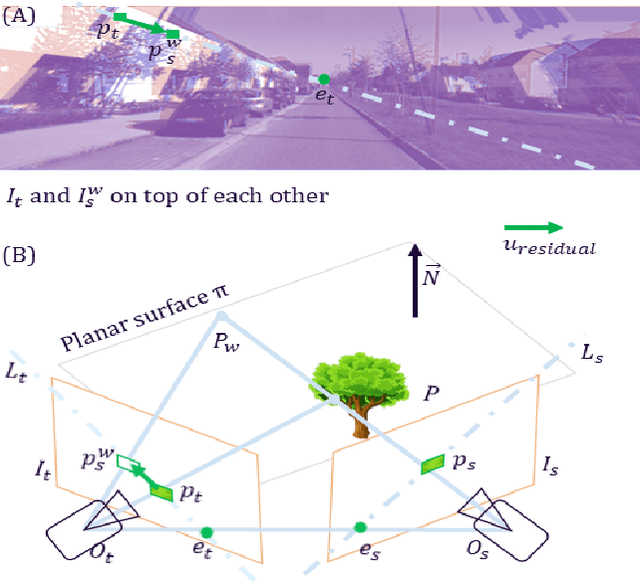

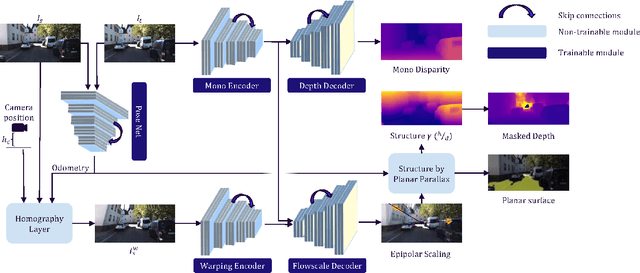
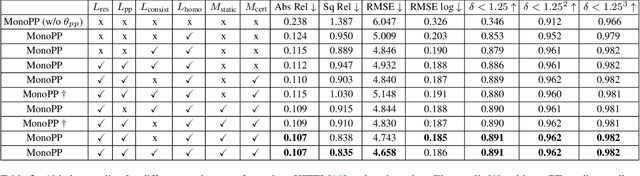
Self-supervised monocular depth estimation (MDE) has gained popularity for obtaining depth predictions directly from videos. However, these methods often produce scale invariant results, unless additional training signals are provided. Addressing this challenge, we introduce a novel self-supervised metric-scaled MDE model that requires only monocular video data and the camera's mounting position, both of which are readily available in modern vehicles. Our approach leverages planar-parallax geometry to reconstruct scene structure. The full pipeline consists of three main networks, a multi-frame network, a singleframe network, and a pose network. The multi-frame network processes sequential frames to estimate the structure of the static scene using planar-parallax geometry and the camera mounting position. Based on this reconstruction, it acts as a teacher, distilling knowledge such as scale information, masked drivable area, metric-scale depth for the static scene, and dynamic object mask to the singleframe network. It also aids the pose network in predicting a metric-scaled relative pose between two subsequent images. Our method achieved state-of-the-art results for the driving benchmark KITTI for metric-scaled depth prediction. Notably, it is one of the first methods to produce self-supervised metric-scaled depth prediction for the challenging Cityscapes dataset, demonstrating its effectiveness and versatility.
How Do You Perceive My Face? Recognizing Facial Expressions in Multi-Modal Context by Modeling Mental Representations
Sep 04, 2024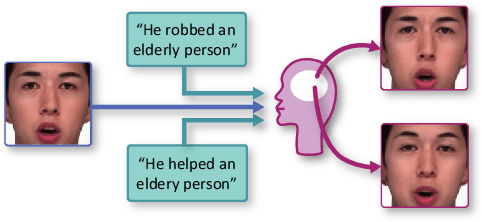

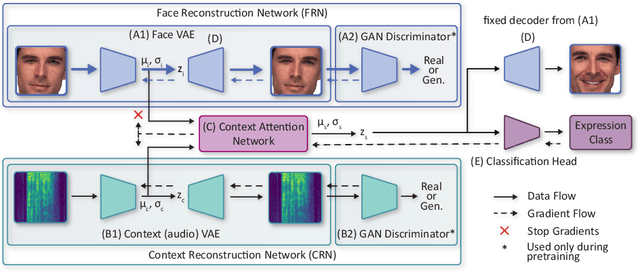
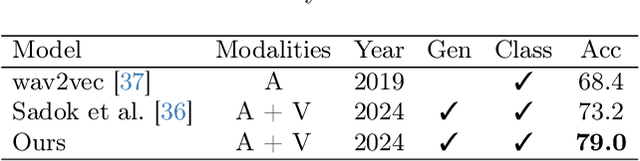
Facial expression perception in humans inherently relies on prior knowledge and contextual cues, contributing to efficient and flexible processing. For instance, multi-modal emotional context (such as voice color, affective text, body pose, etc.) can prompt people to perceive emotional expressions in objectively neutral faces. Drawing inspiration from this, we introduce a novel approach for facial expression classification that goes beyond simple classification tasks. Our model accurately classifies a perceived face and synthesizes the corresponding mental representation perceived by a human when observing a face in context. With this, our model offers visual insights into its internal decision-making process. We achieve this by learning two independent representations of content and context using a VAE-GAN architecture. Subsequently, we propose a novel attention mechanism for context-dependent feature adaptation. The adapted representation is used for classification and to generate a context-augmented expression. We evaluate synthesized expressions in a human study, showing that our model effectively produces approximations of human mental representations. We achieve State-of-the-Art classification accuracies of 81.01% on the RAVDESS dataset and 79.34% on the MEAD dataset. We make our code publicly available.
ConDL: Detector-Free Dense Image Matching
Aug 05, 2024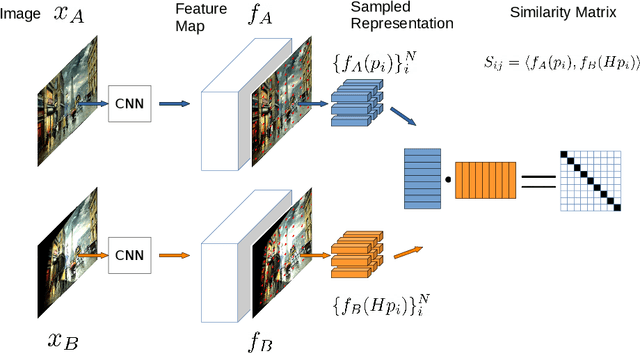
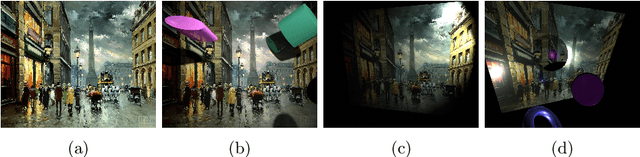
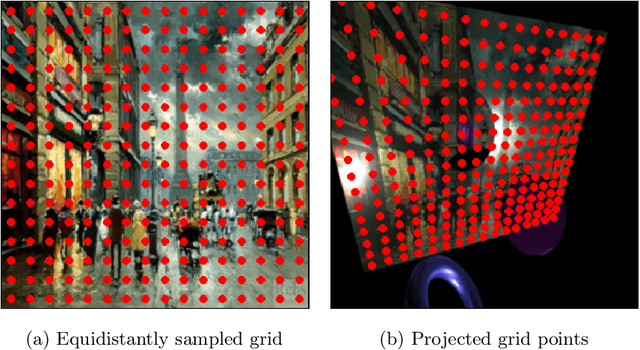
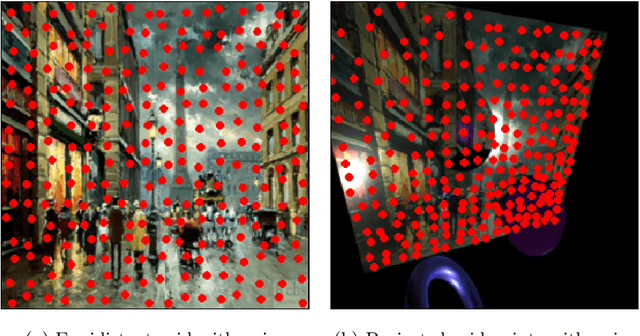
In this work, we introduce a deep-learning framework designed for estimating dense image correspondences. Our fully convolutional model generates dense feature maps for images, where each pixel is associated with a descriptor that can be matched across multiple images. Unlike previous methods, our model is trained on synthetic data that includes significant distortions, such as perspective changes, illumination variations, shadows, and specular highlights. Utilizing contrastive learning, our feature maps achieve greater invariance to these distortions, enabling robust matching. Notably, our method eliminates the need for a keypoint detector, setting it apart from many existing image-matching techniques.
Nonverbal Immediacy Analysis in Education: A Multimodal Computational Model
Jul 24, 2024This paper introduces a novel computational approach for analyzing nonverbal social behavior in educational settings. Integrating multimodal behavioral cues, including facial expressions, gesture intensity, and spatial dynamics, the model assesses the nonverbal immediacy (NVI) of teachers from RGB classroom videos. A dataset of 400 30-second video segments from German classrooms was constructed for model training and validation. The gesture intensity regressor achieved a correlation of 0.84, the perceived distance regressor 0.55, and the NVI model 0.44 with median human ratings. The model demonstrates the potential to provide a valuable support in nonverbal behavior assessment, approximating the accuracy of individual human raters. Validated against both questionnaire data and trained observer ratings, our models show moderate to strong correlations with relevant educational outcomes, indicating their efficacy in reflecting effective teaching behaviors. This research advances the objective assessment of nonverbal communication behaviors, opening new pathways for educational research.