 Add to Chrome
 Add to Firefox
 Add to Edge
CARD: A Multi-Modal Automotive Dataset for Dense 3D Reconstruction in Challenging Road Topography
May 06, 2026
Autonomous driving must operate across diverse surfaces to enable safe mobility. However, most driving datasets are captured on well-paved flat roads. Moreover, recent driving datasets primarily provide sparse LiDAR ground truth for images, which is insufficient for assessing fine-grained geometry in depth estimation and completion. To address these gaps, we introduce CARD, a multi-modal driving dataset that delivers quasi-dense 3D ground truth across continuous sequences rich in speed bumps, potholes, irregular surfaces and off-road segments. Our sensor suite includes synchronized global-shutter stereo cameras, front and rear LiDARs, 6-DoF poses from LiDAR-inertial odometry, per-wheel motion traces, and full calibration. Notably, our multi-LiDAR fusion yields ~500K valid depth pixels per frame, about 6.5x more than KITTI Depth Completion and 10x more on average than other public driving datasets. The dataset spans ~110 km and 4.7 hours across Germany and Italy. In addition, CARD provides 2D bounding boxes targeting road-topography irregularities, enabling accurate benchmarking for both geometry and perception tasks. Furthermore, we establish a standardized evaluation protocol for road surface irregularities on CARD and benchmark state-of-the-art depth estimation models to provide strong baselines. The CARD dataset is hosted on https://huggingface.co/CARD-Data.

MonoPP: Metric-Scaled Self-Supervised Monocular Depth Estimation by Planar-Parallax Geometry in Automotive Applications
Nov 29, 2024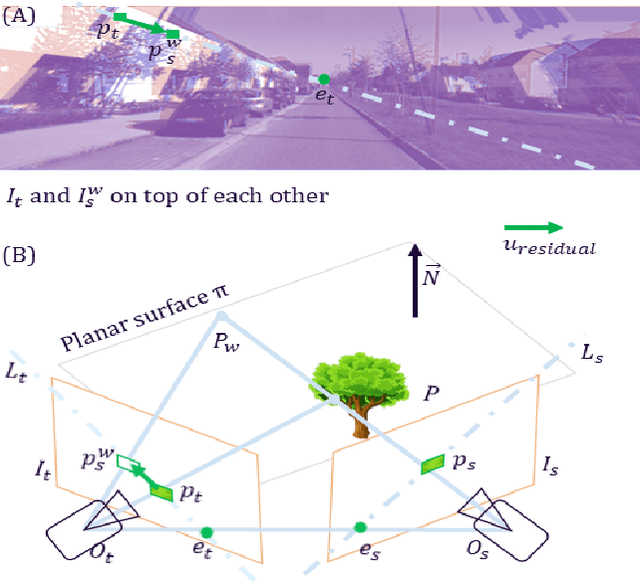

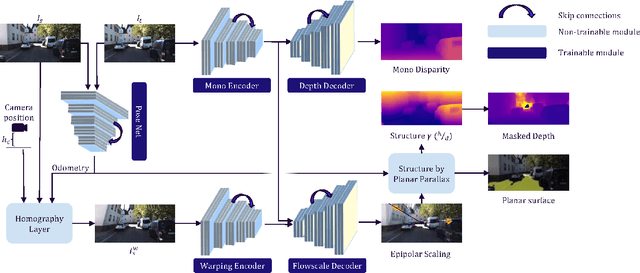
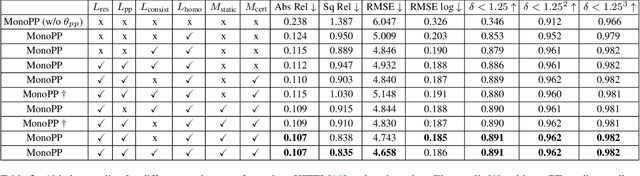
Self-supervised monocular depth estimation (MDE) has gained popularity for obtaining depth predictions directly from videos. However, these methods often produce scale invariant results, unless additional training signals are provided. Addressing this challenge, we introduce a novel self-supervised metric-scaled MDE model that requires only monocular video data and the camera's mounting position, both of which are readily available in modern vehicles. Our approach leverages planar-parallax geometry to reconstruct scene structure. The full pipeline consists of three main networks, a multi-frame network, a singleframe network, and a pose network. The multi-frame network processes sequential frames to estimate the structure of the static scene using planar-parallax geometry and the camera mounting position. Based on this reconstruction, it acts as a teacher, distilling knowledge such as scale information, masked drivable area, metric-scale depth for the static scene, and dynamic object mask to the singleframe network. It also aids the pose network in predicting a metric-scaled relative pose between two subsequent images. Our method achieved state-of-the-art results for the driving benchmark KITTI for metric-scaled depth prediction. Notably, it is one of the first methods to produce self-supervised metric-scaled depth prediction for the challenging Cityscapes dataset, demonstrating its effectiveness and versatility.